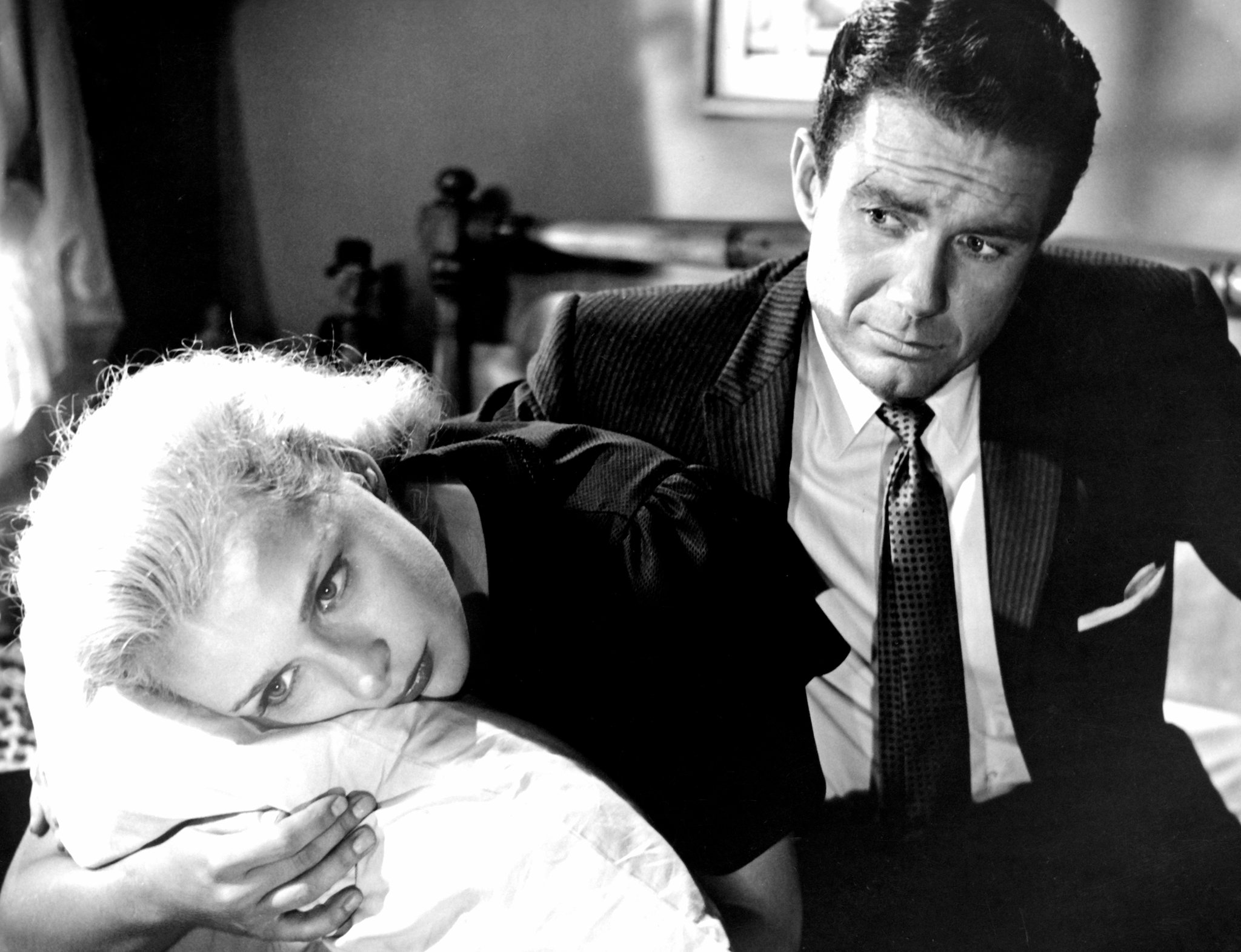
Norman Foster’s sublime, complex Woman on the Run asks – those marital bonds: What does it do to people? Or, rather, how do people perceive them? And, more specifically, how do women? And for women living in 1950? In San Francisco. In a small apartment. With no kids. And her husband’s pet dog. (Good for her, I say — she is not doing what is expected of her).
But here, we see, this is a marriage where perhaps the couple is invisible to one another. They have lost their way. They sleepwalk through the motions — maybe dreaming of another life, floating in some marital netherworld they never anticipated.
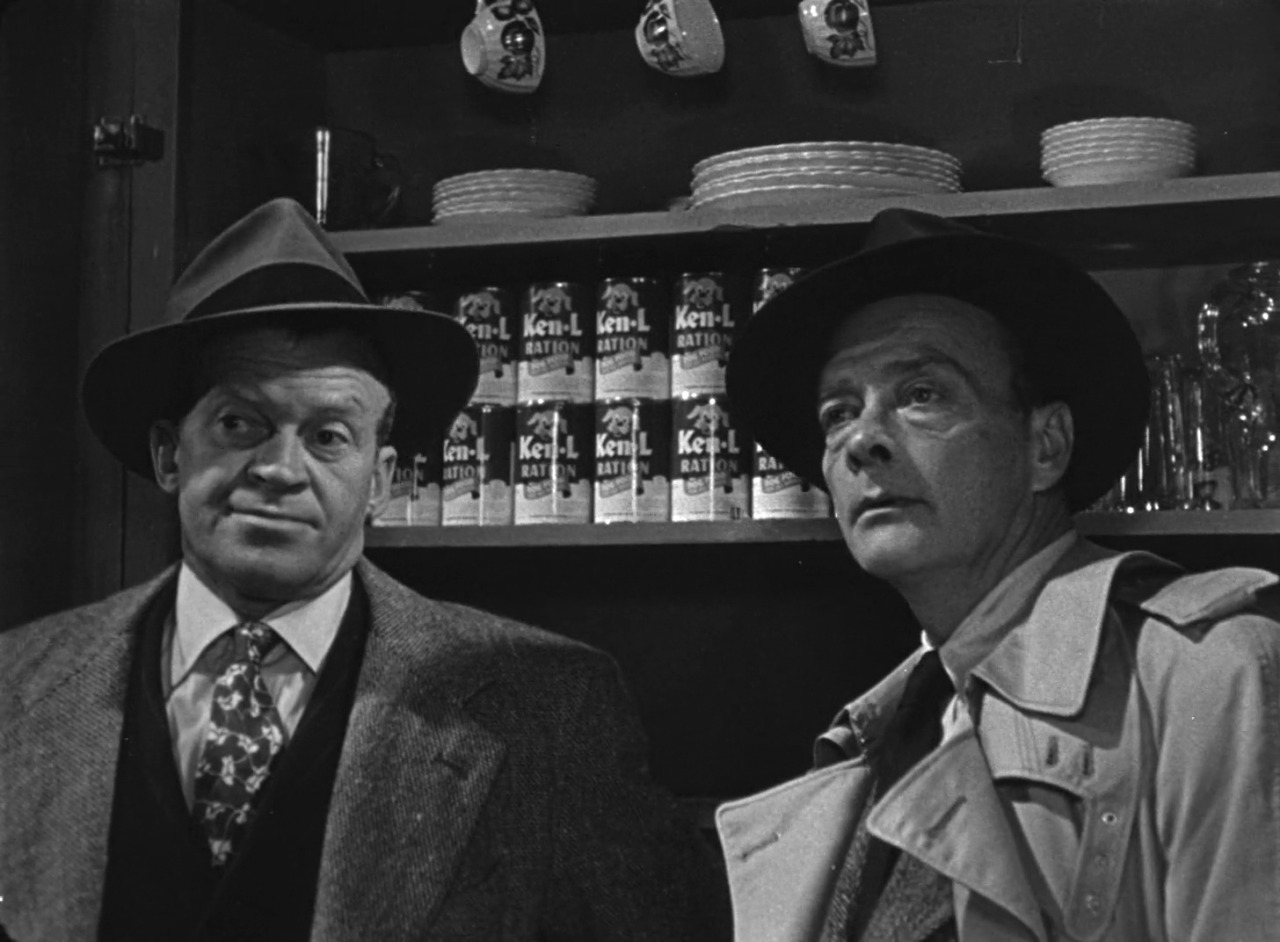
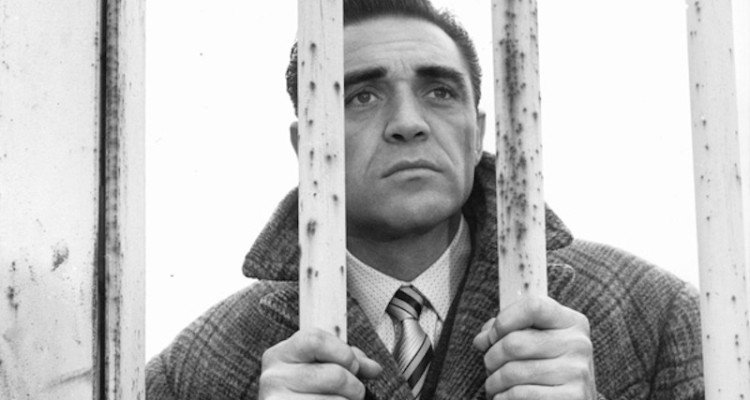
We see this through steely, smart Eleanor (a wonderful Ann Sheridan), who, when the cops come to question her (her husband has bolted from the scene of a crime and they are suspicious as to why — was he involved?), she walks around her small kitchen and coolly reveals rows of dog food cans. She doesn’t cook much, obviously, and she makes that fact known, almost as a matter of sardonic pride. She’s no Donna Reed type. She also doesn’t see her husband much. He does his own thing (he’s a painter – she shows his work to the detectives, praising some of it), and she does her own thing. It’s quite a modern arrangement, really. It would seem that, in 1950, this was not the norm in movies, especially when the woman will not become an easy “femme fatale” — a bitch out to destroy her poor husband. Nothing is unrecognizable in the movie – people, and relationships, are complex. Humans are human. And odd. And frustrating.
When cynical, seen-it-all Eleanor (could she even be described as a housewife?), is asked to describe her missing husband to suspicious detectives, she answers: “I haven’t been able to for a long time.”
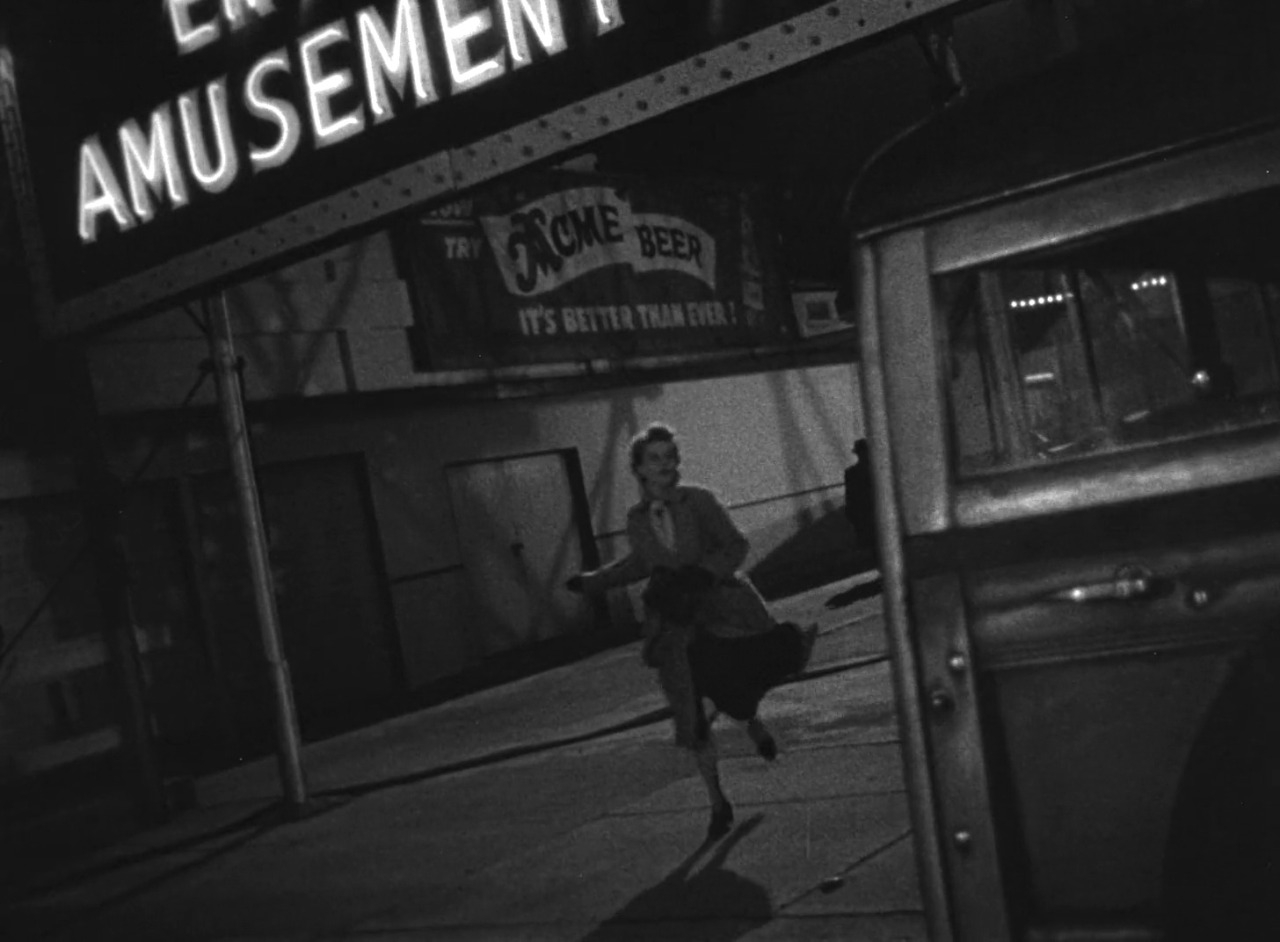
It’s an unusual, intriguing set-up. After Eleanor’s husband, Frank (Ross Elliott) witnesses a murder, he immediately goes missing. Why? Who cares about the cops, we wonder why? And most importantly, Eleanor wonders why. So, it is not the cops (who try to find him) but Eleanor who winds up the one doing arduous detective work to track down Frank. As said, when you first meet her, she seems to barely care he’s gone. He’s always gone, it seems, and their marriage is so damaged, she’s hardened into grim acceptance. That’s just how it is. Still, she’s no rat (see, she does care about marital bonds –thou shall not rat your husband seems implicit – or maybe that’s just me). But then she isn’t even sure what she would be ratting out – she has no idea what is going on. And then she learns that Frank needs life-saving heart medicine – she didn’t know this about him either. This concerns her and so she teams up with a reporter (Dennis O’Keefe) and scours San Francisco (the film utilizes striking and nicely lived-in locations in the city) to find her missing heart-afflicted husband. It can’t be purely medical that she’s out to restore his heart.
You’d think the title — Woman on the Run, a film noir (though it feels a lot more than that – it goes beyond genre) would simply be about a woman fleeing – and as described earlier, fleeing a bad marriage. But it isn’t really about that – this is a woman who is, essentially, fleeing from the nosey, rather sexist interrogations of police detectives who bugging her husband and judging her for her unconventional life. Frank’s the one who has fled, but, now, she is fleeing to figure out what in the hell is going on and where in the hell he is, and, really who is she? She’s fleeing from her own mental prison and it’s a fascinating beautiful thing to watch – and in in the end, incredibly romantic. With style, beautiful grit, and hard-boiled empathy, Woman on the Run dissects the sacred union without any artifice. It’s a tough movie, but damn if you’re not enormously moved by the end.
With that, the picture upends expectations of the cynical wife in this noir landscape – as she searches for him, and talks to locals at bars and various areas in San Francisco, she starts learning how much her husband actually loves her. How much he brought her up to others. She was on his mind. And she starts feeling things again. She starts understanding him more.
Baroquely beautiful, absolutely brimming with style, and even surrealistic at times, Foster’s Woman on the Run still feels firmly grounded in reality. The director’s mentoring and work with Orson Welles (Foster collaborated with Welles on It’s All True and directed Journey Into Fear) is felt throughout (with help by DP Hal Mohr). And marriage is the focal point (with a script by Alan Campbell, who had recently divorced Dorothy Parker, the two got back together after this picture was made, another curiosity).
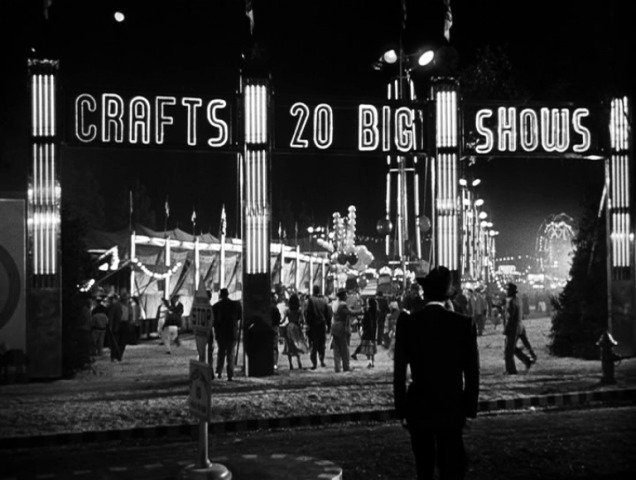
Sheridan (the “Oomph girl!” – a moniker she detested. She once said: “Oomph" is what a fat man says when he leans over to tie his shoelace in a telephone booth.”) gives one of her greatest, perhaps her greatest performance here: Tough, but vulnerable, jaundiced but sophisticated, she’s able to light up when she really starts to see that her marriage has been muddled by a dreary fog. And they both (she and her husband) let it happen. It’s powerful and disarmingly moving that the picture’s finale occurs on what’s often representational of love: a rollercoaster (up and down and up and down and a lot of screaming and laughing and fear) and Sheridan is so moved to finally see her husband, that she screams his name with fear and love. It’s a beautiful moment.
What’s intriguing about Woman on the Run is that the picture isn’t trying to wag its finger at Sheridan for being such a hard-boiled cynic – a “bad” wife.” She’s presented with empathy and complexity and it’s not all her fault things have stagnated in her marriage. It’s not all her husband’s fault either. They both need to work on things. But this is about the “woman on the run” – Sheridan – and she needs to find her life and resuscitate her marriage, so, after she finds herself running from the police, she eventually will find herself running from the reporter (who reveals his true, evil intentions later in the movie). She can’t trust anyone. Really, she can only trust the one she was so dismissive about from the start – her husband.
Sheridan plays a woman who appears to have a hard heart tamped down by disappointment and marital atrophy – but as the movie reveals, she is full of love and understanding once she really opens herself up again. Marriage is viewed through a dreamy, demented landscape here, but it’s part of the institution’s tumultuous journey. A key moment in Woman on the Run occurs when, before Frank flees, he’s asked by an inspector if he’s married. His answer: “In a way.” Yes, in a way. But by the end of the movie, what that really means, romantically, is, it’s their way.
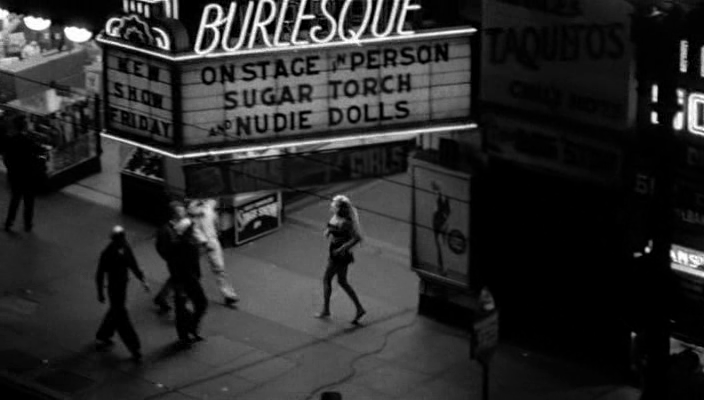
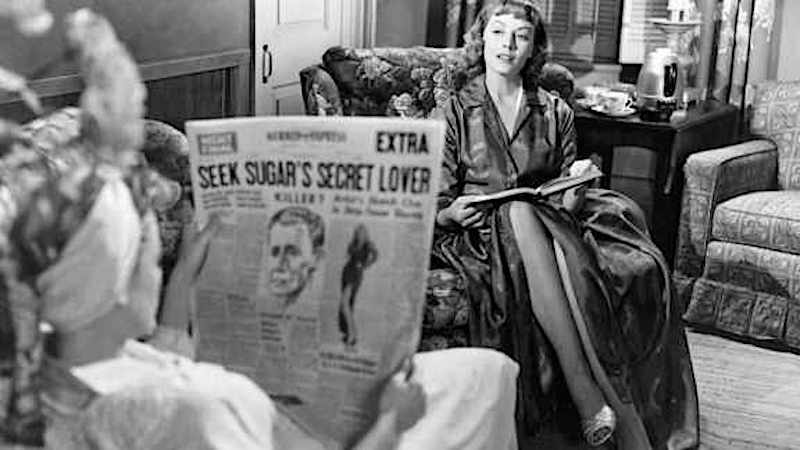
Sugar Torch is running – someone wants her dead. It’s terrifying and visceral and, in the end, very sad.
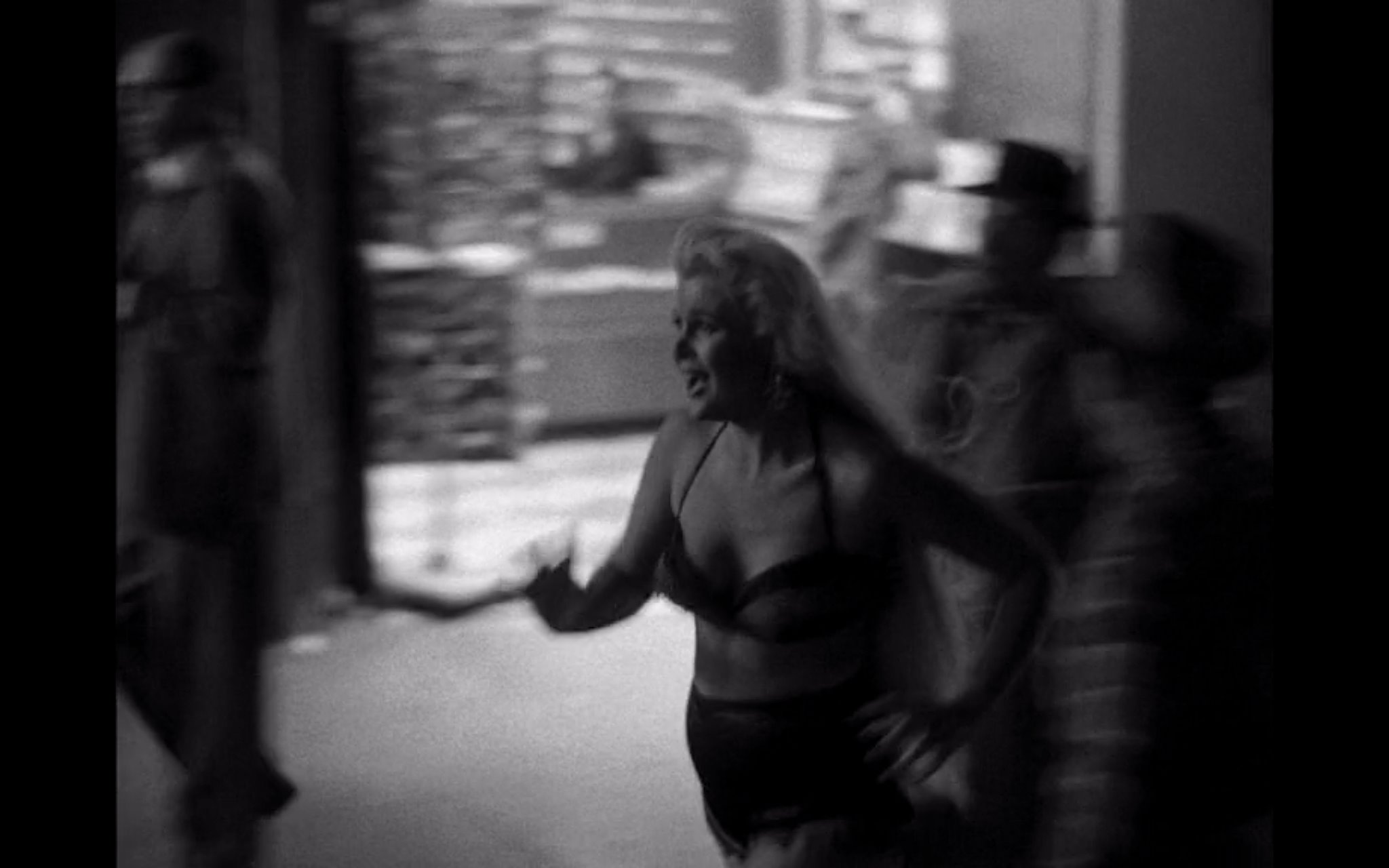
Sugar’s plight opens Samuel Fuller’s The Crimson Kimono and immediately grabs us. Like a pulpy headline or a Weegee photograph, we are drawn in by a stimulating blend of blatancy and mystery – when something is so in your face that you’re knocked off balance, perplexed but enthralled. We just watched Sugar, the tall blonde gyrating on stage, smiling and winking with a kind of paroxysmal madness, shaking it in a downtown Los Angeles Burlesque House. Her dancing is aggressively sexy and bizarre – we hear but never see the audience. She looks to be performing for darkness, or maybe in a hallucination. The dance is brief, told through jump cuts, making it all the more surreal. She ends her performance, walks back to her dressing room and … gunshot. It then becomes verité – Sugar runs outside clad in her shimmy costume, desperately scared and screaming, quite the sight running down a populated L.A. street at night. The poor woman runs right into traffic and is shot down, collapsing dead between two cars. It’s fast and it’s sad. It’s quintessential Fuller.
“Motion as emotion.” That’s how Martin Scorsese described Fuller’s films in his introduction to Fuller’s fantastic autobiography, A Third Face, and Sugar Torch is certainly that. Scorsese wrote, “When you respond to a Fuller film, what you're responding to is cinema at its essence. Motion as emotion. Fuller's pictures move convulsively, violently. Just like life when it's being lived with genuine passion.”
It’s a beautiful, perfect description of Fuller, and something we feel and see either writ large, or in glimpses within this box set of Fuller’s films with Columbia – there’s something remarkable even in the pictures he wrote but didn’t direct, and pictures the American maverick wasn’t too happy about when placed in the studio and director’s hands.
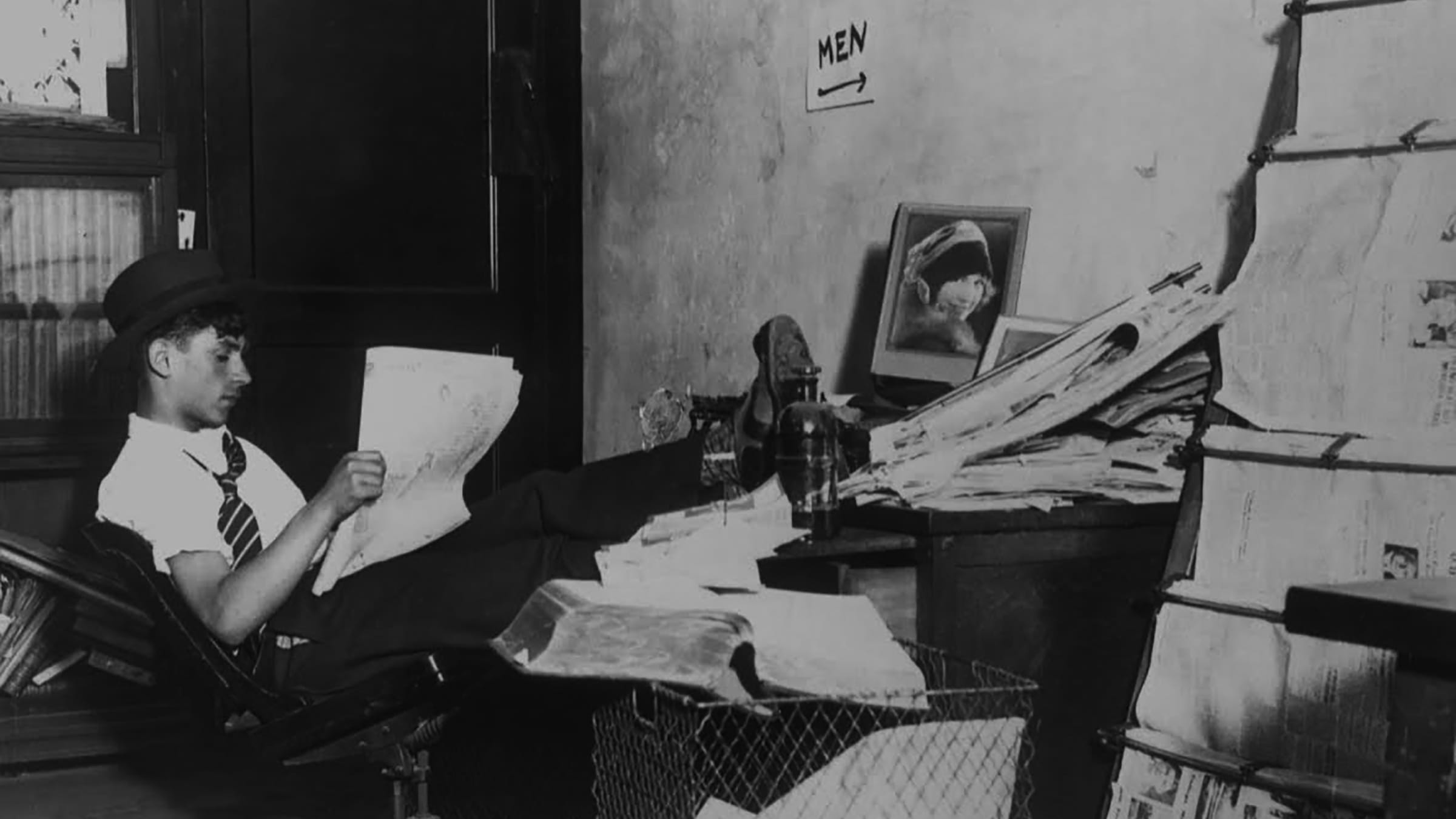
Fuller loved the pulse and rigor of writing – he started out as a 17-year-old crime reporter, tapping out pieces for the New York Evening Graphic, merging real life with sensationalism but always after the truth, words jumping from the page to create their own visual poetry. And he understood people in all of their drama, vulnerability and complexity. When he was working the Upper West Side, he’d phone stories in to his editor from a friendly brothel, where he’d gotten to know the women so well that he didn’t feel any urges toward them – they became friends, people he respected (something he revels with his female characters in many of his films). He listened and observed and surely took notes. At a young age, he defended the marginalized while standing in the thick of a good yarn, something that never left him. When he enlisted in the Army during WW II (and the wartime service that would inform one of his great works – The Big Red One) he wrote that, “fighting-didn't really give me a hard-on. What kept going through my brain was that I had a helluva opportunity to cover the biggest crime story of the century, and nothing was going to stop me from being an eyewitness.”
This Blu-ray set allows us a fascinating look at Fuller’s early beginnings as a screenwriter and, one would suspect, a look at some of the films that, when altered, prompted him to tackle directing himself and made him fiercely independent.
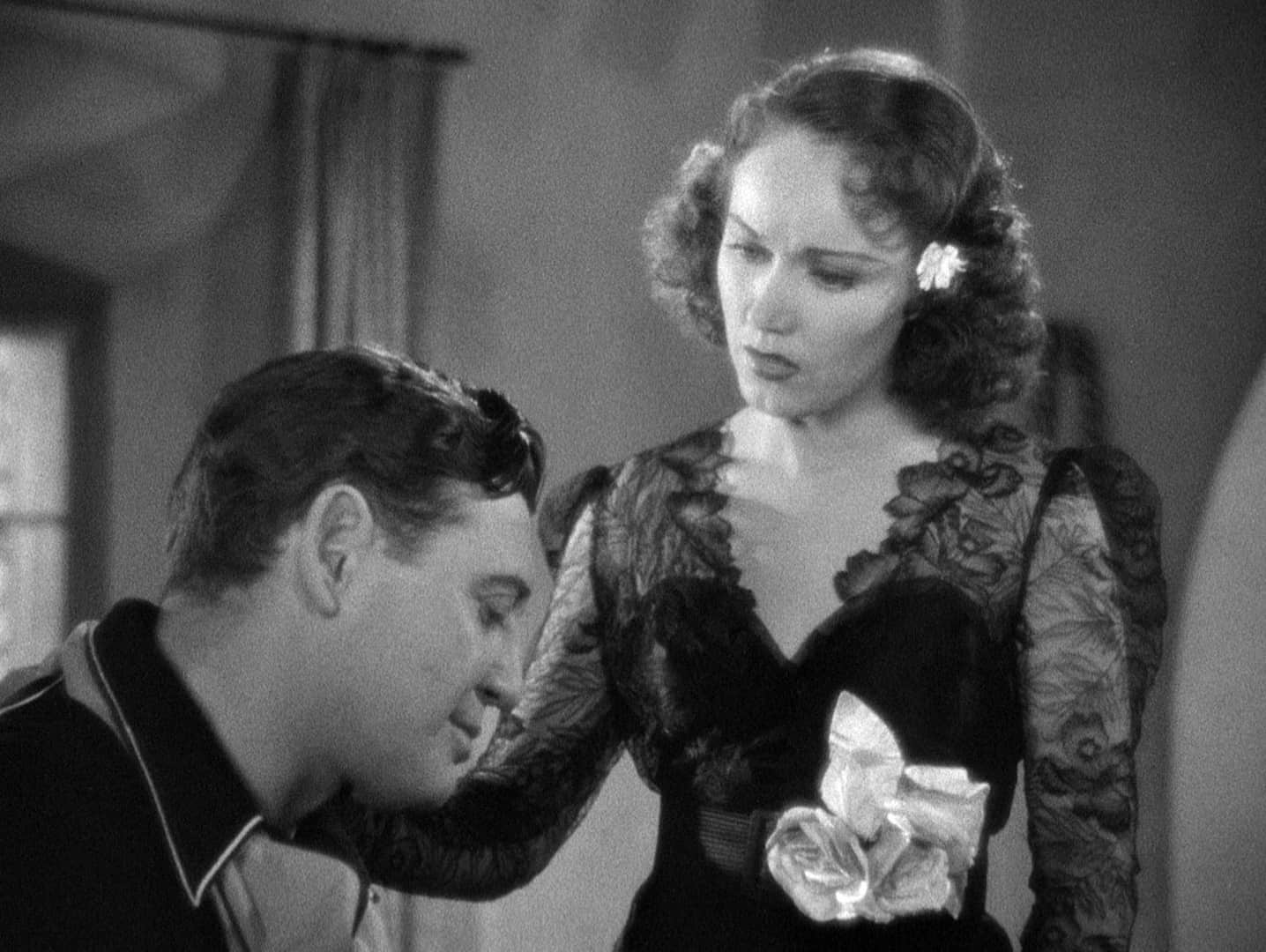
Fuller was a writer among four (with Ethel Hill, Harvey Fergusson and Myles Connolly) in the earliest picture in this set, Harry Lachman’s It Happened in Hollywood (1937). Somewhat Reminiscent of A Star is Born (they were released the same year) or Singin’ in the Rain, the story finds a Tom Mix-fashioned cowboy star (played by Richard Dix) struggling to make the transition from silent pictures to talkies. It’s an endearing movie, and often quite smart, and Dix is likable (along with Fay Wray), but we wonder how much further Fuller would have taken this story had he written it himself.
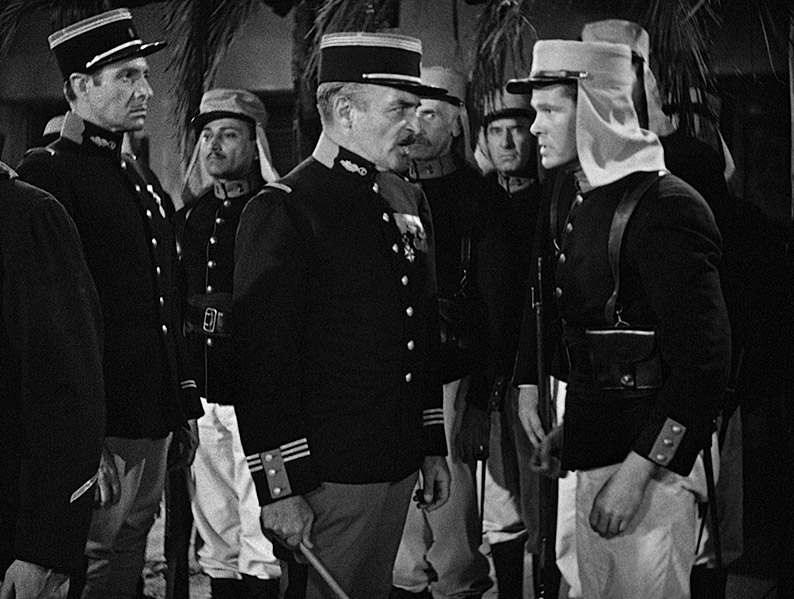
You wonder the same of D. Ross Lederman’s Adventure in Sahara (1938) the least notable among this set (screenplay by Maxwell Shane from Fuller’s story), but a relatively entertaining and quick (clocked right at an hour) adventure yarn. It’s a revenge tale set in the French Foreign Legion that features a good story and some lovely cinematography by Franz Plane, but moves along without much bite – you strain to find Fuller in this one. It does, however, come with an amusing real-life story: Fuller made the treatment up, on the fly, as he pitched to Columbia, borrowing from Victor Hugo and Mutiny on the Bounty. As Fuller wrote, “See, studio heads back then may have grown up selling furs instead of reading French literature, but they loved a good story. So, thank you, Monsieur Hugo, for saving my ass with your wonderful novel Ninety-Three.”
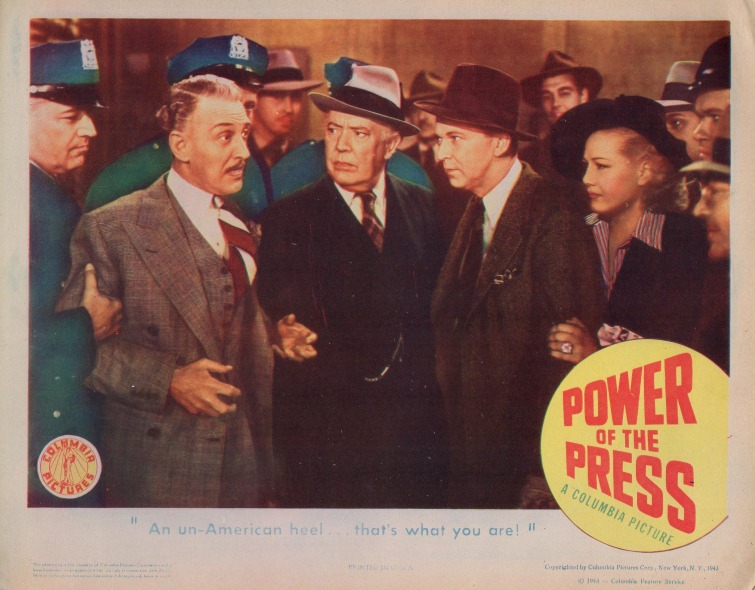
It’s easy to discern how Fuller’s own experience must have informed the Power of the Press and the film, directed by Lew Landers and written by Robert Hardy Andrews (from a story by Fuller) has some keen musings about media, isolationism and patriotism, but it’s ultimately disappointing, particularly for such a potentially compelling story. We spend a lot of the time hoping (and perhaps we shouldn’t be hoping) for the picture to explode into full-on Fuller, but, alas, it never does. It’s worth viewing for the story and the actors, however (a principled Guy Kibbee and a villainous Otto Kruger stand out), even if it’s a bit too much speechifying. His next effort would prove to be far more interesting even if not perfect, and in the end, vexing for Fuller.
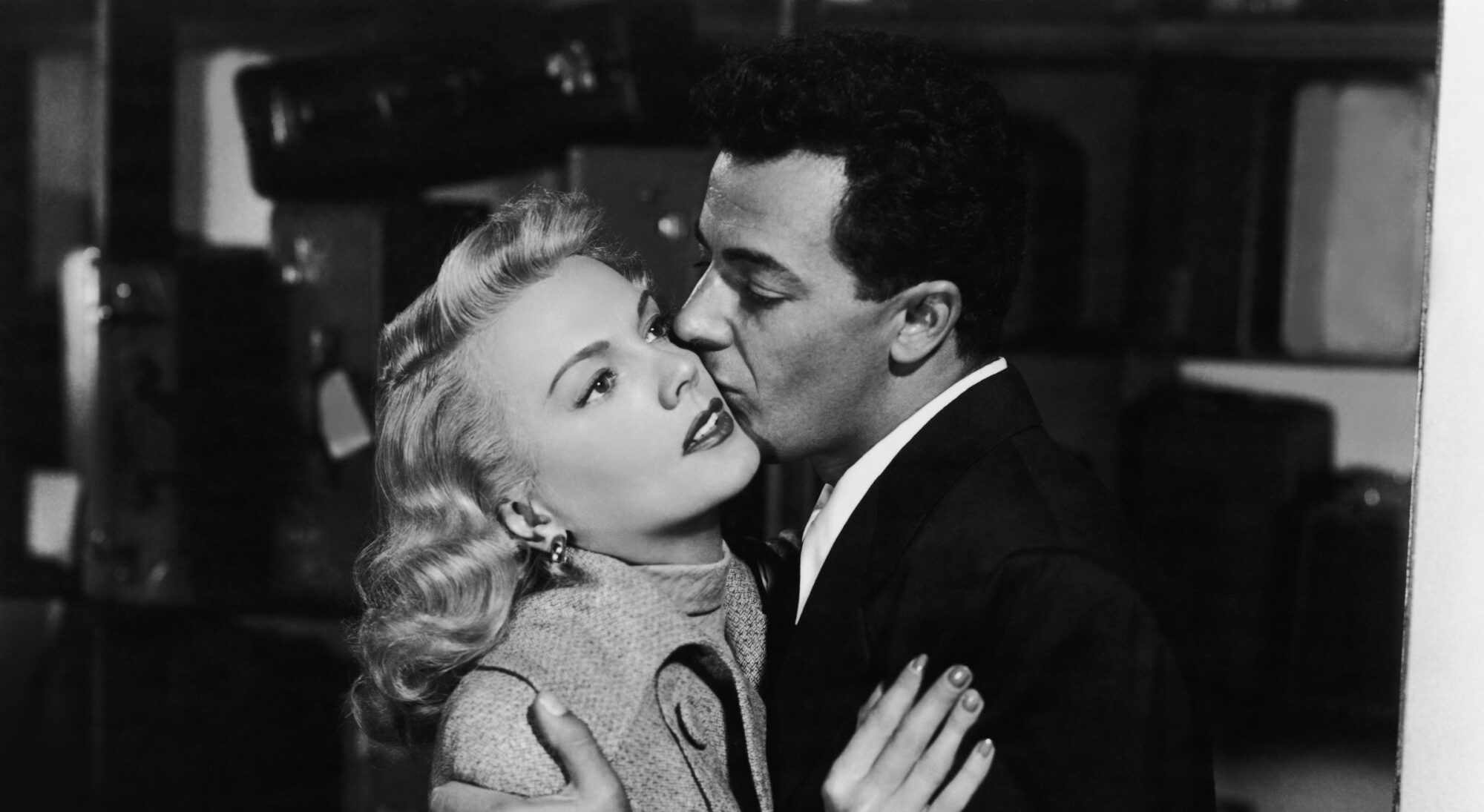
Directed by Douglas Sirk and written by Fuller, Shockproof is a well-cast, finely modulated thriller/melodrama that’s absolutely gorgeous to look at. The story is of Griff Marat, a parole officer (played with passion by Cornel Wilde) inexorably falling in love with his parolee charge, Jenny Marsh (Wilde’s real-life wife Patricia Knight) and losing everything he once held dear as they become first, lovers and then, wanted fugitives. The combination of Fuller’s and Sirk’s sensibilities does mesh in an intriguingly odd way and, is at times, beautiful and powerful (a scene where a parole-breaker jumps to his death rather than risking imprisonment is potently horrifying), and the film exhibits enough visual style to hold the improbable melodrama at its core. Griff’s household, though sweet, is in a way, a variation of the suffocating cells Jenny has spent years in: all steep expressionist angles and multi-level Victorian woodwork — there is no escape from institutionalization. Marriage or jail appear to be two forms of doom hanging over her head.
After the shooting of Jenny’s lover – Harry Wesson, played skillfully by John Baragrev (he manages to make Harry both repellent and suave, cheap and elegant) “The Lovers,” as the tabloid press calls them (also the original title of Fuller’s screenplay), head down the Mexico way, but are ensnared by the authorities. The film is moving straight for an American tragedy and its visual invention keeps up but, then, the tone abruptly changes, and everything is neatly wrapped into an unconvincing happy ending. The tampering of this film (the ending was written by National Velvet’s Helen Deutsch) left both Sirk and Fuller disappointed and was likely a decisive factor in Fuller’s decision to eventually helm and produce his films himself.
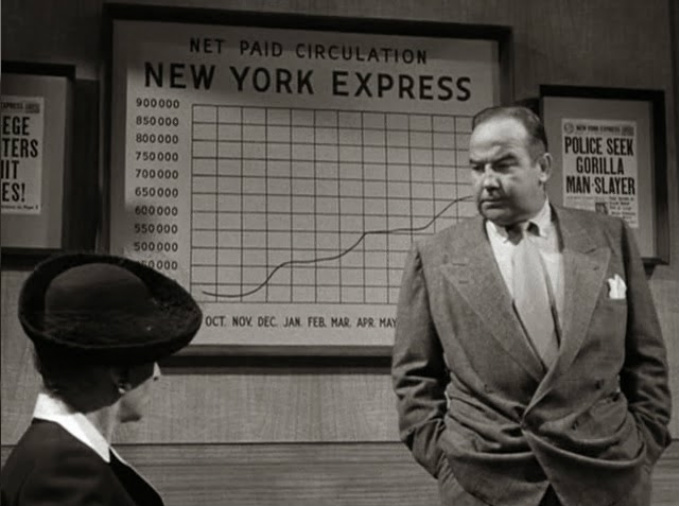
Even though he didn’t write the screenplay, Scandal Sheet (directed by Phil Karlson — who directed the terrific, tough-as-nails Kansas City Confidential, 99 River Street, and The Phenix City Story), is truer to Fuller’s spirit and voice. Not a surprise since it’s adapted from Fuller’s best-selling 1944 novel, The Dark Page (with screenwriters Eugene Ling, James Poe, and Ted Sherdeman). An intense, at times, touching, well-engineered thriller the story looks at a ruthless tabloid editor Mark Chapman (played with mean, barking zeal by Broderick Crawford) who murders his long-estranged wife (Rosemary DeCamp) and has to stay one step ahead of his two ace reporters (played by Donna Reed and John Derek). The film is full of Fullerisms, mostly hollered by Crawford, and not only does it chastise the circulation-chasing tabloid press and unscrupulous investigative techniques, but it also populates the film with skid row characters, Lonely Hearts meet-ups, and assorted urban lowlifes. Chief amongst them is a moving ex-reporter — down on his luck, played with vulnerable integrity by Henry O’Neill. Derek seems uncomfortable at first, and green on screen, but his character grows on you – he’s not all that he’s puffing himself up to be and his lightweight qualities next to Crawford and Reed start to make sense. But the film rests on Crawford’s tense shoulders— all of his inner turmoil and ambivalence sweating out of him. He loves Derek’s character like a son and seems compulsively spellbound by the increasing circulation that his own tragedy brings him – even if it means chronicling his own destruction.
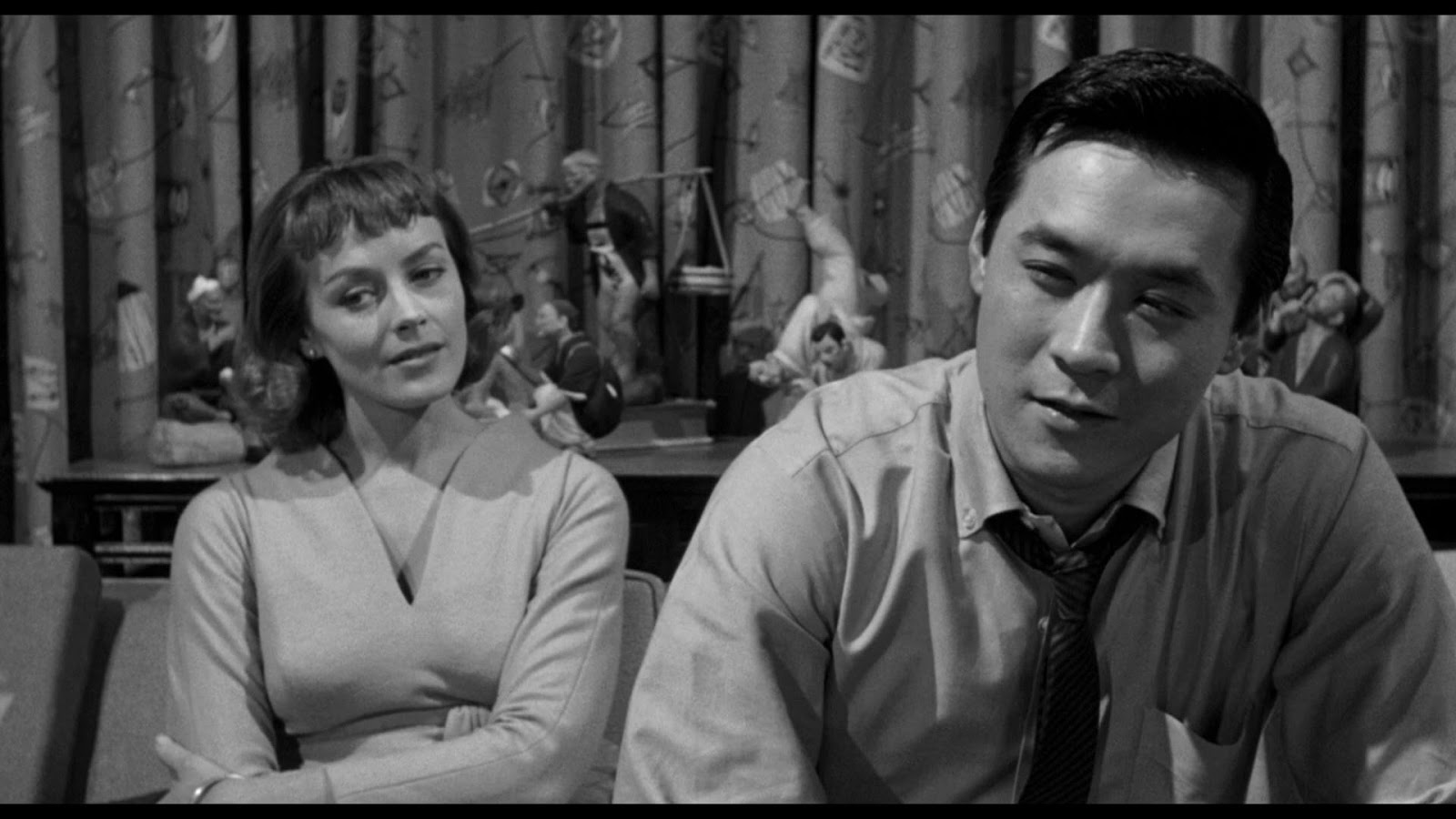
And now back to Sugar Torch (played by Gloria Pall). She’s an important side-player (and one who doesn’t live long) to one of Fuller’s most innovative and daring films, The Crimson Kimono (which Fuller produced, wrote, and directed) but her awful death, though pulpy and loud, presages the quieter troubles and passions the other characters will experience within themselves. After Sugar is murdered, the film cuts right to a close-up of detective Joe (James Shigeta) – the Japanese-American cop who will, with his partner, best friend, and war buddy, Charlie (Glenn Corbett), crack the case of Sugar and a sad love triangle. And then, become involved in a triangle of his own: he falls for Joe’s love, Chris, and she falls for him.
A rare picture for its time, it examines the struggles of an interracial relationship and Joe’s concerns about how he is perceived in a racist world. And then, how he must come to terms with his friendship to Charlie. Interestingly, Charlie is not shown as intolerant, and though hurt, he handles Joe and Chris’s relationship with maturity. Fuller fought for this more agreeable depiction of Charlie – the studio felt that Chris needed a reason to leave him other than her love for Joe. Fuller felt, no way. Presumably, that would read as insulting to Chris’s attraction to Joe. Chris loves Joe – they have more chemistry and more in common and more of a connection – she doesn’t need a reason to leave beyond that. It’s a complicated, touching approach – modern for its time.
And its modern approach is helped by the Los Angeles Little Tokyo locations – those Fuller stylistics – close-ups that make us almost taste a person’s sweat, and those impressive long takes – including one rather complicated single-shot scene showing Charlie and Joe waking up in their shared apartment that is so naturalistic in style and acting, that we absolutely believe these guys are buddies. The movie feels real.
And that reality spilled into the filmmaking process as well. After shooting the extremely dangerous Sugar-running-opening, Fuller reflected later about how no one on the street (these were reportedly not paid extras, but real people) gave a damn about this poor woman. In The Third Face Fuller wrote of watching that scene with head of Columbia, Sam Briskin: “When I looked at the rushes with Sam Briskin, we realized that nobody, not even a passing sailor or a homeless drunk-was paying any attention to the big, scantily clad gal running along that downtown street. Nobody gave a damn. ‘What the hell's wrong with this country?’ asked Briskin.”
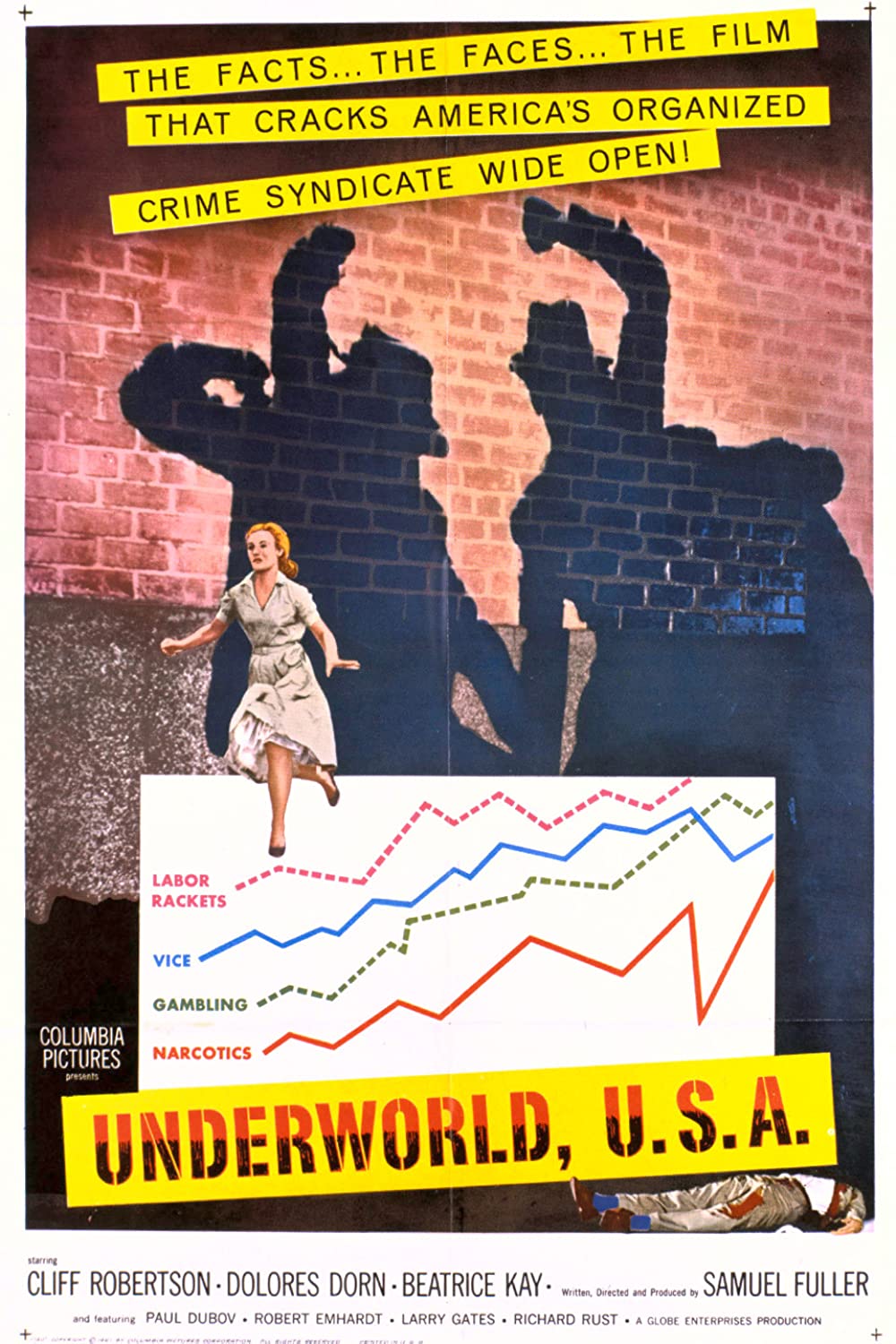
What the hell is wrong with this country could be asked of Underworld U.S.A. (or what the hell is wrong with everyone?) – a movie where the good guys and the bad guys are all bad. Who knows? The picture showcases some of his most beautifully designed and staged shots while it digs deep into violence and revenge. Fuller’s visual invention and edgy violence feel almost avant-garde here. The morally complex story of retribution showcases many of Fuller’s trademarks: An older woman that knows the ways of the world (think Thelma Ritter in Pick Up on South Street), a woman (named Cuddles – so touchingly played by Dolores Dorn) who would be considered a tramp but is given real pathos and depth (think Constance Towers in The Naked Kiss), a protagonist taking the path of crime to transit into a moral awakening, criminals hiding within the respectability of institutions, stainless steel pulp dialogue and gripping, at times, disturbing violence.
The film is built around a remarkable Cliff Robertson as Tolly Devlin, whose face is perpetually twisted, his eyes darkened with wrath. He’s got a reason – as a kid (played with impressive aplomb and perfect mimicry by David Kent) he is scarred for life the night he witnesses the deadly beating of his father in a dank alley. Earlier that night in a dispute over a pickpocketed wallet, Tolly had received an injury over his right eye and that scar remains on the adult Tolly, God’s lonely avenger. He will track and terminate each of the killers even if, as shown in a concise, elliptical sequence, it means pursuing increasing prison time. That’s in order to reach one of the murderers, imprisoned in a maximum-security facility.
And so you watch this scarred kid and, then, young man, just keeping going and going and going … Tolly will infiltrate the crime syndicate, playing a dangerous game in which he uses the criminals and the chief of police with the same ruthlessness.
The violence in the film pushed the limits of censorship at the time and Fuller had to make compromises to tone the movie down, and yet it is still hard-hitting. An example: in an impeccably choreographed scene, an All-American-looking contract killer (constantly wearing shades) played to creepy-cool perfection by Richard Rust, runs over the young daughter of a snitch (the shot of her dead returns in a newspaper photo). Fuller uses every resource to deliver the impact of this killing – setting up the unmerciful forces that Tolly will face if found out.
One of the simplest, most beautiful shots in the film also showcases Tolly walking relentlessly on a mission to end it all, to do the right thing. The camera leads him on, staying ahead of him, in a beautiful, dynamic shot as he faces off the crime boss at a pool where he does business (Fuller liked the idea of these guys spending their time in clean places – he wanted you to practically smell the chlorine). In a bout of fiscal probity, Fuller will powerfully reuse the same rig (likely a crane) to deliver Tully’s final steps out of the place, wounded and faltering, this time, his back to us. Fuller also uses beautifully designed transitions and ellipsis to chronicle the passage of time and its fluid nature in a spare 99 minutes – it works perfectly. At its core, this resource, resolute syntax also makes the decades between Tolly’s youth and his adult age, blurry, fluid, as if hatred has made time irrelevant.
And the film ends on a most symbolic image: Tolly, now dead, acquiescing, but incapable of letting go, dies with a clenched fist. His fist isn’t just about violence, it represents his emotional fight as well, which recalls Fuller discussing in an interview how he preferred “emotional violence.”
As the great man said, “You don’t have to be violent with your fist, a voice can do it as well. One word can cut the hell out of your heart.”
Originally published in August 2018 at Sight & Sound Magazine
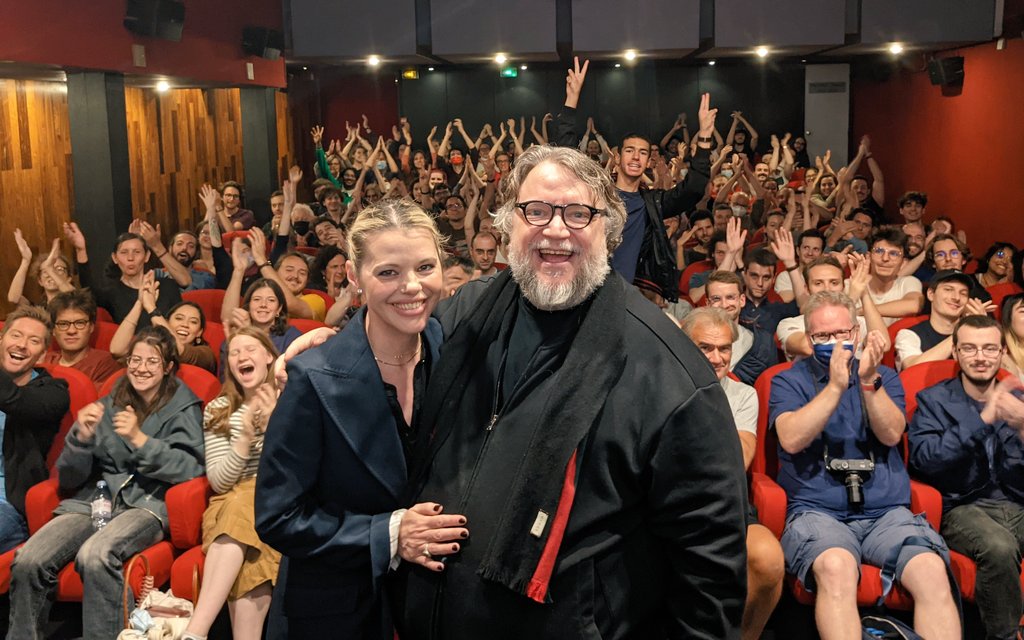
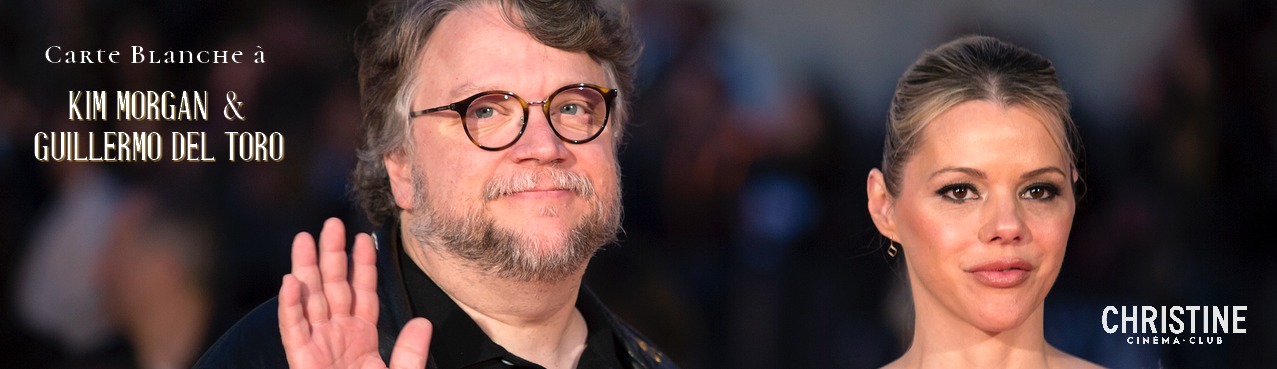
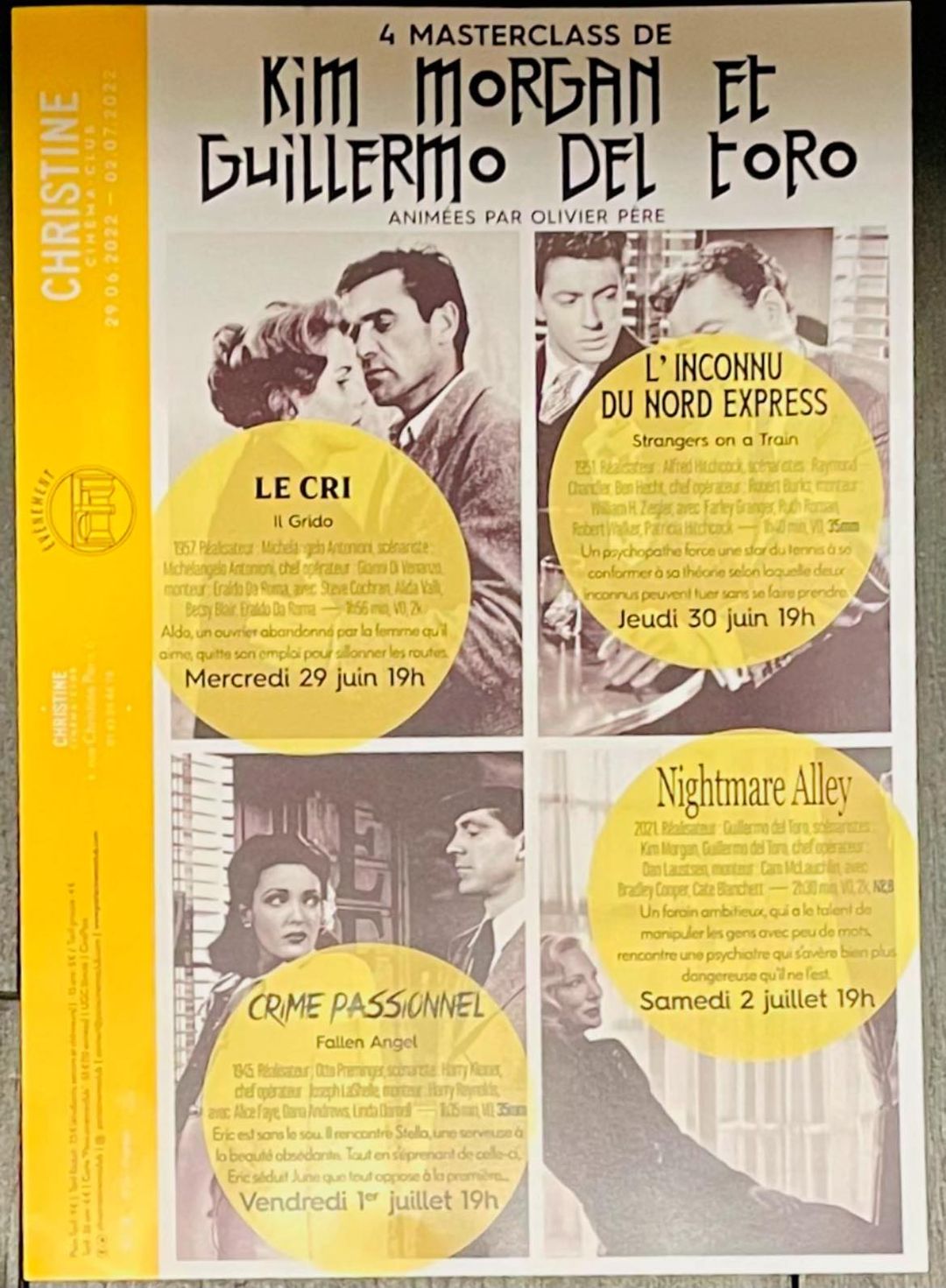
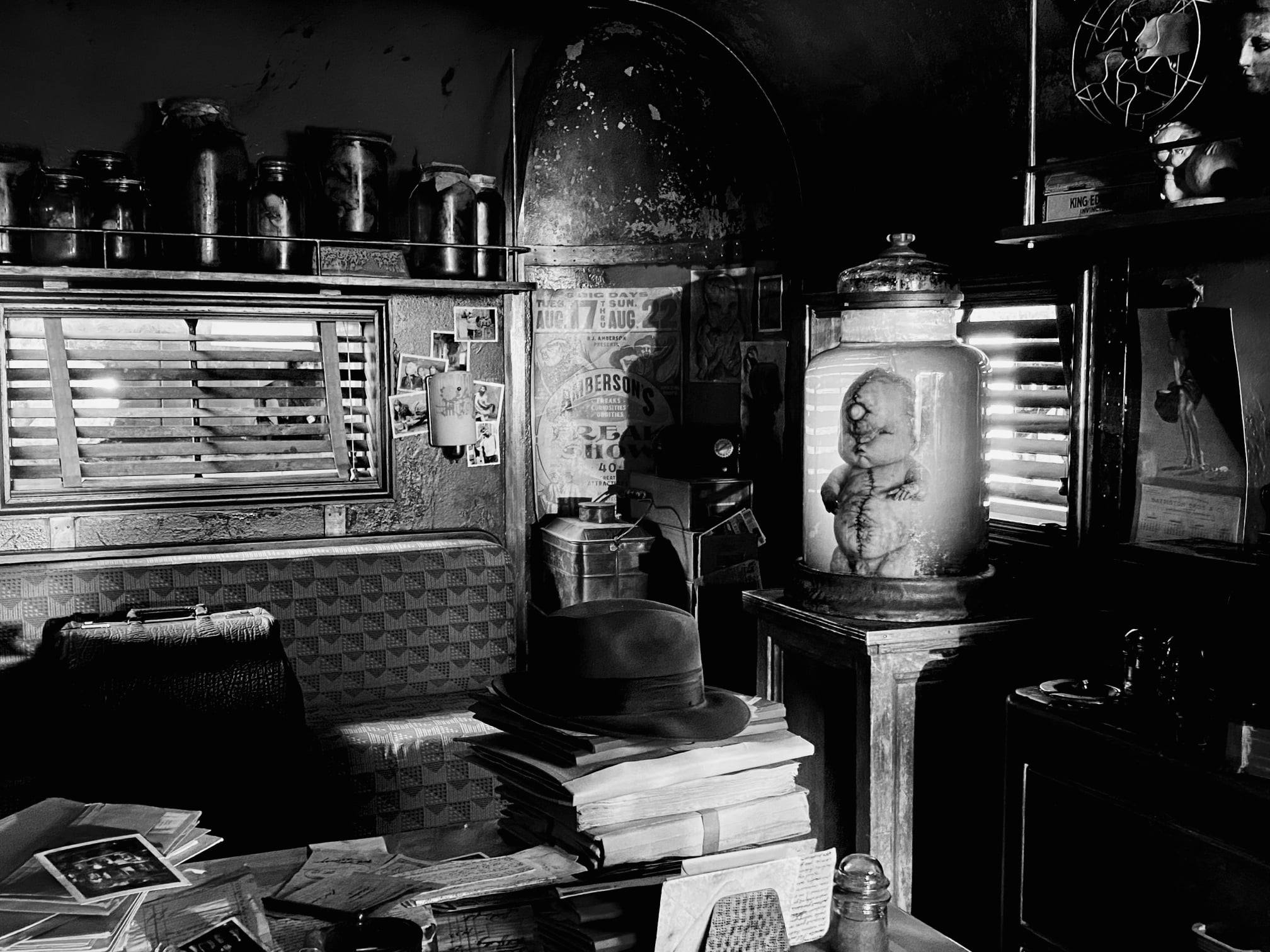
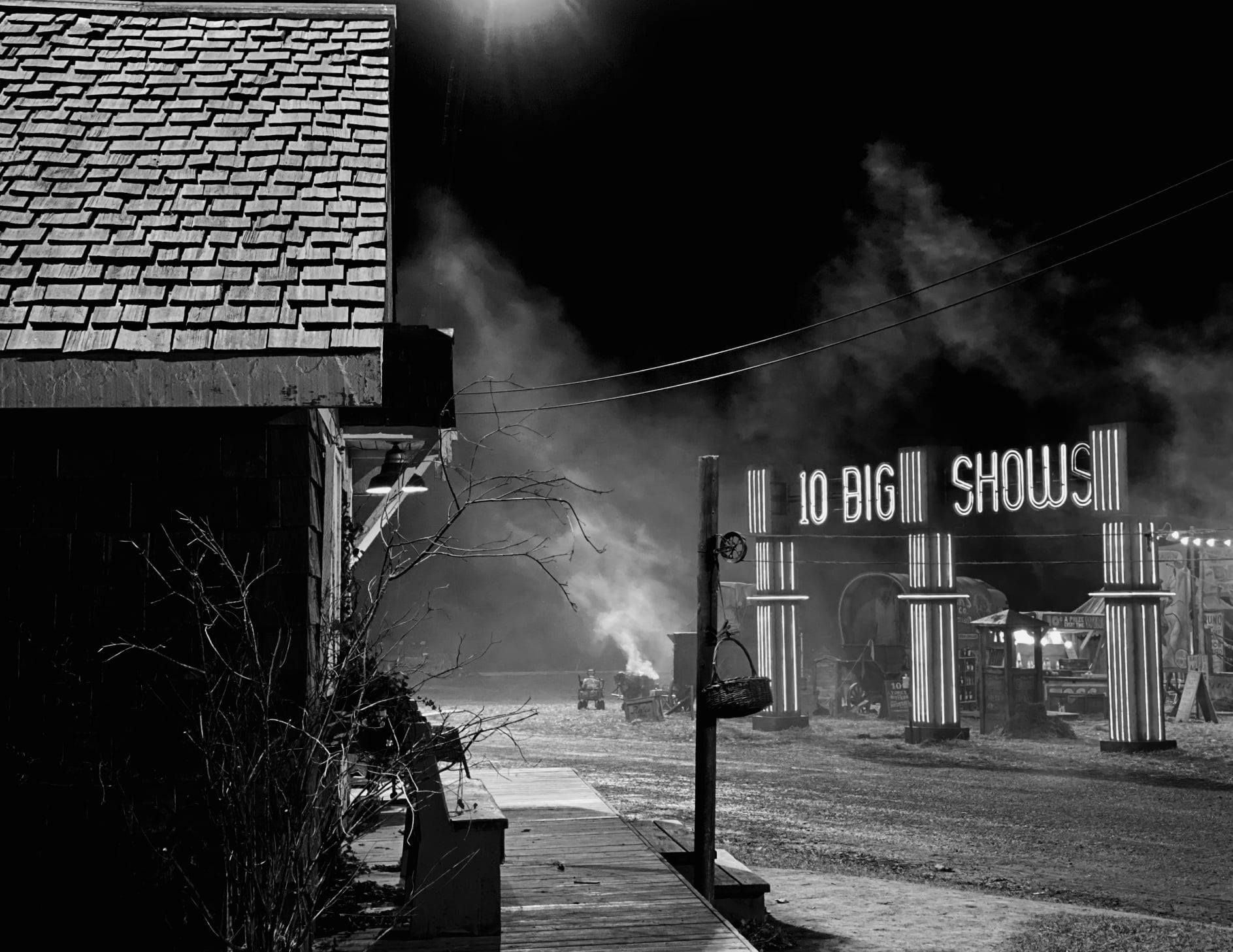
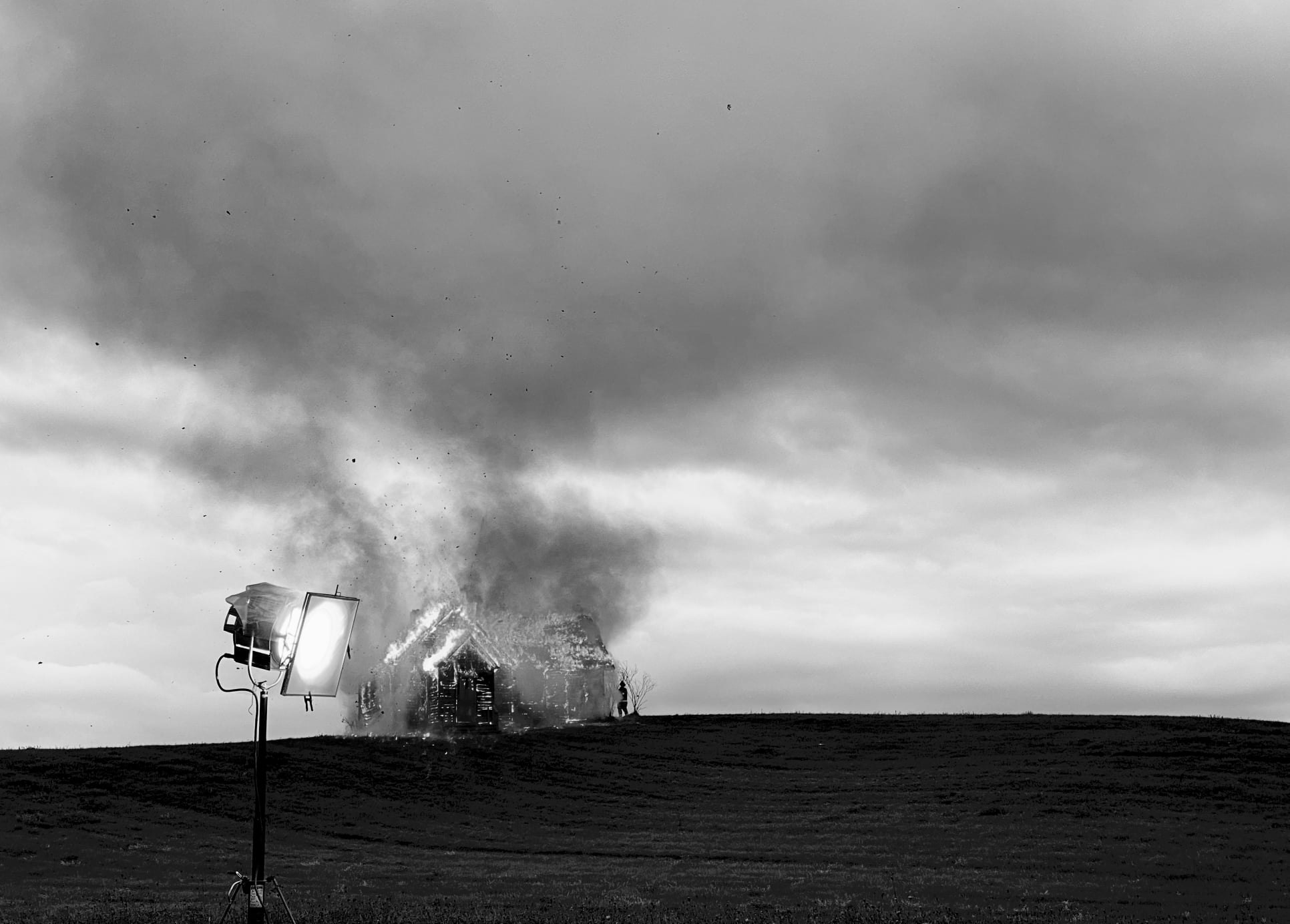
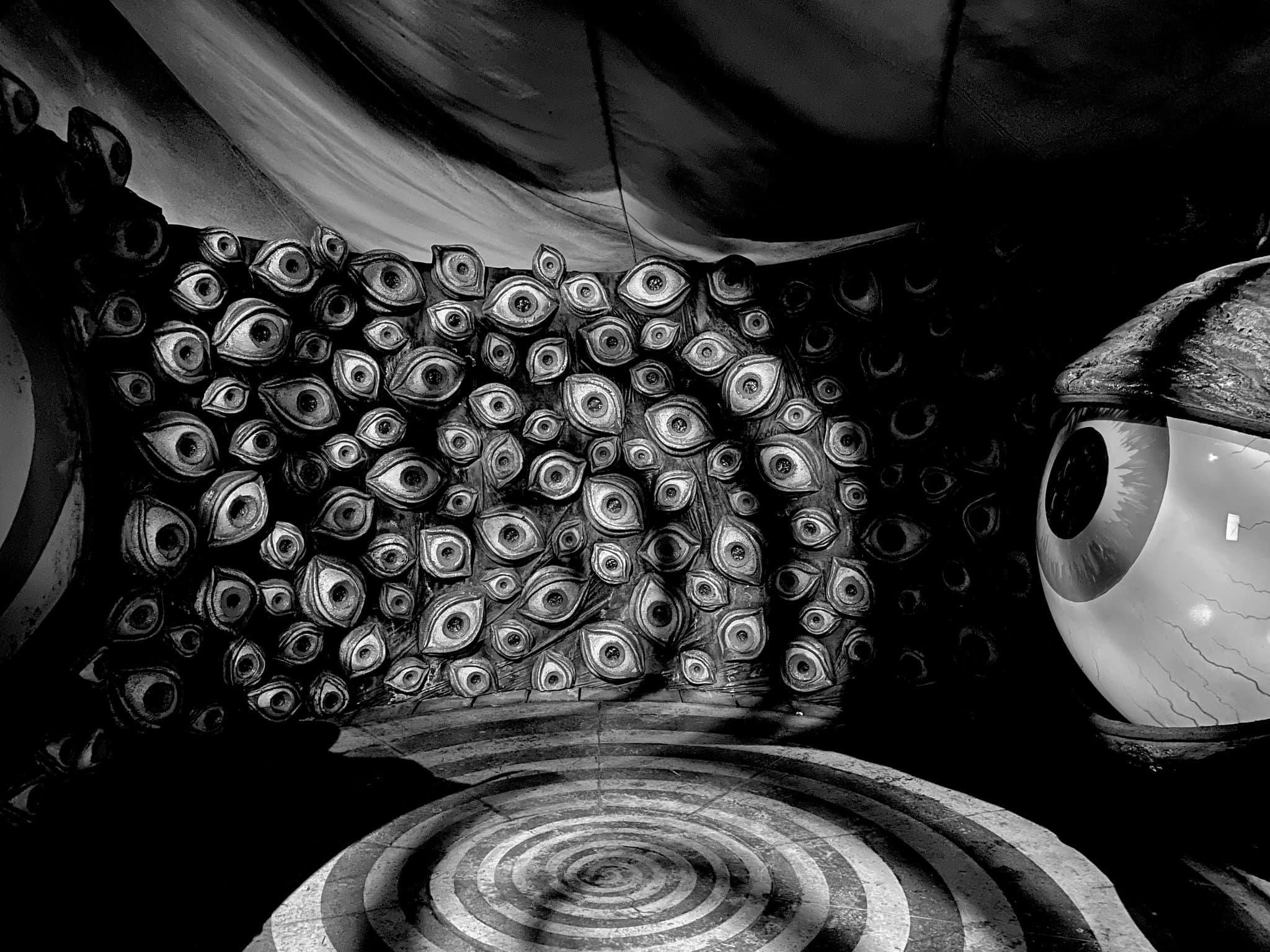
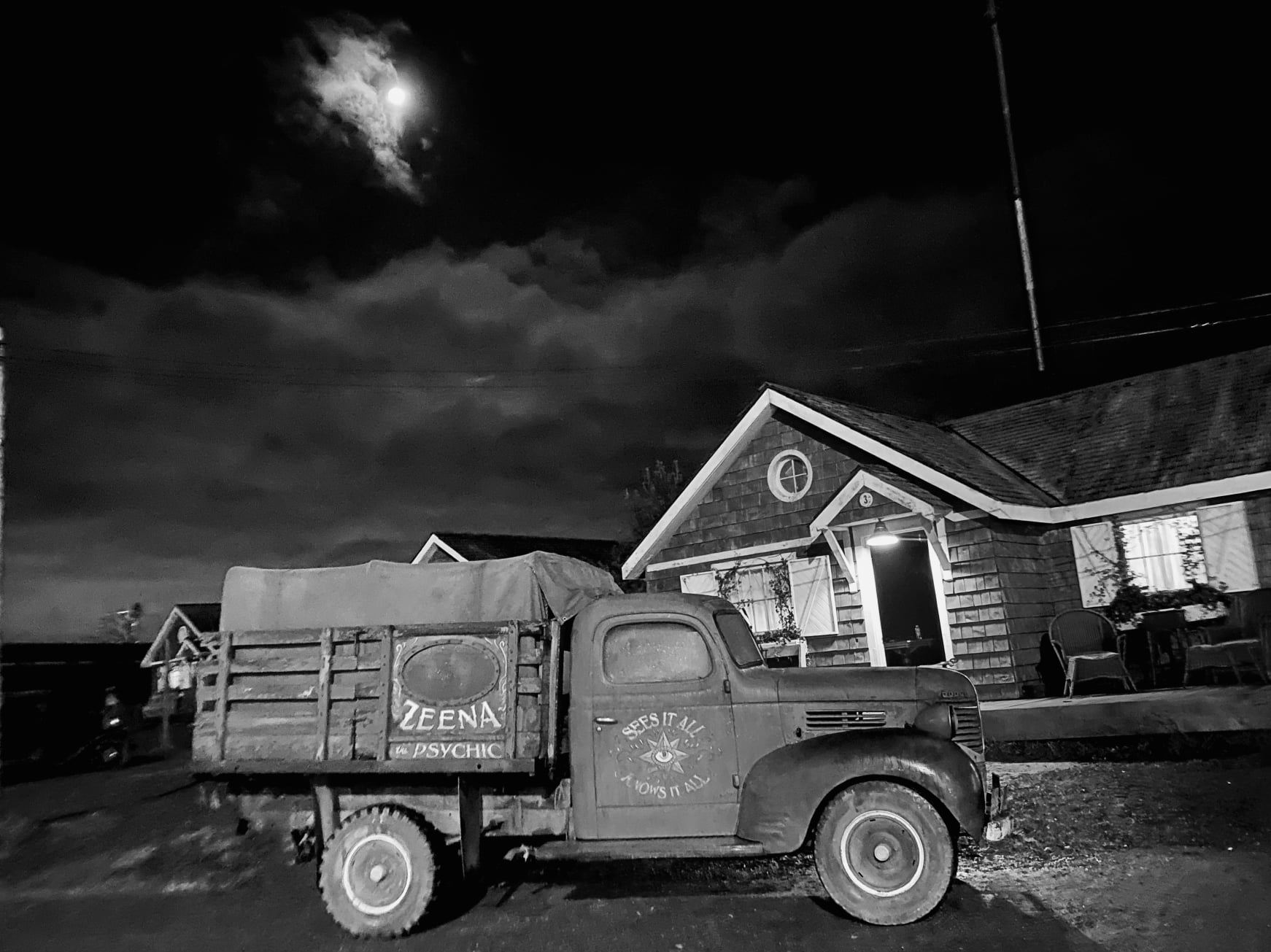
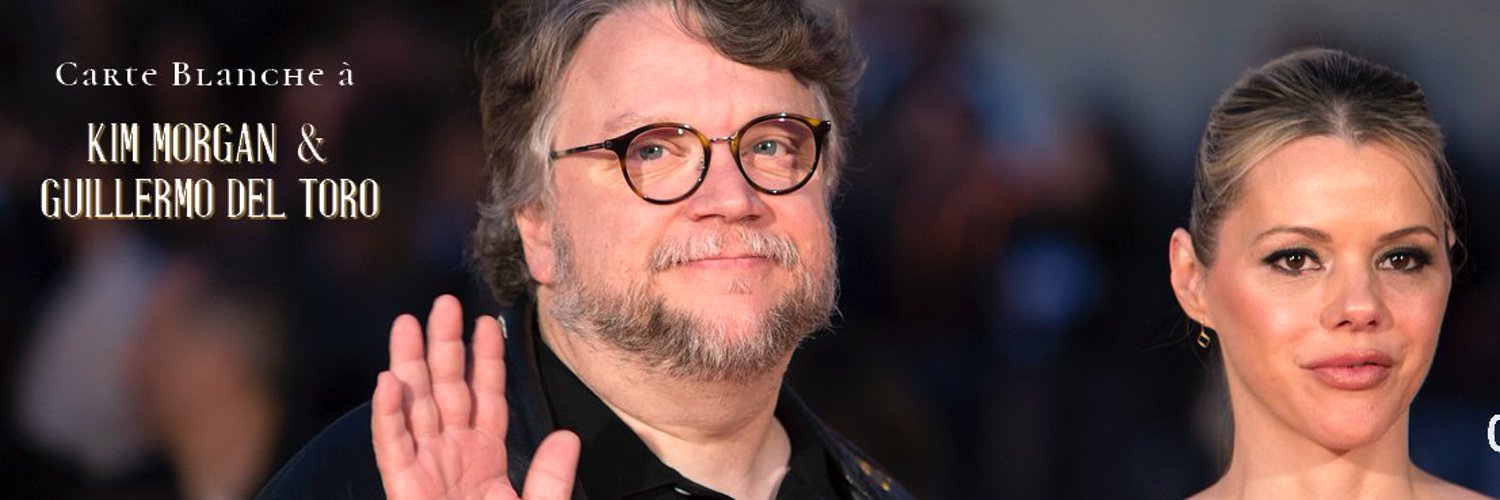
June 29-July 2 Guillermo & I will be presenting and discussing films at one of our favorite theaters in Paris — Christine Cinema — three movies that, in one way or another, informed our Nightmare Alley. Here are the movies:
Elroy Jackson Jr.: I don’t want no job, neither. I work for nothin’, take fifty percent of the prize money.
Burton Colt: To begin with, I hire drivers on my terms.
Elroy Jackson Jr.: And end up nowhere.
Burton Colt: Where do you get off being so goddamn snotty?
Elroy Jackson Jr.: I know my potential. So do you.
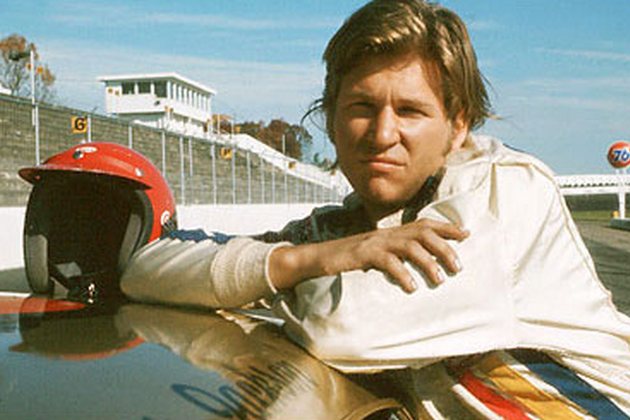
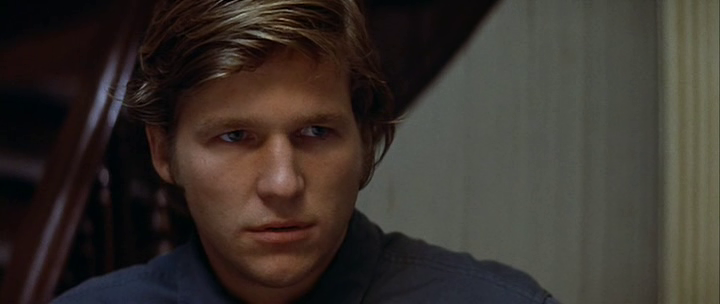
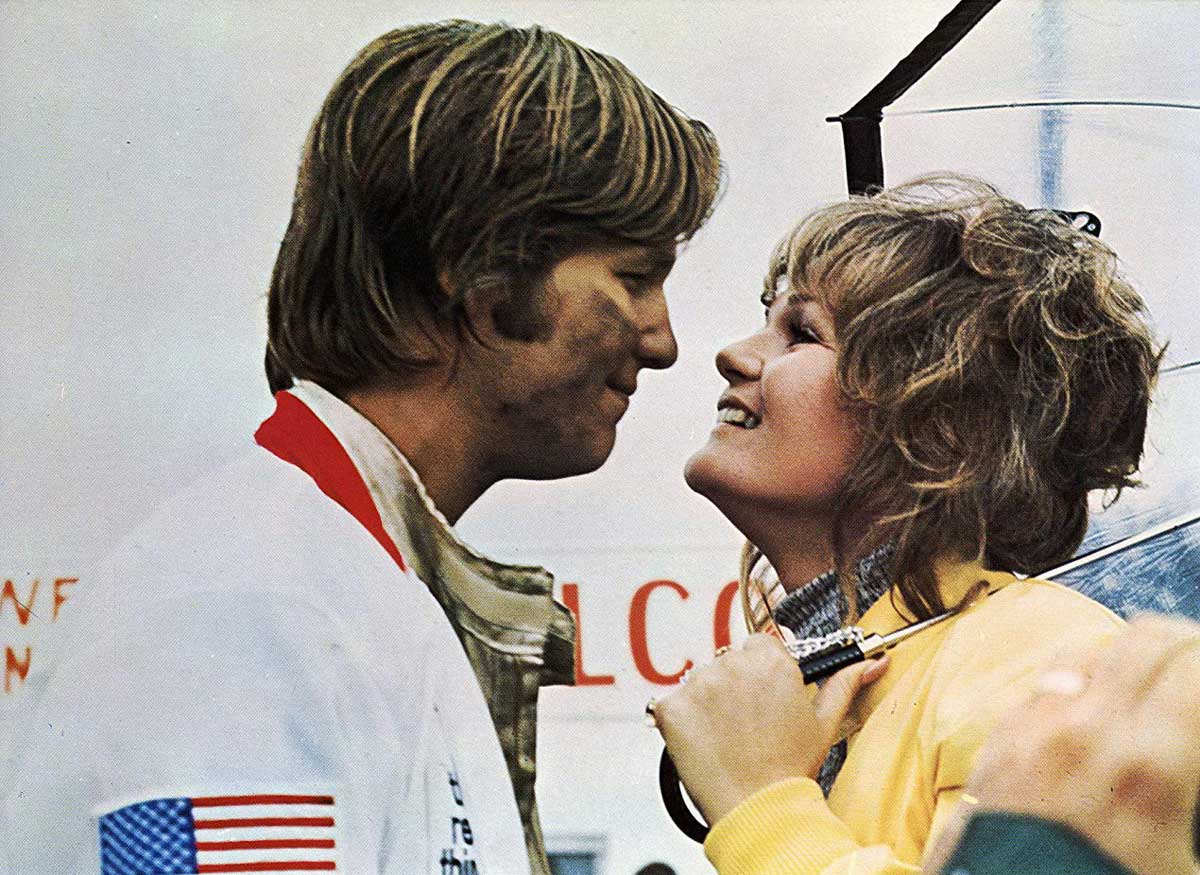
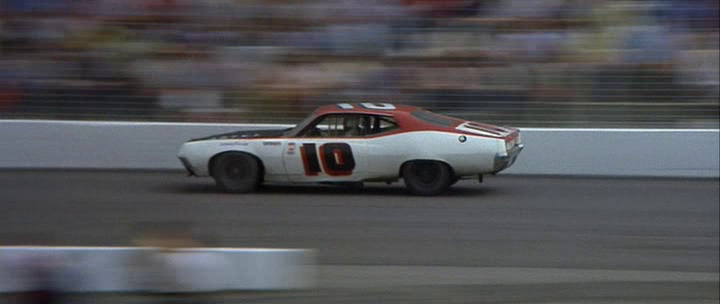
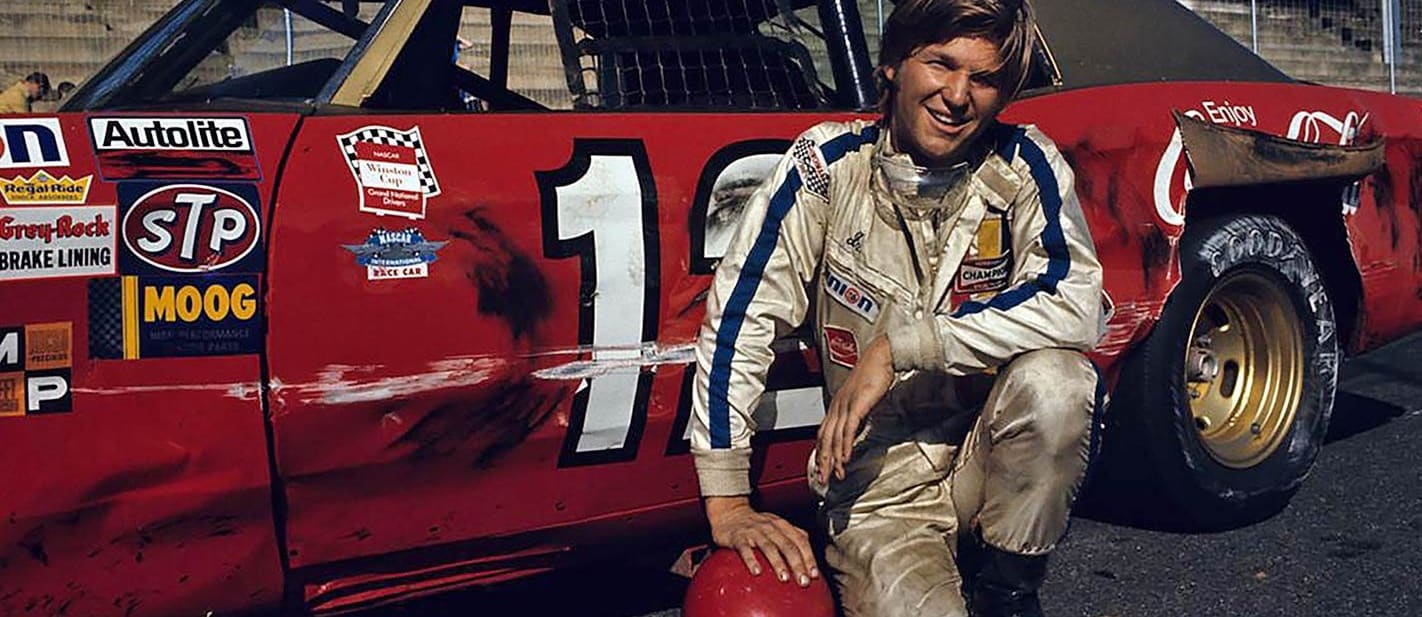
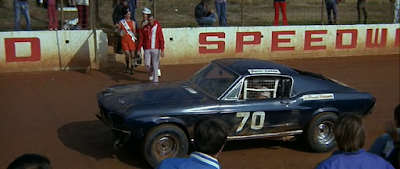
Junior Jackson has a lot of pressure in his life. It doesn’t seem fair to this young man but … he’s been a little cocky on the roads lately. His daddy, a moonshiner, has just been pinched by the law, the family moonshine still blown up and destroyed. The business is ruined – for now. The reason? Junior, driving his 1968 Mustang fastback full of hooch, tears down the North Carolina country roads, not just whizzing past police officers but knocking them over, laughing and singing along to the bluegrass tune on his car radio. He feels he’s invincible. Of course he’s not. The world is going to come at him one way or another – be it the law, his family or the profession he will find himself in. And yet, there’s something beautiful and innocent and free about all of this, this young man speeding along, his talent and his out-and-out joy of driving. Moonshining is what he grew up with – his daddy got him in this business, it’s all his younger brother knows – but you can see where his passion lies – racing. Speed. Maybe deep down he wants to drive the hell out of this county, out of this business, even as he loves his family so much.
But when his father is busted, Junior feels guilt and sadness and determination to help him out – and also to give his mother a break. There’s a lot hanging on him. His brother, Wayne, is furious: “It’s your hot doggin’ that put him there!” he hollers at him when he tears up to Junior distressed over their father’s predicament. He also knows Junior is the one who is going to have to fix it. Junior is upset and, in that flash, thinking about the next step – you can see it all register on his face: what the hell is he going to do about this? He’s got to do something. And he feels it’s all his fault. All of that “hot doggin’” in that car. But when Wayne slams his hand down on his Mustang, Junior says to him firmly, “Don’t hit the car, man.”
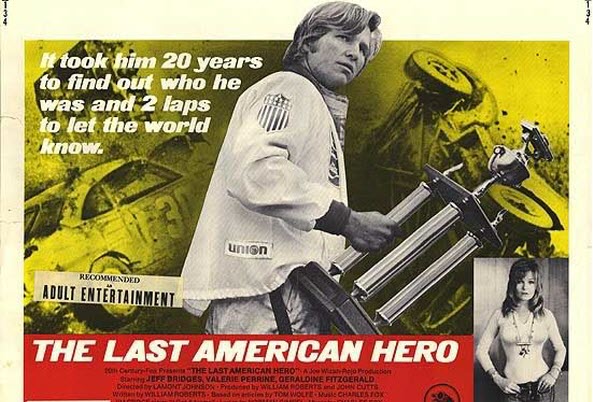
It’s a funny little moment, but it’s a truthful one, almost as if Junior knows right then and there that this car (or an even better car) and that law-breaking speed will be his key to success and wealth and, most importantly, his father’s freedom. There’s all kinds of wonderful moments like this in Lamont Johnson’s The Last American Hero, a movie about racing, yes, but really, more of an absorbing character study of a boy growing into a man and moving beyond his father – a country kid who is navigating through a world that is crooked and corrupt and paid off all over, and becoming tougher and more cognizant in the process. But through the course of the movie, he doesn’t become too hardened by what he experiences, not yet, and that makes the picture, at times, immensely touching. He’s a hothead, and while he’s not stupid, he’s still green in many ways. But even when he states his worth and stands his ground, he has empathy, and that seems to come to him quite naturally, it helps him understand; to put things in perspective. And with that kind of empathy and sweetness, you wonder how everything will turn out for Junior Jackson after the last beautifully frozen frame – is he gonna be OK? Will he harden, become too slick or commercial? He can’t stay the same. What will happen?
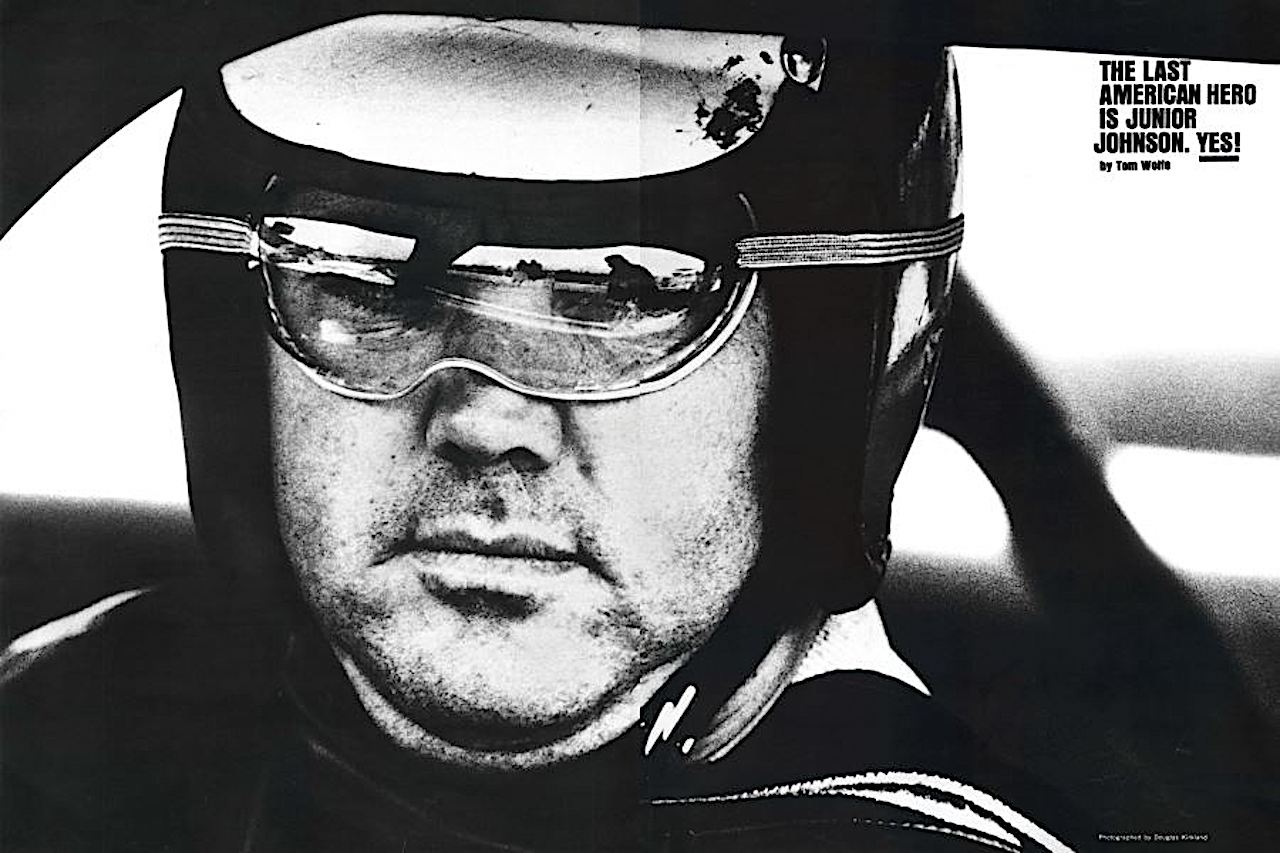
The real Junior Jackson, or rather, Junior Johnson – Robert Glenn Johnson, Jr. (whom Tom Wolfe helped immortalize in his famous 1965 Esquire piece – “The Last American Hero is Junior Johnson. Yes!” – which the film is based on – script by William Roberts William Kerby) was indeed OK – in terms of his success anyway. He won 50 NASCAR races during his career, he became a NASCAR racing team owner and was pardoned by Ronald Reagan for his past moonshining conviction. In real life Junior Johnson was the one arrested (his dad did serious jail time – a good portion of his life) but his arrest is omitted from this picture, giving the character, in some ways, more to work towards past himself – his daddy’s freedom. The name was also changed from Johnson to Jackson (I’m assuming this was a legal decision, though Junior Johnson was a consultant on the movie). Another revision: Junior Johnson’s driving career started in the 1950s and he retired as a driver by 1966 – here it’s right in the present – right there in the early 1970s with all of those gorgeous American muscle cars prowling the roads.
The movie doesn’t entirely mimic the appealing, hyperactive zeal of Wolfe’s piece either – a joy to read, like five really good shots of espresso – but that was a wise choice on director Johnson’s part. Johnson instead crafts an understated, personal, beautifully acted and shot (by cinematographer George Silano) and expertly edited picture (by Tom Rolf and Robbe Roberts – Rolf edited The French Connection II, Blue Collar, Hardcore, Jacob’s Ladder and Black Sunday, and was also co-editor on Taxi Driver, The Right Stuff and Heat, among many other pictures. He also had previously edited one of Johnson’s most interesting movies – The McKenzie Break). The picture knows it’s not a by-the-book chronicle of Junior or of stock car racing in general (though the racing scenes are exciting, beautifully textured and obviously carefully researched), and the director, instead, makes a thoughtful Lamont Johnson picture.
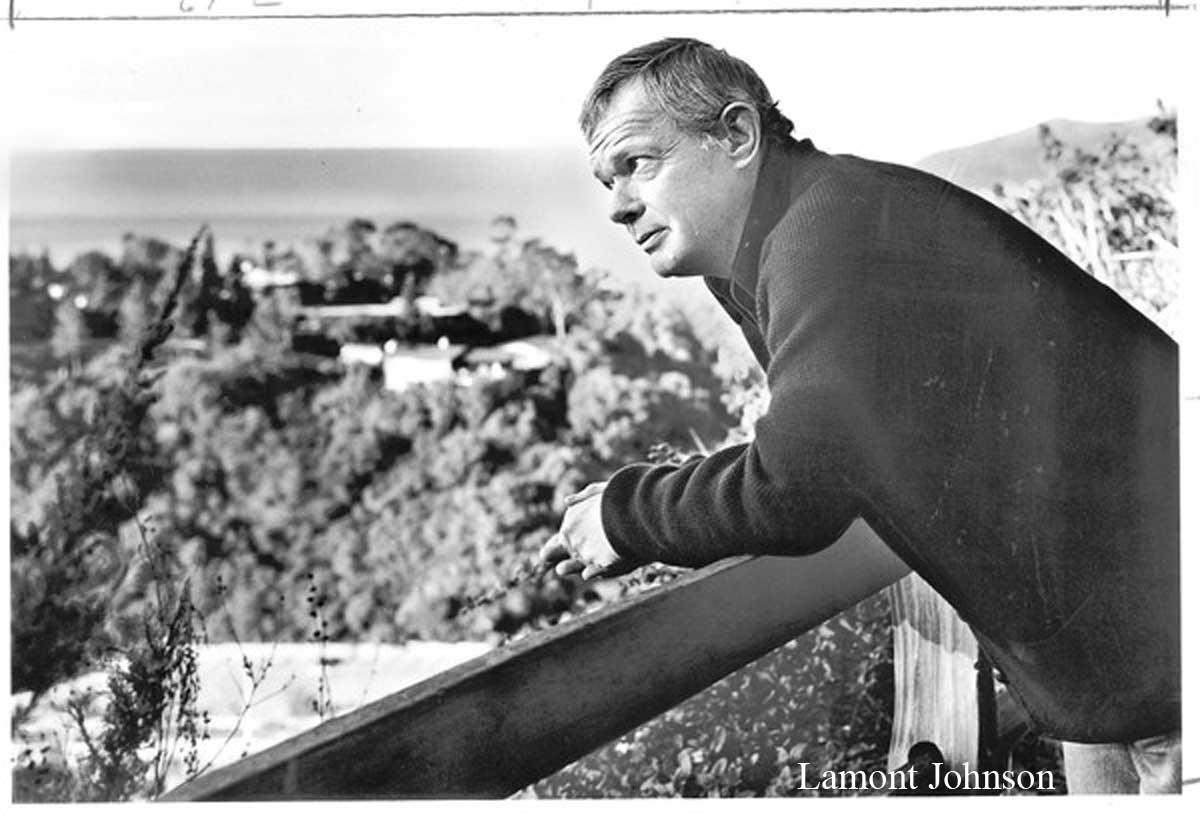
And Johnson, throughout his long and varied career, was frequently thoughtful – he was also intelligent, gritty, daring and enlightened. Johnson started out as an actor (he played Ishmael in a 1954 TV movie of Moby Dick, and appeared on stage and in numerous television series, including Alfred Hitchcock Presents, Climax! and Cavalcade of America – he makes an appearance as the hotel desk clerk in The Last American Hero) and, at this point, had directed major and acclaimed work in television – directing episodes of The Rifleman, Five Fingers, The Richard Boone Show, Have Gun – Will Travel, Peter Gunn, Dr. Kildare, Mr. Lucky, Naked City and more. He also helmed eight The Twilight Zone episodes that are smart, scary and memorable, especially the Sartre, Pirandello-inspired title, “Five Characters in Search of an Exit,” “Kick the Can” (which was re-made for the Spielberg episode of Twilight Zone: The Movie), the perverse, horrifying moral crusading “Four O Clock,” and “Nothing in the Dark,” (featuring a fantastic Robert Redford as Death). In these, you can really see how excellent he was with staging, and his understanding of complex psychological tension.
Johnson often delved into social and political themes in his work – progressive ones, including racial issues (like the powerful “Deadlock,” the 1969 pilot for the television series, The Bold Ones: The Protectors, and his 1970 TV movie, My Sweet Charlie) and the blacklist, (the 1975 TV movie Fear on Trial starring William Devane and George C. Scott about the blacklisting of John Henry Faulk), which had to have been personal since Johnson, himself, had been blacklisted during his career. He directed a well-regarded 1972 TV movie, That Certain Summer, about a gay couple (played by Hal Holbrook and Martin Sheen), and how a father will come out to his teenage son. It was a relationship and subject not often seen on television, if ever, at that time, and is considered a milestone moment in television history. Two years later, he made what some consider one of the greatest TV movies ever made, the 1974 The Execution of Private Slovik (also starring Sheen) about a real-life WWII American soldier who was executed for desertion.
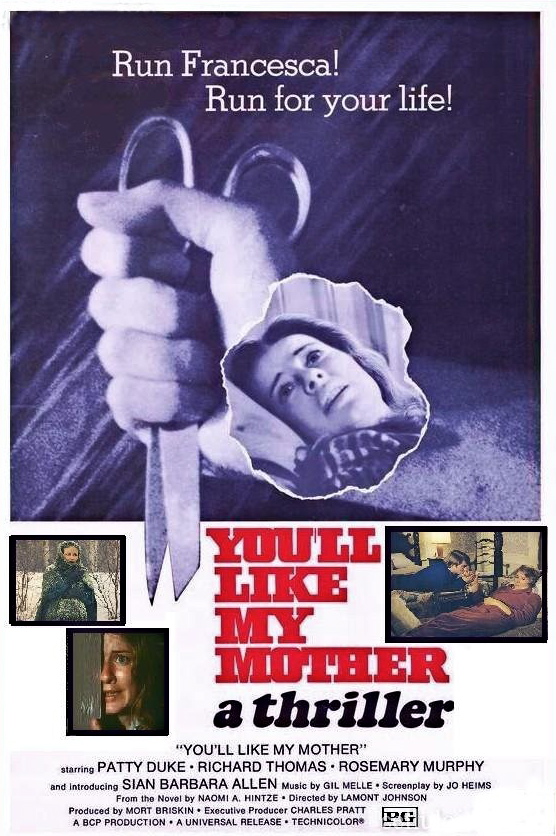
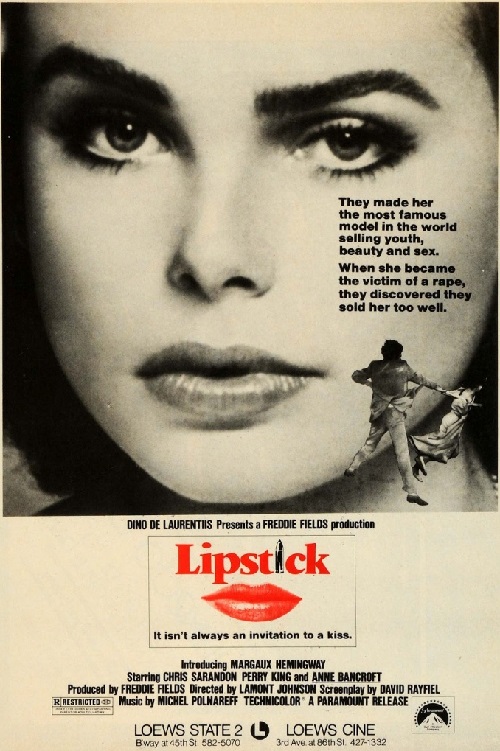
At the point of The Last American Hero he had directed some compelling features in what would be a long and fascinating career in film and television – The McKenzie Break (with an excellent Brian Keith), A Gunfight (Kirk Douglas and Johnny Cash as aging gunfighters – worth the price of admission for that – they have great chemistry), You’ll Like My Mother (with Patty Duke – a terrifying movie) and the trippy The Groundstar Conspiracy (with George Peppard and Michael Sarrazin). Later on we’d see Cattle Annie and Little Britches (featuring terrific performances by Burt Lancaster and young Amanda Plummer and Diane Lane), One on One (starring Robby Benson) and the much-maligned Lipstick (which is understandably disturbing in its graphic depiction of rape, but also manages to show how sexist the judicial system is, and Margaux Hemingway is a lot better than she’s given credit for – there’s much to discuss about this controversial picture).
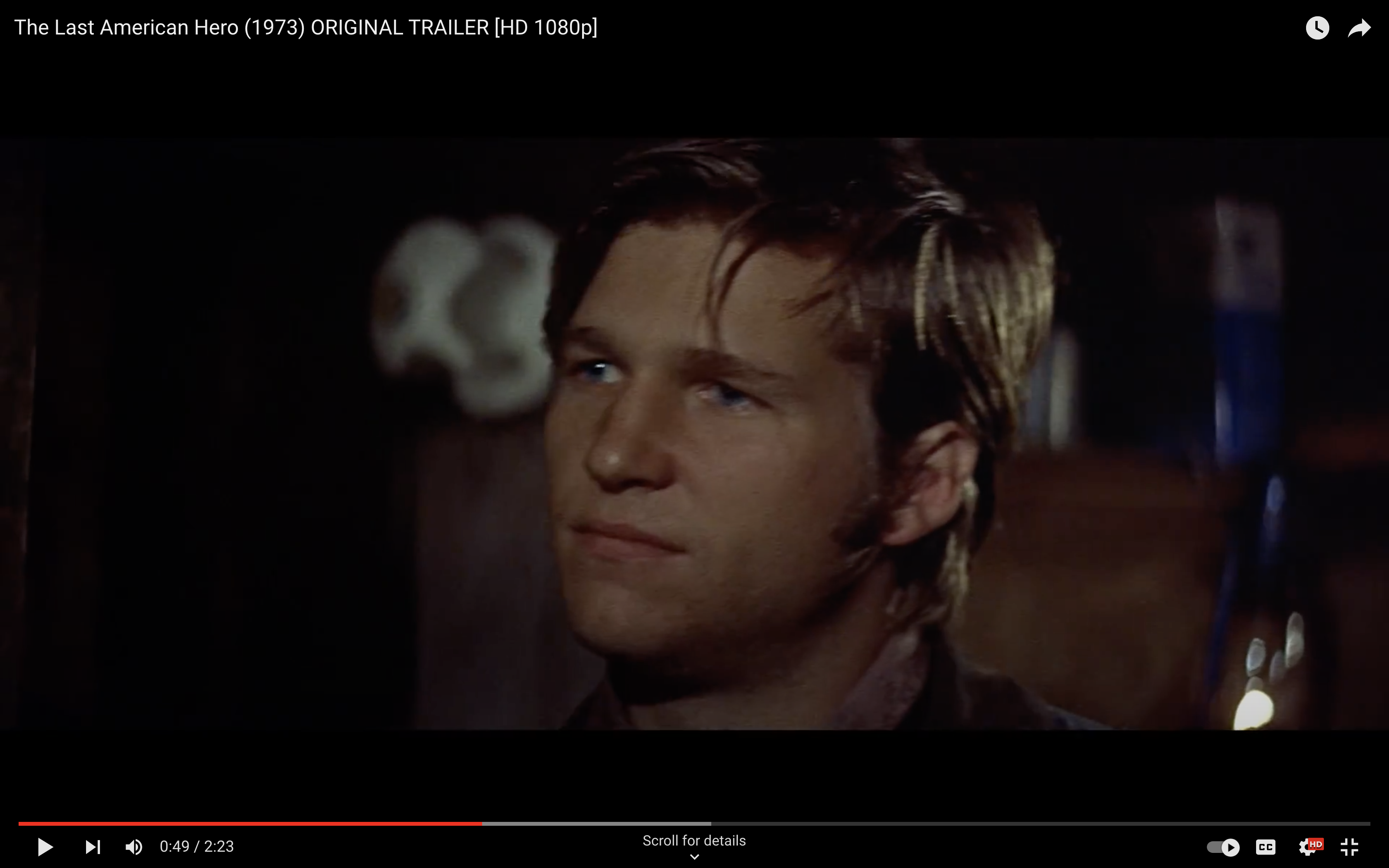
Having been an actor himself, one of his directorial strengths was working with actors – and in casting such excellent players and knowing their strengths – he really allowed his casts to inhabit their characters, make them come alive, feel real and lived-in. In some of his work, Johnson shows that there’s something deeper within the material – and material some viewers might expect to be less insightful, particularly in Johnson’s more “genre” films. The Last American Hero was a race car movie, a moonshining movie, a movie that could have leaned on easy clichés – but it never does. And Jeff Bridges makes this picture something special.
When Junior really rises up in his field – getting around some untrustworthy characters (like Ned Beatty’s promoter Hackel) – and he’s on his way to becoming not just a hero of stock car racing, but a folk hero in general, (he also goes head to head with his car owner and sponsor, Burton Colt, played by a fantastic Ed Lauter) – we watch Bridges truly feel the inner turmoil this young man is experiencing. On the one hand, he’s proud of himself, he’s full of youthful exuberance and cockiness, but on the other, he’s nervous and a bit of unsure about the world. He wants his freedom to remain independent, but sponsorship and ownership seem increasingly necessary. How long can he outrun that?
When he starts having feelings for a racing secretary named Marge (a poignant Valerie Perrine who always seemed to possess an overlay of sadness – she’s wonderful) the movie takes the time to actually present this woman as something more than just a groupie. Yes, she’s sleeping with another driver, Kyle Kingman (a terrific, almost humorously macho William Smith), and though he’s not pleased about it, Junior doesn’t stay mad at her, and neither does the movie. When Junior and Marge do have their intimate moment together, she tells him about how she was before she came to her present – in her words not attractive – and she relays a horrifying, sad story about being invited to a pig party by a fraternity. She describes it almost humorously, even though she was the butt of the awful “joke,” and she laughs at the humiliation now. But you can feel the lingering sadness within her. And Junior feels it too. He tells her she’s the most beautiful girl he’s ever seen. And then … she will eventually move on again. What’s refreshing is the movie doesn’t center itself on a typical love story or a by-the-book heartbreak arc – it doesn’t damn her for her decisions, as if Junior has to learn some lesson about the wrong woman (she’s not wrong or right – she just is), and it doesn’t present his loss as a tragedy. It’s just bittersweet. That’s the way of life, it says. It’s lovely.
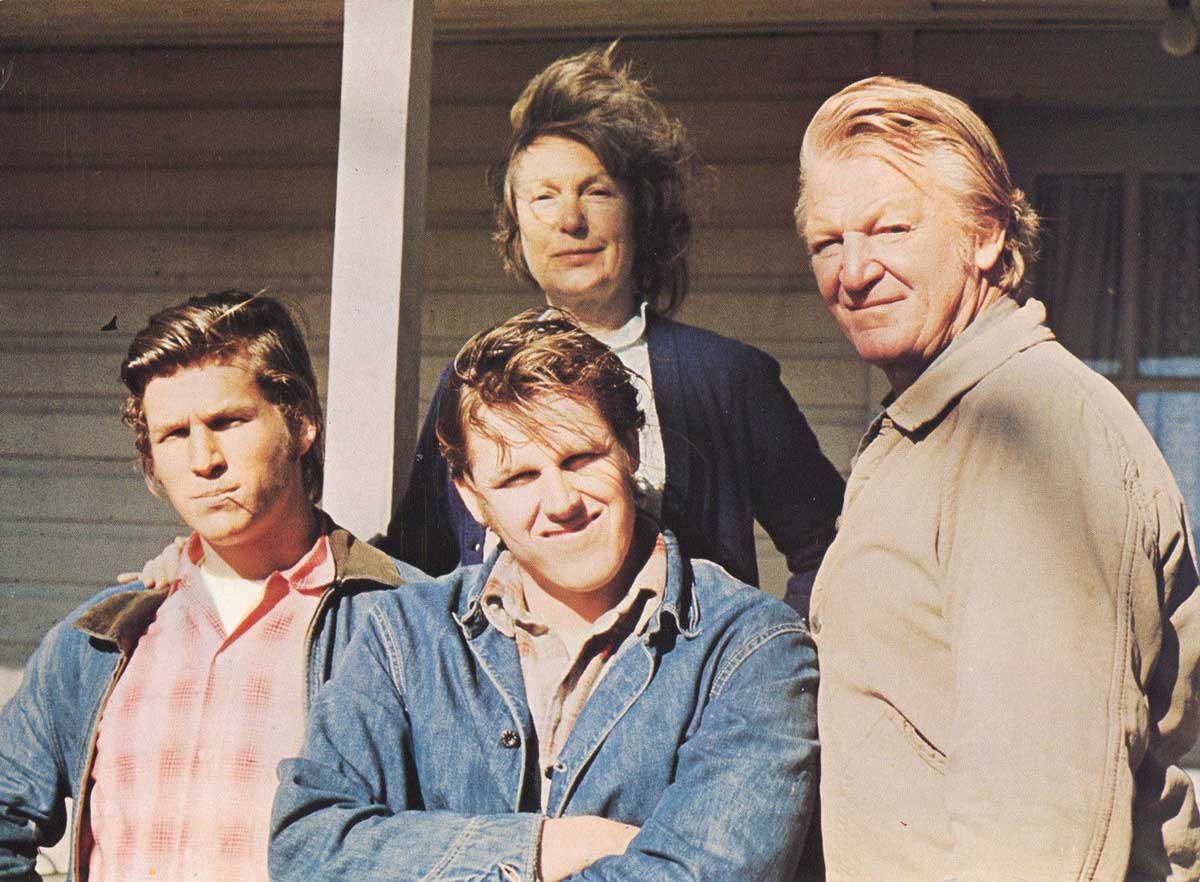
And for a fast movie – and it’s fast – the racing sequences are incredibly visceral; you can smell the motor oil, the country air, the fumes, you really feel like you are there – it takes its time presenting Junior’s experiences, and particularly his inner feelings. You get this from the supporting performances as well – Art Lund as Junior’s proud, moonshining father, Geraldine Fitzgerald as his long-suffering mother, and Gary Busey as his younger brother – they help create a more nuanced family portrait. These aren’t simply moonshining stereotypes, and Lund brings a poignancy to the role of what could have been a stock heroic criminal daddy, or simply a terrible father.
What he really wants, in the end, is for his sons to not follow in his footsteps. After they build him a new still when he gets out of prison, they’re thrilled to show him his new set-up. He’s not. He says to Junior: “If you lose a race, you get other chances. If you lose runnin’ liquor you get a prison cell, ’cause boy, they got your number.” When Junior asks him just how he’s going to get money to race his car without working moonshine, his dads asks him what his name is. Junior loudly states: “Elroy Jackson, Jr.” His dad then says – “You’ll find a way.” Meaning, go out on your own, you have the stuff. And, you’re not a kid anymore. Junior is already rumbling with a need for something bigger, while being tied to helping out his father. At this moment, father sets son free.
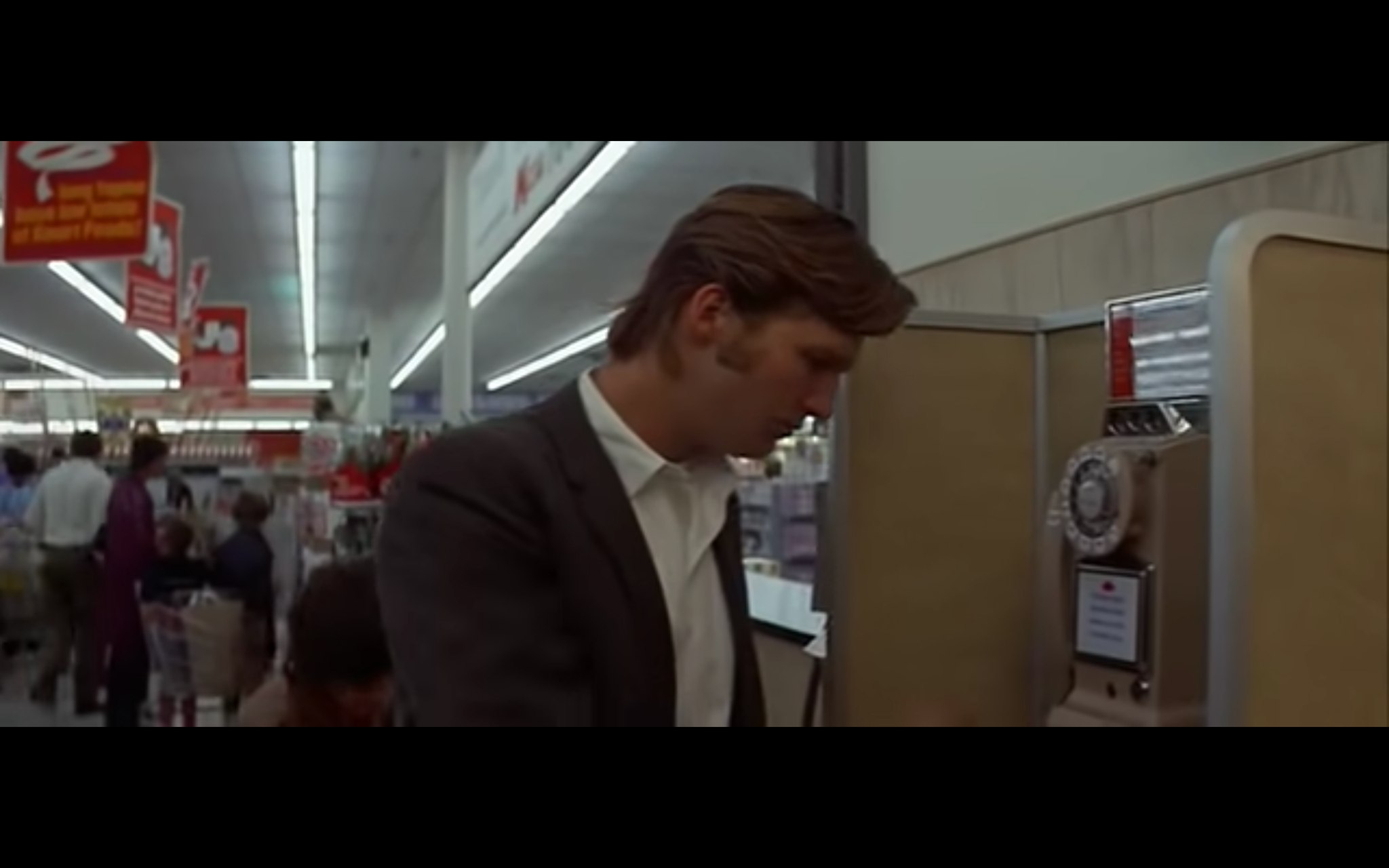
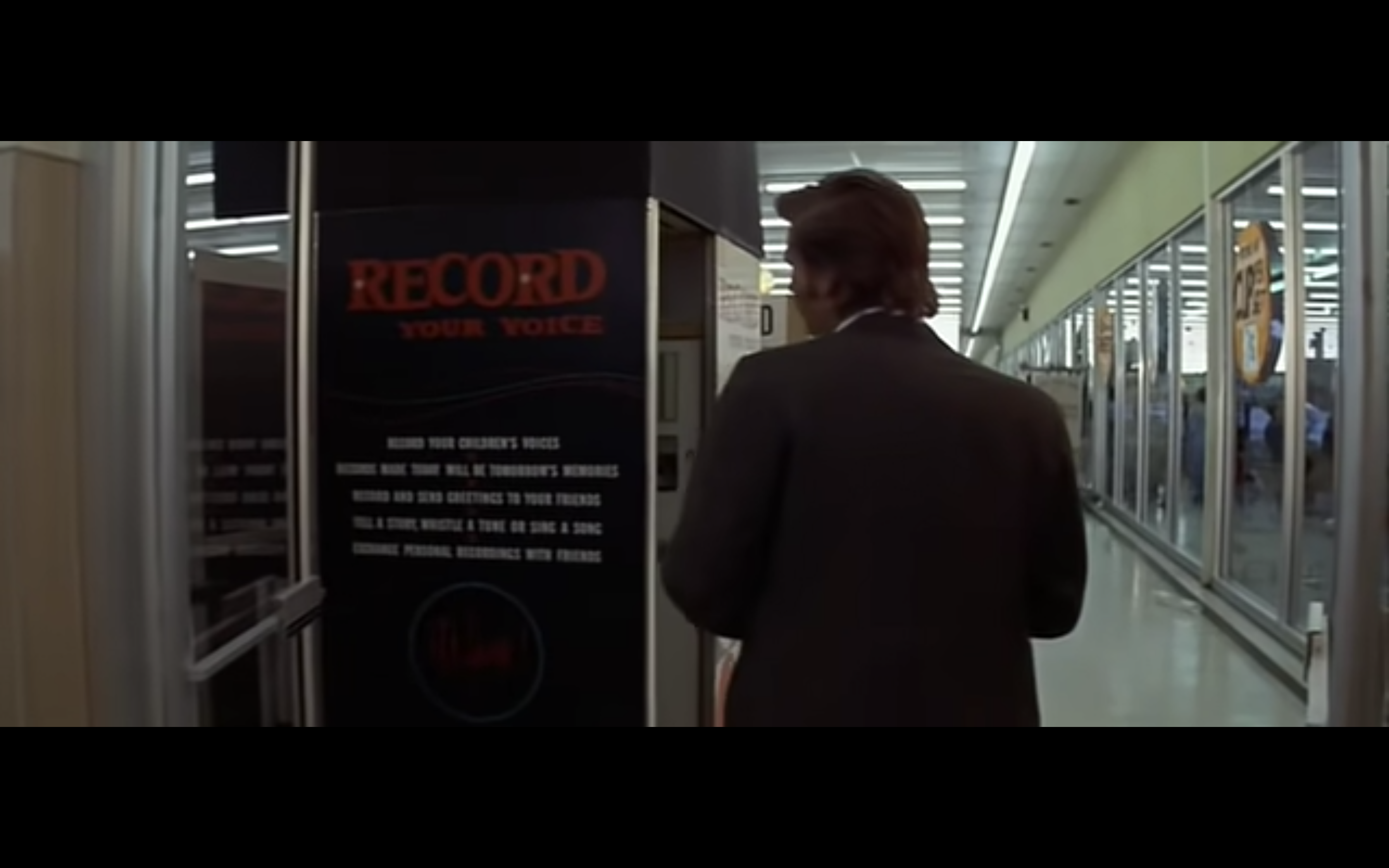
In an extraordinary scene (before his daddy is out of jail), after Junior has dropped Marge off from a party he’s not too keen on (too many strutting peacocks), the young man finds himself wandering around a Kmart at night. That image itself, the fluorescent lights and the Kmart bright colors, is so distinctly American that it catches you off guard with how evocative and, in this case, melancholic it is. He’s lonely. He calls what might be home but no one answers. He then goes into a vinyl recording booth located in the Kmart and records a greeting to his family: “I sure hope you got your stereo fixed, Wayne, so you can play this.” He keeps talking, laughing a bit nervously while trying to put a little showmanship in his message: “This is Elroy talking to you from Hickory where the cars are fast and the women are faster.” He continues with some thoughtful pauses, smiles and lingering sadness:
“Excuse me Mama. Hey, uh, see if you can send this along to Dad, and maybe they’ll let him play it, you know, uh, get that lawyer fella to jerk on some strings. Well, I, uh, I sure been havin’ a fun time here, uh, drivin’ and all .… I don’t know. These us, people out here – they ain’t exactly what you’d call, uh, normal. These drivers – they strut around like they’s damn movie stars or something, laughing all the time, talking too loud… Oh, uh, Mama? I got a real nice motel room. It’s got a color TV and a shower and – uh – And a shower. I mean, the, you know, the color TV ain’t in the shower. I guess the real rich folks get them kind of rooms, huh, Mama? And, uh, Daddy. I just want to say that I’m sorry. And that I love you. And don’t you worry ‘cause I got this plan. So I’m gonna see you real soon. Okay? Okay. Well, goodbye, Mama. Goodbye, Daddy. See you after a while, Wayney. You little suck ass!”
It’s a powerful piece of acting, and not easy (it made me think of Montgomery Clift’s brilliant phone booth monologue in John Huston’s The Misfits), and Bridges goes through a multitude of emotions here without any strain – he is layered and so utterly natural – it’s incredible. It’s also a beautifully composed sequence – a long lens composition, it splits the frame 50/50 between Bridges and his own reflection on the stainless-steel recorder faceplate, working almost like a monologue Junior is having with himself. You can see that he’s not sure about this recording – it seems like just something to do on a bored, alienating night, and maybe it’ll be fun. But while recording, he’s possibly revealing how he’s feeling a little in over his head, how he’s vulnerable. He seems anxious, doubtful. Does he want his family to sense this? When he’s done recording he picks up the record and then breaks it right there. He chucks it in the garbage.
At this point Junior is set to face a lot more in the movie, things he doesn’t know yet. But he must know, somewhere deep down, that things are really going to change for him. There’s something sad in realizing that you’re going to have to let go someday – both to let go of your family, and finally, to let go of some of your independence (he’s going to need a sponsor). You see it all on Bridges’ face, but with such minimalism and mercurial nuance. And Johnson knows how powerful this is. He takes his time with it – unfolding Junior’s feelings with beauty and sensitivity.
The film’s tender theme song, “I Got a Name,” sung by Jim Croce (written by Charles Fox and Norman Gimbel), follows Junior Jackson around with a mournful kind of pride. It could feel a bit too on-the-nose, but the way Bridges acts and Johnson directs, it never feels that way. It feels like an elegy. Proud but wistful, claiming yourself, but, maybe, losing something in the process. “Movin' me down the highway, rollin’ me down the highway, movin’ ahead so life won’t pass me by."
“On April 20, the telephone rang at the Wyler home in Los Angeles. When Talli picked it up, she heard her husband on the other end of the line, but if she had not known he was calling, she might not have recognized his voice. Wyler had cabled her that he was on his way home, but he hadn’t told her the extent of the damage to his ears—something he didn’t yet know himself. For more than a week, he had been on a ship, alone, waiting to see if he could discern any improvement. A few days into the crossing, a tiny bit of hearing had returned in his left ear, but by the time he disembarked in Boston, it was clear to him that he was not getting better, and he plunged into depression. ‘Instead of a happy voice, I heard an absolutely dead voice, toneless, without emotions, totally depressed,’ Talli said. ‘I was stunned and shocked and couldn’t imagine what had gone wrong. He sounded totally unlike himself, terribly disturbed. He talked as if his life was over, not only his career.”’
“… Wyler couldn’t bear the idea of a visit from Talli or his young daughters, and the few old friends he allowed to come to Mitchell Field to see him found a shattered man. ‘I’d never seen anybody in such a real state of horror,’ said Lillian Hellman. ‘He was sure his career was over, he would never direct again.’ They were, said Wyler, the ‘worst weeks of my life.’”
– Mark Harris, “Five Came Back: A Story of Hollywood and the Second World War”
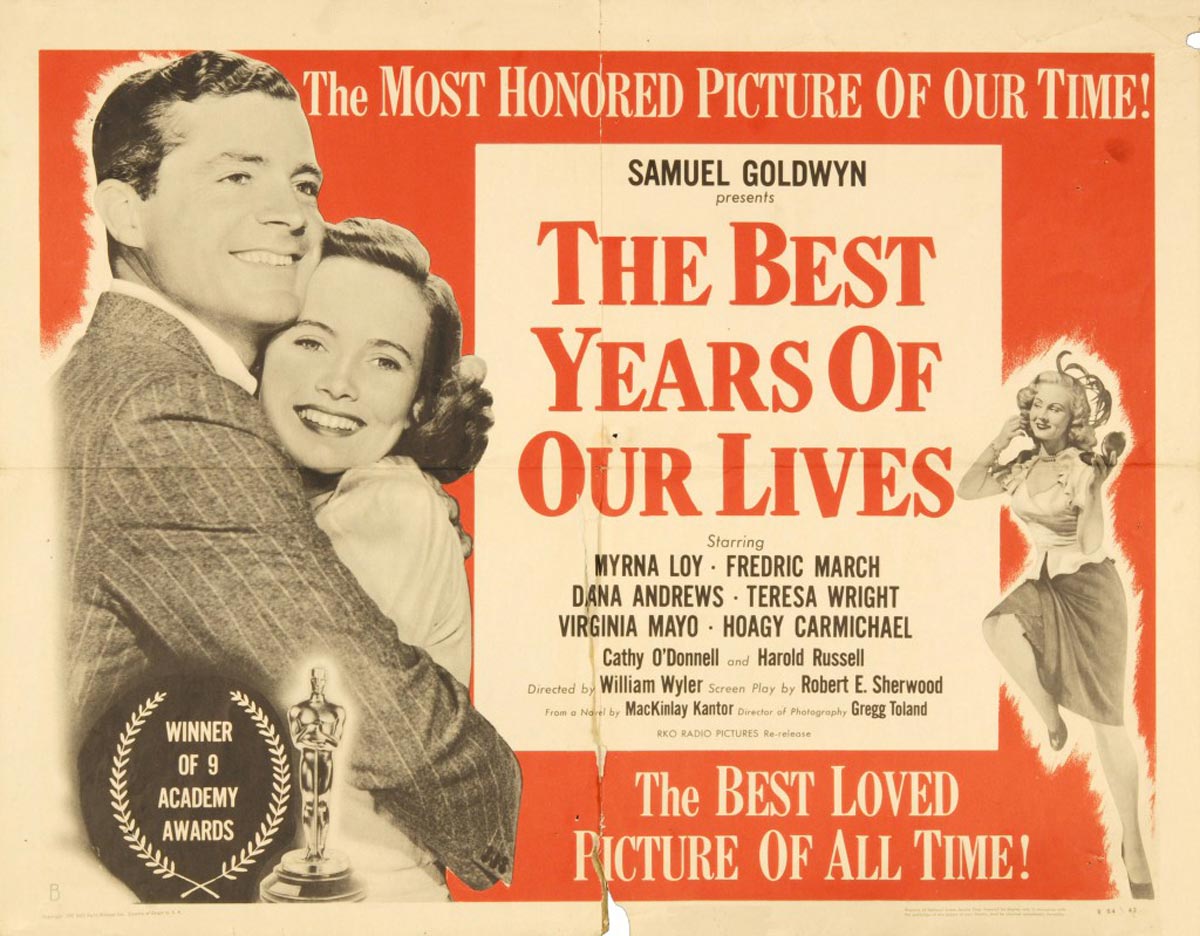
How does home feel? And how do the women back home feel? We wonder as we watch three returning servicemen, recently acquainted and crammed together in the back seat of a taxi cab coming home from World War II. They are taking in their surroundings. They are nervous. The men are glad to be back, in a way, looking at the recognizable sites of their Midwestern town Boone City, but mostly apprehensive – worried about readjusting to civilian life, wondering what their families will think of them and wondering what they’ll think of their families. Questioning if their minds and even their souls will align with anything in “regular” life. As the older one said earlier, “The thing that scares me most is that everybody is gonna try to rehabilitate me.” To what? We’re not sure and perhaps he’s not either. These are three different men sitting in that cab with three pensive faces that all understand each other’s uneasiness – what now? And all three have women in their lives – that’s a big part of it. What is going to happen with all that? Those women they love or loved or maybe shouldn’t love? The same? Different? The youngest, the sailor, Homer, with his hands blasted off, is returning home physically changed – he knows it won’t be the same and he fears seeing his young fiancée, Wilma. He’s got hooks for hands and as dexterous and as good-natured as he is with the guys about it, he’s scared of letting her down. Or being too much for her. “Wilma’s only a kid,” he says earlier, “She’s never seen anything like these hooks.”
And so the other two men watch Homer (Harold Russell) being dropped off at his sweet middle-class home and his sweet family greeting him. Army sergeant Al Stephenson (Fredric March), the oldest of the three, the most well-off and the longest married, and Air Force bombardier Fred Derry (Dana Andrews), younger than Al, not well-off, married for mere weeks before he went away – they know Homer can’t hide his apprehension, or at least, what’s happened to him. It’s all right there in front of the world to see. The family excitedly embrace their returning soldier and then Wilma (Cathy O’Donnell) sees him. She seems a little shy at first, how to approach, but her face is so full of love and tenderness towards Homer, she throws her arms around him, crying. She loves him and you know it. Her vulnerability and warmth is so immediate, and O’Donnell’s face so pure and giving, that you know she’ll understand Homer – you see it all in Wilma’s body language. And maybe that’s part of why Homer is scared – because Wilma is so lovely and compassionate. He’s big-hearted and lovable and brave, but at times he feels freakish, haunted. And he’s concerned that he’ll be placing her within his struggle. Her light shadowed by his darkness. You see that on his face too. Homer receives her embrace without a smile, standing stiff, arms down. It’s a remarkable, beautifully acted scene.
This is the first homecoming we witness in William Wyler’s masterpiece, The Best Years of Our Lives, homecomings that were powerfully personal to the director himself. As detailed in the excellent, essential “Five Came Back: A Story of Hollywood and the Second World War” by Mark Harris, while Wyler worked with Robert Sherwood (adapting the script from the blank verse novel “Glory for Me” by MacKinlay Kantor) the director, a World War II vet, identified. As Harris wrote:
“As they collaborated, ‘The Best Years of Our Lives’ gradually evolved into Wyler’s own story. He openly identified with Al, the family man who gives up the comfort of success to go into the military and then comes back only to realize that, as Wyler put it, ‘no man can walk right into the house after two or three years and pick up his life as before.’ But Sherwood infused all three of his main characters with aspects of Wyler’s own experiences: The anger that had almost gotten him court-martialed after he threw a punch at an anti-Semite was given life in the pugnacious, hard-bitten Fred, and Homer became a repository for all of the director’s anguish about living with a disability. ‘I explained all my own fears and problems to Bob Sherwood,” he said, “and he worked them in just the way I wanted them.’”
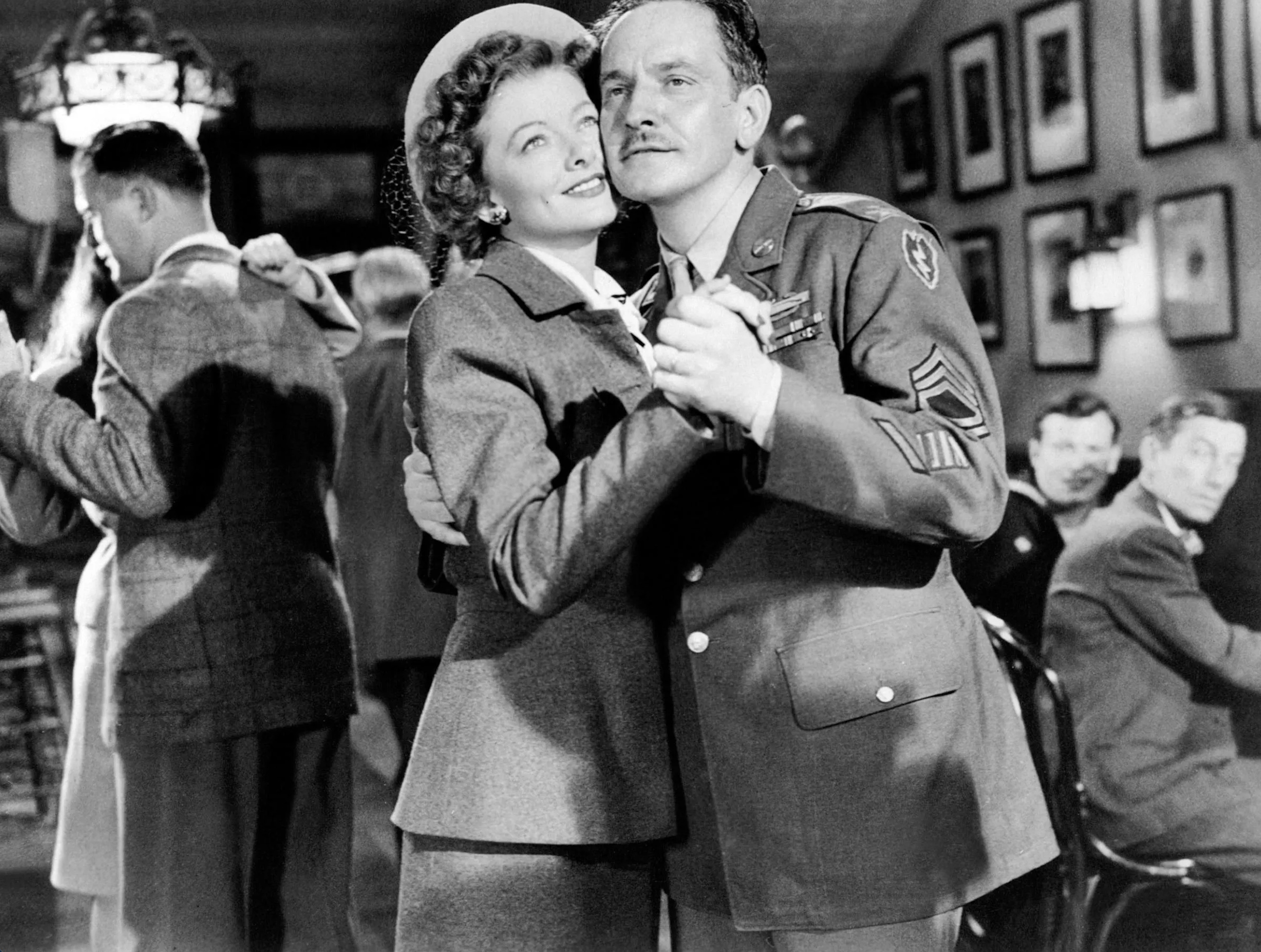
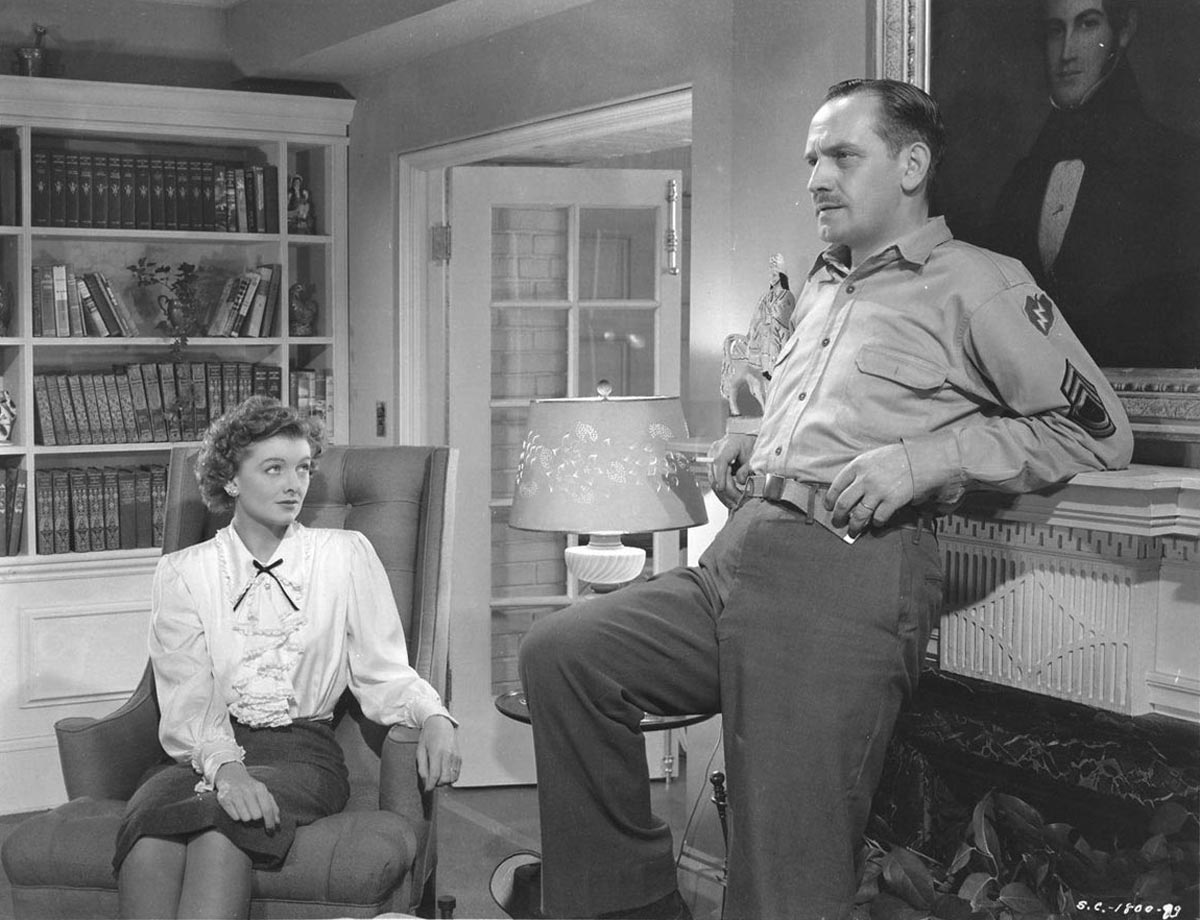
Al’s dropped home second. Fred admires his nice digs, a swanky apartment building, and jokingly asks if he’s a bootlegger. Al reassures him it’s nothing as glamourous as all that – he’s a banker. Al walks to the door, and upon entering, shushes his excited, now grown-up kids – son, Rob (Michael Hall) and daughter, Peggy (Teresa Wright) – so to not ruin the surprise for his wife, Milly (Myrna Loy). The subtle beauty and poignancy of this scene – we are not prepared for – Wyler directs with such a wonderful combination of raw emotion and gentleness that we’re almost taken aback by how much it overwhelms us. And Myrna Loy is brilliant. Her reaction to what she thinks might just be someone (she knows her husband is coming, but hadn’t expected him back quite yet), is superb silent acting: the turn of her head, the near dropping of a plate, a look of almost fear and then rapture – could it be? She walks into the hallway and they see each other from across the way — they rush to each other and embrace. Married for twenty years, these are people who have loved each other and, as they reveal to their young daughter later in the film, they have hated each other too. A real couple. In that later scene, the distraught daughter who rather childishly thinks her parents have had it perfect (she’s later in love with Fred and loathes his wife), is given a dose of real life via Milly. She underscores her point while looking at her husband: “’We never had any trouble.’ How many times have I told you I hated you and believed it in my heart? How many times have you said you were sick and tired of me; that we were all washed up? How many times have we had to fall in love all over again?” It’s a scene that’s as moving as the hallway reunion – no one has a perfect marriage and no one is coming home to a perfect wife because … that is impossible.
As Al’s with his family – a bit antsy, not sure how to relate to his son and definitely needing a drink – Fred can’t find his wife. He returns to his parent’s house, a shack by the train tracks, and they inform him his wife got an apartment and a job. When he finds her apartment he can’t get in – it’s too late. The viewer feels suspicious of her already – where’s Fred’s loving embrace from a woman? But that’s not fair to her. It’s not surprising a woman would need to work (in her case, a night club, and late, she sleeps in for reasons other than what we may think). And Fred’s being understanding too – and so he winds up at the bar Homer told him about, Butch’s, run by his uncle (played by Hoagy Carmichael), unexpectedly meeting up with both Homer and Al – Al who has charmingly taken his wife and daughter out on the town. Preoccupied Al was almost pacing around the house, unsettled, like a guy just out of jail. He’s not bored, he just needed some kind of excitement – perhaps something to blot out what he’s thinking about. He certainly needs to be lubricated. Who can blame him?
Milly sure doesn’t, even if we begin to suspect Al has a drinking problem, and she’s aware of it. I love the touch of Al out on the town with wife and daughter as he gets completely sloshed – this is his family, but these two very interesting female human beings are his friends too. It’s one of the movie’s many moments that remain so timeless – Al’s relationship with the two women in his life and that he wants them to come out. And I love how elegant, down-to-earth Loy relays so many emotions here: she’s patient when she could be exasperated, she’s amused, she’s touched, she’s loving, she’s a little worried. She’s also having fun watching her husband and his new friends get plowed (though Homer drinks only beer – Butch’s orders). She’s just so thrilled he’s home, he’s OK, he’s alive. And this continues on in the film – Loy’s calm and wit and reassurance towards her haunted but frequently amusing husband, beautifully played by March – it fills the heart with hope, but never in a cloying, easy way. Nothing is really easy in this movie.
Part of this unease is watching the times you think a drunken Al is going to step in it – especially when he gives an important speech – and he doesn’t. And Loy rushes to him – for his strength and for his vulnerability. You see that marriage isn’t just built on a strong perfect loving bond, but on all of those mistakes and regrets and fuck-ups one has forgiven. Milly understands that Al has changed since the war – or whoever he was before has awakened – but it’s with a quiet reassurance that’s never showy in neither the film’s writing nor Loy’s acting. The actors are so comfortable with one another that they feel married – which makes the moment when mother and daughter helping to haul Al and his new friend Fred, blind drunk, to bed, all the more touching and intimate. The daughter now becomes the wife Fred really came home to – soothing him in the middle of the night from a PTSD nightmare (another timeless moment of many in the picture). He may not remember it all in the morning, but they remember each other and they’ve bonded in an important moment – and that will become both an issue and a beautiful thing.
Which leads to Fred’s wife. It takes a while to catch up with her after Peggy drops him outside the apartment, sitting in the car and waiting for him to safely get inside like a fella making sure the door is closed behind you. She’s also half hoping he doesn’t get in as she’s already falling for him – a married man. Later, this “good girl” who’s not as simple as that at all, will vow to break up that marriage. It’s a fantastically layered scene — heartfelt and angry and even funny and then, in the end so utterly poignant. Peggy has made herself double date with Fred’s wife so she can wash the infatuation out of her system. But listening to Fred’s woman talk about makeup and money and whatever else, and witnessing the lack of love between them, she returns home with a mission. So much so that the “good girl” become the “femme fatale” – almost – she tells her parents: “I’ve made up my mind. I’m going to break that marriage up!” Al says, “So you’re gonna break this marriage up. Have you decided how? Are you gonna do it with an axe?”
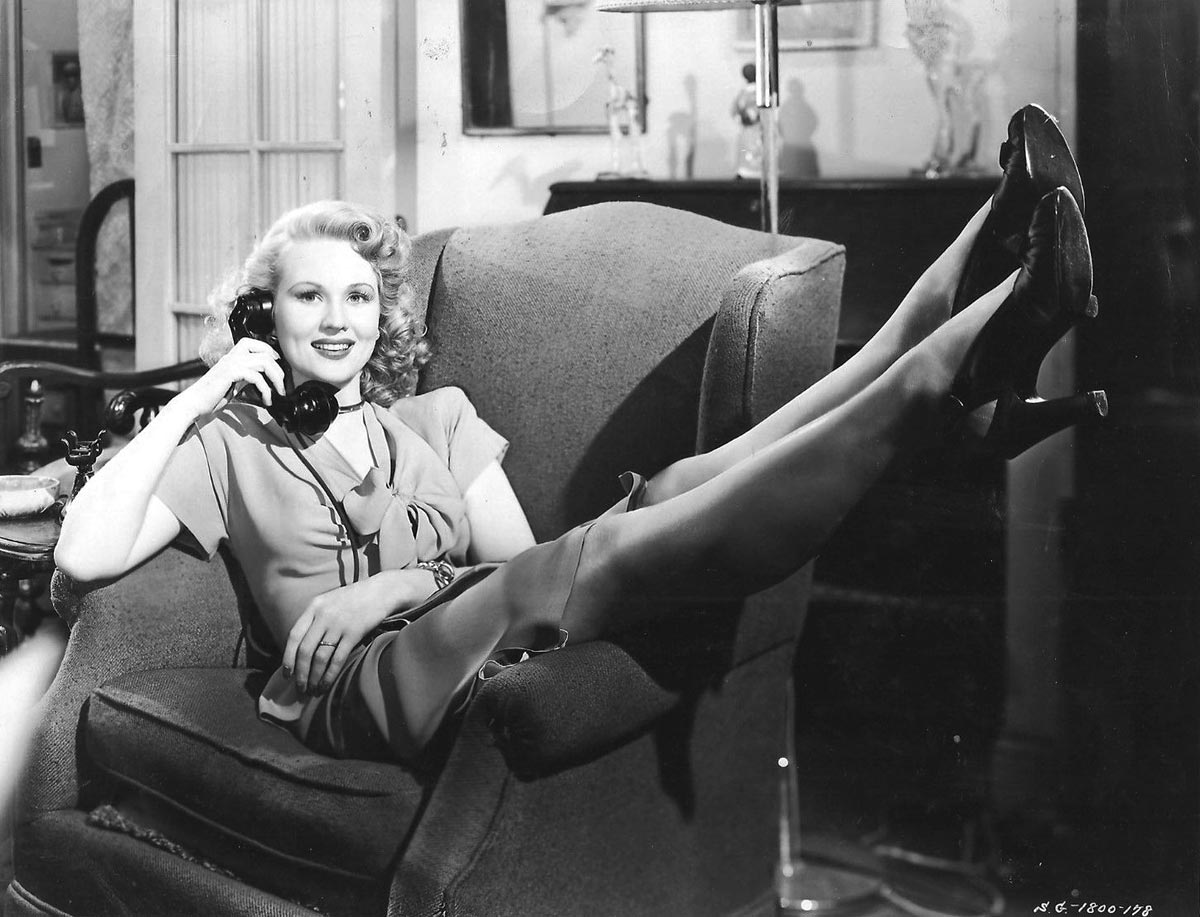
But for now, Peggy is waiting outside, not quite yet the potential “home-wrecker,” and then Fred realizes the door is open anyway. It’s funny to him, all that buzzing and waiting outside this door that is actually open, but it’s obviously a portent of how he doesn’t really want to be there – this isn’t his place, and who is his wife? Who is she really? Fred wakes up Marie (Virginia Mayo) his hotsy-totsy blonde prize who greets him excitedly (“Oh, you’re marvelous. All those ribbons! You gotta tell me what they all mean!”) – but that thrill will be gone soon. Fred, who was a soda jerk before he left, is having a hard time finding a better job and returns to the drugstore – he’ll be an assistant to the floor manager and work part time at the soda fountain. Doesn’t matter how much he made in the Air Force and how decorated he is – how much he sacrificed for the country – the outside world doesn’t seem to care – something veterans continually feel to this day. But Marie sure likes his uniform. He’s so handsome and impressive in it. She wants her friends to see. He’d just as soon never look at it again. Marie just doesn’t get it – how can a man so handsome and impressive want to hang his uniform in the closet? And how can he make so little? Marie quits her job but misses the money and the excitement – she doesn’t want to sit at home while Fred cooks here up a can of soup. We could demonize Marie as the floozy, the awful wife, and given what Fred is going through mentally and indeed, in the real world, it’s hard to sympathize with her. But, clearly, these two should never have been married. Her sexy picture was likely more meaningful to him during the war than the woman in the flesh. And it’s not just that we suspect her of being untrue that makes us dislike her, it’s more that she bought into this dumb, glamorous notion that her hunky, decorated veteran husband would be a show piece. It’s all looks to her and, hopefully, dough. It’s this American Dream – it’s not going to work out for her in the end.
And then, soon enough a snake-in-the-grass named Cliff shows up (Steve Cochran – perfectly cast, he was also Mayo’s lover in White Heat) and Marie barely makes an effort to hide what’s going on. It’s interesting in this moment that, when Fred sees that Cliff is a fellow serviceman – it really doesn’t mean anything – maybe for a brief second, but not all of these guys want to talk or have anything to do with one another. Yes, he’s probably sleeping with his wife, but you get the sense Fred wouldn’t like this man anyway:
Fred: Another ex-serviceman, huh?
Cliff: Greetings.
Fred: Have you had any trouble getting readjusted?
Cliff: Not in particular. It’s easy if you just take everything in your stride.
Fred: That’s what I’ve heard.
Cliff: Be seeing you.
Fred: I doubt it.
Marie, all puffed up and pissed, then says she’s getting a divorce. It’s an aggressive move, and she spits out some mean words to him, but it’s the right move. She even states the title, in a moment that seems like the world is hollering at Fred. Fred is searching. He’s trying. He’s not simply winning (to use a terrible word of the now). Marie, and the harsh, shitty, hollering world don’t like that. “I’ve given you every chance to make something of yourself!” she snaps, “I gave up my job. I gave up the best years of my life! And what have you done? You’ve flopped.” How many times has anyone depressed heard that one? And especially returning vets who are supposed to fulfill some stereotype of masculinity? “Can’t you get those things out of your system?” Marie asks. Oh, sure. That’s so easy.
He’s depressed, but he’s now able to find himself without her butting in, and that’s something. And yet, this mean recrimination from this shallow woman (you get the sense Marie might understand things better when she herself goes back into the tough side of life and Mayo offers glimpse of that under her brassy performance) is one thing that will free Fred from giving a shit about her or about the absolute importance of making it big, whatever the hell that means, or if he even cared in the first place. Why should he? This is what he should feel patriotic about? This? What he came home to? Not just this woman but everything she represents and that he should just, as she said: “snap out of it.” As played by Andrews, Fred is a little mysterious in just what he wants, and even with the challenges so obviously in front of him, making his dilemmas all the more provocative. As we’ve seen him suffer wartime nightmares, endure the indignities of the soda fountain, loss of income to the indifference of his civilian employers and co-workers, and, in a stunning culmination of all this, his tour de force flashback inside the cockpit sitting in a graveyard of bombardier planes, Fred is still a bit enigmatic. Andrews is tight lipped and manly but warm and vulnerable. Peggy saw this right away and understood. And cared. Marie did not.
The women in The Best Years of Our Lives may have been waiting and longing for their men to return, but they’re also assertive, real people. Peggy is going to break up that damn marriage (for a spell – Marie will break it up for her), Milly faces off to her daughter, very honestly, with the admission that she and Al have almost called it quits before, and even sweet Wilma is pushing, pushing to Homer. She’s dying to be with him so much, that, in the film’s most intimate, romantic scene – when he shows her how he removes his hooks before going to bed –she buttons up his pajama top, no hesitation. In her own quiet way, Wilma has been screaming at Homer that she’s not just a kid, that she can handle it, that she loves him, that she’ll never leave him.
We hope she never leaves him. The movie ends with Homer and Wilma’s wedding and a gorgeously composed shot (cinematographer Gregg Toland – brilliant throughout) of their vows, while Peggy and Fred gaze at each other. They’ll end up together too. Is it a happy ending? Yes. But the future? We’re not so sure. Nothing will be easy, and the idea of home, even as solid as the more loving couples appear, is still a sort of dream. And they will likely continue to search for that dream. It may continue just as Al asked: “You know, I had a dream. I dreamt I was home. I’ve had that dream hundreds of times before. This time, I wanted to find out if it’s really true. Am I really home?”
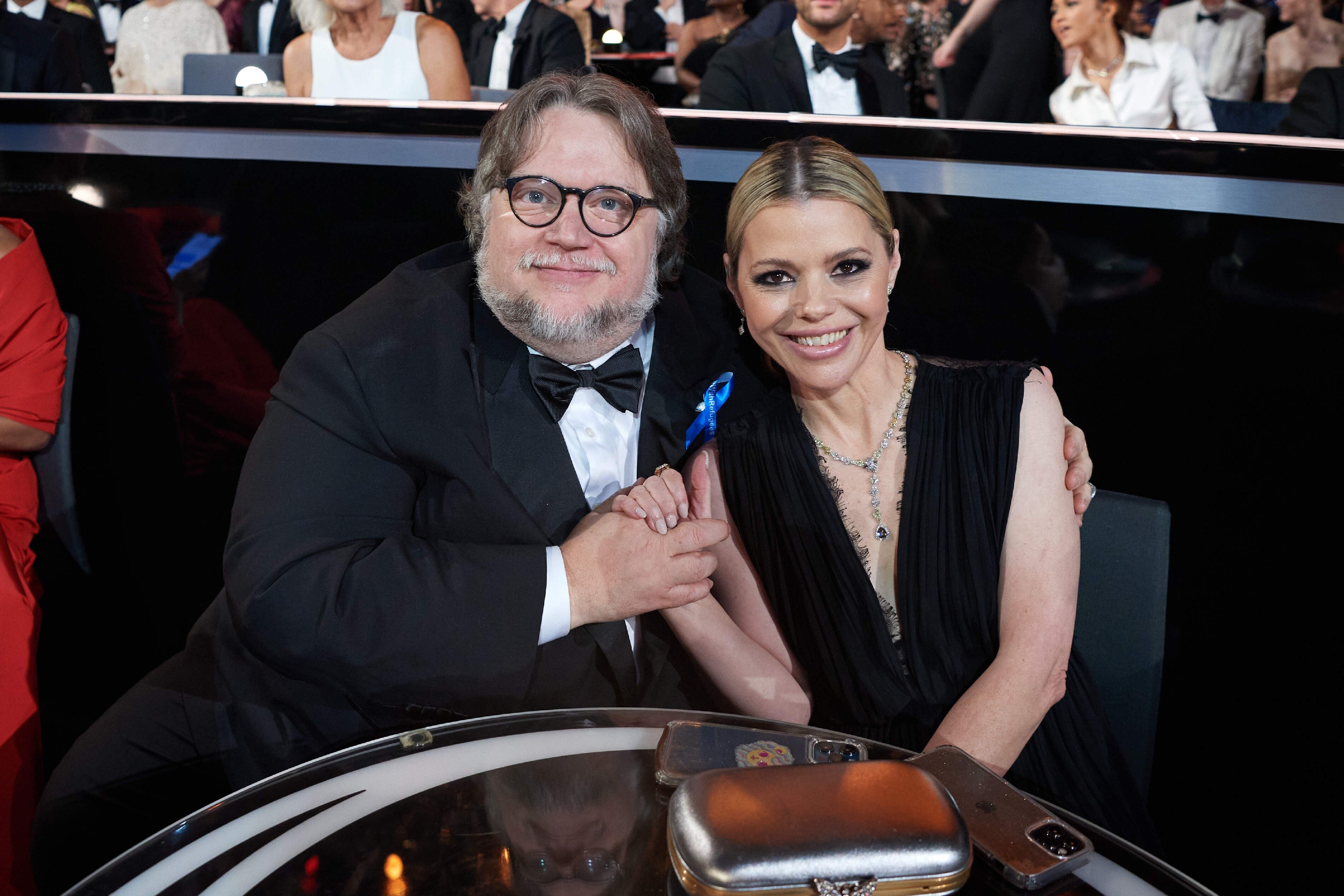
Guillermo and I at the 94th Academy Awards where Nightmare Alley was nominated for Best Picture. March 27, 2022.
(photo credit: Age of Stock: Oscar® nominee Guillermo del Toro and Kim Morgan during the 94th Oscars® at the Dolby Theatre at Ovation Hollywood in Los Angeles, CA, on Sunday, March 27, 2022.)


 When cynical, seen-it-all Eleanor (could she even be described as a housewife?), is asked to describe her missing husband to suspicious detectives, she answers: “I haven’t been able to for a long time.”