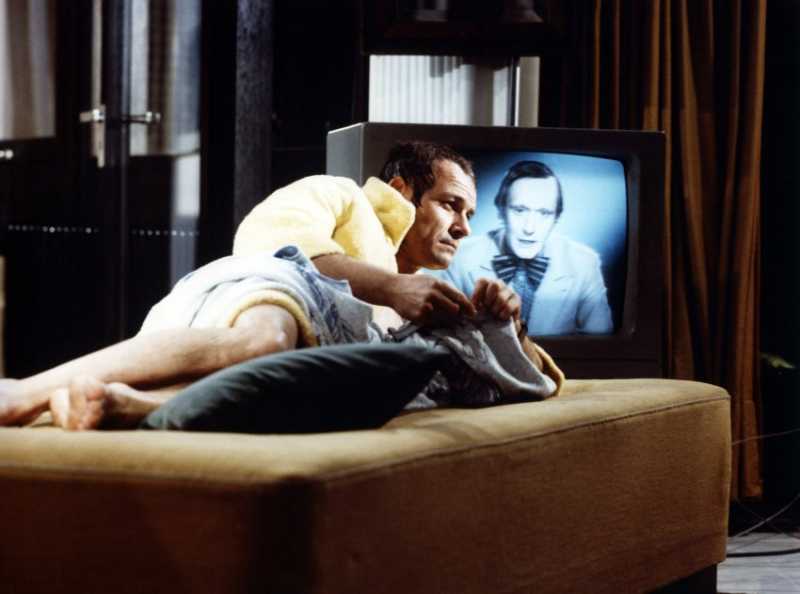
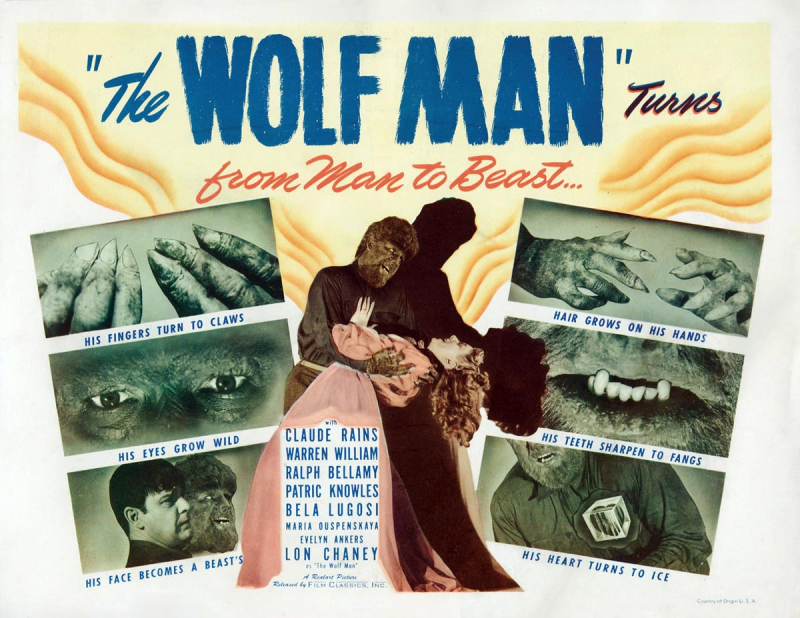
A Family Tragedy: The Wolf Man

6a00d83451cb7469e201b7c92bb5e1970b-800wi

Even a man who is pure in heart, and says his prayers by night; May become a wolf when the wolfbane blooms and the autumn moon is bright.

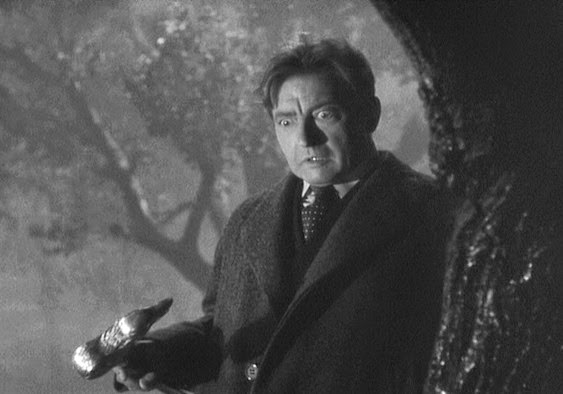
Lon Chaney Jr. does not look like the son of Claude Rains. Not only does he not look like Rains physically, with his tall stature and everyman awkwardness, but with his voice, his sometimes-lumbering carriage, his lack of suaveness and his sad, lost eyes that seem to be perpetually looking for a father figure, or a lover, or a soft bunny rabbit to hold –  anything to sooth what haunts this man underneath his “normal” exterior. Something is missing within him, and we’re not sure what, but in Chaney Jr.’s best performances, that lost boy quality makes him immensely moving (watch Lewis Milestone’s Of Mice and Men). And, so, in George Waggner’s The Wolf Man, Chaney Jr.’s genetic disparity with elegant Rains works – it immediately sets up a distinction with a dad he left (fled from?) eighteen years earlier for reasons we’re not entirely certain of, and it makes us sympathetic to both him and his father – a father who is quietly grieving the loss of his older son. The Claude Rains dad (Sir John Talbot) clearly loves the Chaney Jr. son (the very average-Joe-named Larry), even if his son is, perhaps, the black sheep of the family, the outcast, and the father has a feeling why his son took off all of those years ago: sibling rivalry. Perhaps he’s right. Perhaps not? We don’t know. It takes the death of Larry’s brother (who looks exactly like Larry) to make him return with the idea to run the estate. Is that the only reason? Did he really miss his father? Why on earth was he gone for nearly 20 years? Is there something wrong … with him?

Wolf man 12

In the movie’s opening scene between Larry and Sir John, father discusses his living son’s estrangement frankly, something that could seem obvious; to be spelling it out so succinctly, but is instead, refreshing in its simultaneous directness and mystery. Sir John dives right into the possible wedge between them and wishes it would cease, but it’s from Sir John’s viewpoint, and we never learn what Larry might have endured. Perhaps the home life was awful. Perhaps his brother was a terrible person.  As Sir John pokes at a fire in his grand, Welsh estate with the dead older son, John Jr.’s, portrait hanging ominously above, Larry sits down and listens to the psychological musings of his father. Rains talks with him, not angrily, just directly, and it’s a nicely realized moment:

Sir John: You know, Larry, there’s developed what amounts to a tradition about the Talbot sons. The elder, next in line of succession and so forth is considered in everything. The younger, frequently resents the position in which he’s found and leaves home, just as you did.

Larry: Yes, but I’m here now.

Sir John: Fortunately. But isn’t it a sad commentary on our relationship that it took a hunting accident and your brother’s death to bring you?

6a00d83451cb7469e201bb09ced804970d-800wi

Reading this could almost sound passive-aggressive, but it’s not. Rains’ crispness and warmth is merely telling his son the way he sees things, that he’s thought about this, and that he takes the blame too. In terms of his child-rearing and what has been expected of the sons, Sir John continues:

Sir John: The whole tradition is the Talbot’s be the stick necked un-demonstrative type. Frequently this has been carried to very unhappy extremes.

Larry: Don’t I know that…

Curious. What does Larry know so well that he utters this immediately? That the unhappy extremes resulted in him leaving for eighteen years? Just that? That he was competing with his brother and that was too much for him so he needed to set himself apart from the family (that is the obvious answer). But to the film’s credit (and Curt Siodmak’s wonderful script), there’s more here for us to ponder, for instance, is there something darker and more dramatic going on in this family? In Larry himself? In his father? Those uncertainties hang over the picture with an enigmatic question mark, and are never solved, making the character’s actions and unlucky predicaments intriguing all the way through – even in more staid moments. The picture is filled with a foggy, dreamlike beauty (and creepiness, shot by cinematographer Joseph Valentine), that reflects the dreamy beauty and creepiness of Larry and Sir John, their questionable family history and maybe even their minds. The loveliness and horror of the environment mirror what Sir John discusses about the duality of man, and, perhaps, how Larry’s been submerging baser, wolf instincts into a foggy underworld – before he even becomes a werewolf.

7830

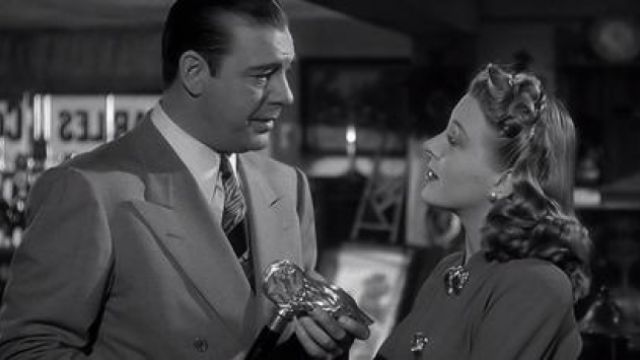
Putting aside the folklore turned into the literal lycanthropy, Larry is already revealing wolfy aspects to his personality – which are quite normal. Only with Larry, this seems a bit off. Look how he tries to pick up pretty Gwen Conliffe (Evelyn Ankers), for instance. He’s pushy, slightly immature and a little creepy. He watched her through a telescope and fixated on her earrings (moon earrings), which he brings up to her as a supposedly charming thing to do –  being a Peeping Tom. In the early 1940’s this might pass as normal flirting for men (spying), even if women were made uncomfortable by it, but with Chaney Jr., it plays in the movie like a clunky pass. We’re almost cringing. She’s not sure about him not only because she has other suitors, but because… he’s this weird guy trying to be normal. You already know he’s not going to get the girl. And, yet, he’s sympathetic, lovable (she feels he is, too, and is indeed, drawn to him), and even tragic at that point. As her boyfriend (Frank Andrews) says later after meeting him: “There’s something very tragic about that man and I’m sure that nothing but harm will come to you through him.

6a00d83451cb7469e201b7c92bb628970b-800wi

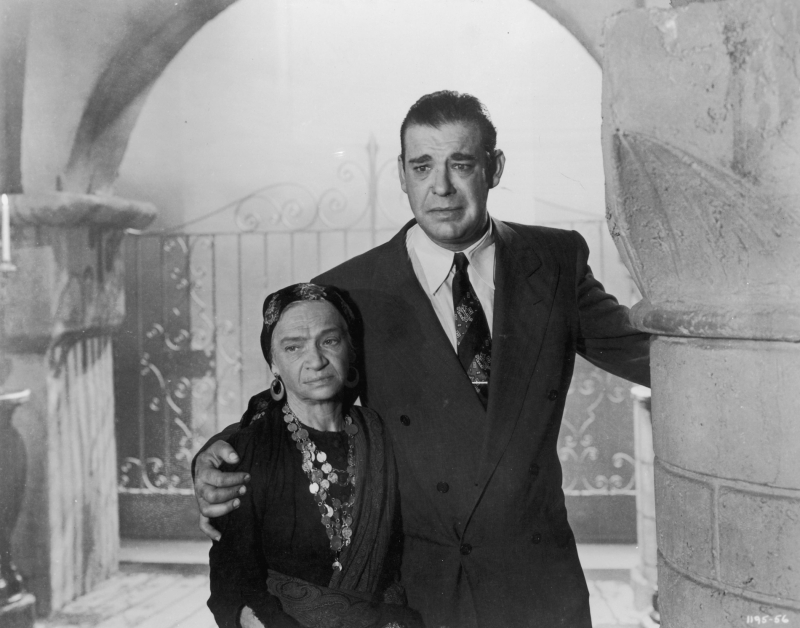
Those themes of marked tragedy and duality are also carried over into the fascinating gypsy characters, fortune teller Maleva (Maria Ouspenskaya) and her son Bela (Bela Lugosi), who in so many ways merge with the family Talbot – Sir John and Maleva. Both have afflicted sons with dual natures they cannot control (and conditions that are not their fault), both have quite a few thoughts about it, and both sons will die. Sir John believes in science, god and psychology; he believes men can be so influenced by superstitious folklore, and that a normal individual can imagine himself so strongly that he thinks he’s becoming a monster. Maleva believes in the folklore, for she has seen it first-hand, but her acceptance and directness, and also the protection of her son (which leads to an attempt to protect Larry – as much as she can), mirrors Sir John. The toney Welsh family and the traveling gypsies are not too far removed – they are individuals and they are unique. They stick out. You get a sense many in the town suspects something about the Talbots in a negative way (cursed?), and in the gossipy townsfolk’s busy-body averageness, they talk about it. When Larry does in fact turn into the Wolf Man and wreaks havoc at night, some are quick to “know” – to know something; that they suspected murder within this family in the first place. And without proof. One woman sneers: “Very strange there were no murders before Larry Talbot arrived… I know what I know. You should have seen the way he looked at me in Conliffe’s shop. Like a wild animal. With murder in his eyes.”

Wolf-man7

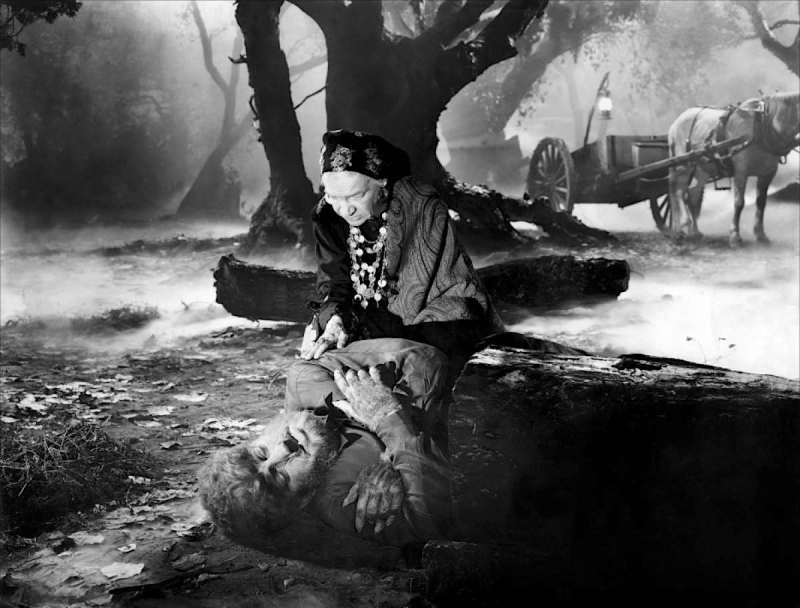
When Larry pushes himself on a date with Gwen and, accidentally, with her friend, Jenny (Fay Helm), he skulks out at night to meet her as she leaves work – essentially crashing the girl’s night out. Kind of a drag. But they all go along, seemingly happily. The threesome venture out to Maleva and her son, Bela, for the thrill of fortune telling, but as Bela is clearly suffering, Jenny is soon killed by him. Bravely, Larry attacks Bela, whom he sees as a wolf, but he sadly cannot save Jenny. To Larry he has killed an animal who has bitten him, and that is that. Not so. In a portentous moment, he’s already heard about the werewolf curse and bought the wolf cane from Gwen’s antique story (this wolfish flirtation sets Larry right on the road to becoming a Wolf Man, with Gwen explaining the curse, little does she know at that point), and bludgeons the wolf with the silver-tipped cane. Things get complicated when Colonel Paul Montford (Ralph Bellamy) and other’s investigating see that he’s actually killed a man, poor, tortured Bela, instead. Dr. Lloyd (Warren William – this is a terrific cast) suspects he might be crazy. It’s not a ridiculous thing to suspect. Sir John expresses anger over the idea that Larry should be locked up, and in an enlightened way, believes men are murky creatures, expressing this thought frequently. Larry will soon be turning into a werewolf at night, something that is making him terrified and crazed (who can blame him?) and he expresses his horrible fear to his father. Sir John’s answer would be reassuring if Larry wasn’t literally growing hair all over his body (beautifully created, by Jack Pierce), but one can understand Sir John’s thoughts. He says:

6a00d83451cb7469e201b8d2b621a9970c-800wi
“Larry, to some people life is very simple. They decide that this is good, that is bad, this is wrong, that’s right. There’s no right and wrong, no good and bad. No shadings in grey. All blacks and whites … Now, others of us find that good, bad, right, wrong, are many-sided, complex things. We try to see every side. But the more we see, the less sure we are. Now you ask me if I believe a man can become a wolf. Well, if you mean he can take on the physical characteristics of an animal, no. It’s fantastic. However, I do believe that most anything can happen to a man in his own mind.”

Indeed, they can. And, so, even as we watch Larry turn into a werewolf, we can imagine that he is, in fact, losing his senses. That this is all some horrific fantasia – as if he’s a wolfish drug addict, waking up with animal prints in his room, passed out in his clothes, not sure what he did the night before but feeling immense guilt over it. As his father said, “It’s a legend. You’ll find something like it in the folklore of nearly every nation. The scientific name for it is lycanthropia. It’s a variety of schizophrenia.” You half believe Sir John, even as you know you are watching The Wolf Man (a movie crafted from mythology, but a story all its own – there was no source novel for this one, it was Siodmak’s creation). With insanity and surreality in mind, the sequence of Larry’s first transformation and subsequent attack is hallucinatory, stressful and weirdly lovely. He rushes home and begins removing his clothes –  bursting, a literal fever dream. He then sits in a chair and it is there when we see his transformation beginning, but, not with his face as we might expect (a la Dr. Jekyll and Mr. Hyde, as this story resembles), instead, we see his legs and feet changing: they are slowly covered with hair. Larry is visibly distraught by the freaky body conversion – he’s caught some new sickness brought on by the werewolf curse (but perhaps brought on by his mind), and he’s losing his mind. We feel for him. As we look at his two feet on the floor grow hairier and hairier, Larry then stands up and, in a touch that is strangely beautiful and even vulnerable, we watch Larry walking on his tip toes.

The-Wolf-Man-Feet

The picture transitions to just show Larry’s feet and lower legs again, now out of his room, and walking on those tip toes in the foggy forest. His careful movements are intriguing –  he is walking almost gingerly, like on eggshells, and these movements are a touching thing to behold. Even as the Wolf Man there is something sad and careful about Larry. As the camera moves up, we see Larry in his full transformation – hunched over, face full of hair and wolf-ishness, he wanders through the miasma looking for, what? Seeing him peer from around a tree and growl, he’s both scary and something from a dream – he’s even gorgeous in this man-animal creation. The fog and the studio crafted woods are not at all real, nor should they, adding a sense of illusory mystification to Larry’s state. When he attacks the grave-digger, we’re sorry for both poor fellows.

6a00d83451cb7469e201b8d2b621c1970c-800wi

And on it goes, more and more Larry is suffering and panicking and trying his hardest to tell his father to help him –  that this werewolf curse is real. What’s so interesting about this 1941 story is that we can’t fault Rains’ Sir John for his comfort towards Larry – a person would think they were crazy, even if they know the affliction is real, and it’s good that someone tells them they can cure themselves at home. That could be what one wants to hear. And why would Rains believe this mythology? It’s hard to find blame in this film – there are no bad guys. So in an unintended ultimate family showdown, perhaps manifested from resentment or guilt or hatred, whatever that mysterious question mark is hanging there between father and son, and which reigns so powerful over this movie, Sir John will wind up killing his son. On accident. A sort of hunting accident, as he believes Larry to be an animal, like how his previous son died. And he’ll enact exactly what his younger son did (kill a wolf that turned out to be a man) and with his son’s own cane. From son to father.

6a00d83451cb7469e201b7c92bb68f970b-800wi

The Wolf Man, in the end, is not really a terrifying movie, it’s a family tragedy, superbly acted by Chaney Jr. and Rains, and a movie that is, in the end, terribly sad. With Rains realizing he’s killed his own son, Maleva’s poetic mediation becomes all the more moving: “The way you walked was thorny, though no fault of your own, but as the rain enters the soil, the river enters the sea, so tears run to a predestined end. Now you will have peace for eternity.”

From my piece for the New Beverly.

Kill Or Be Killed: Who Killed Teddy Bear

6a00d83451cb7469e201b7c92806ce970b-800wi

Ed Brubaker's newest Kill Or Be Killed is still out. I wrote a piece digging into Joseph Cates' strangely beautiful, disturbing, "Who Killed Teddy Bear?" featuring a brilliant, daring Sal Mineo. Pick it up or order here: https://imagecomics.com/comics/releases/kill-or-be-killed-12

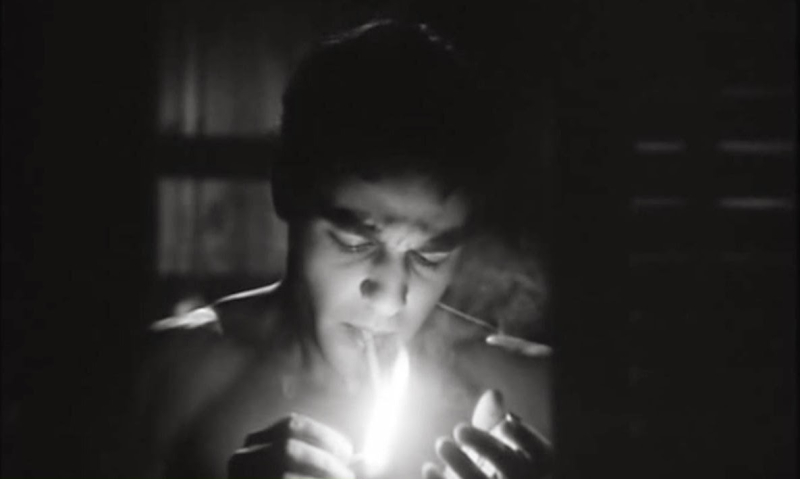
“I played a telephone freak, and we were having this hassle with the censors. In some of the shots while I was on the phone they wanted to sorta suggest that I was masturbating, but I couldn’t be naked. So I was just wearing jockey shorts. It turned out that was the first American film where a man wore jockey shorts on-screen.” – Sal Mineo “I was a lesbian owner of a disco who fell in love with Juliet Prowse and got strangled on Ninety-third Street and East End Avenue with a silk stocking by Sal Mineo. Jesus, who’s not going to play that part?” – Elaine Stritch

6a00d83451cb7469e201bb09cb2663970d-800wi-1

Joseph Cates’ Who Killed Teddy Bear? is a movie that lives in its own kind of sickly stunning, neon-blinking 1965 New York City nightfall – a terrifying and terrified world that’s drawn towards deviancy while desperately running from it. A world that punishes perverts via men who become so obsessed with punishing perverts, that they become perverts themselves; and perhaps even more demented than the nutjobs they bust. A world that observes the beauty of the pursued, but relishes, indeed pants over the beauty of the pursuer, focusing very specifically on the physicality of the depraved. And that’s a depraved Sal Mineo, which is really something quite unique and disquietly beautiful here…

Read more in that issue here.

A Scarf: The Panic In Needle Park

6a00d83451cb7469e201b7c9280642970b-800wi

Helen: I don’t like to wake up alone.

Bobby: I don’t want you to. But it happens sometimes.

The smallest thing can change a life forever. In the case of Jerry Schatzberg’s The Panic in Needle Park, it’s a scarf. A thoughtful moment in which one stranger gives a shit about another, and just for a mere few seconds, the stranger’s scarf warms the young woman who lies shivering on a bed, bleeding, in full view of her insensitive boyfriend. It’s a much-appreciated gesture of kindness after this woman has sat cold and in pain on a grim subway ride after having an abortion. There’s something extra sad about a woman taking a subway back, alone, from such a procedure (no one came with her? Did she want to be by herself?) and writers John Gregory Dunne and Joan Didion well understand this (think of Maria’s trip to the abortionist in Didion’s Play It As It Lays, the novel and in Frank Perry’s movie). We don’t know what’s happened to this woman when we first see her in that tube, but that she looks troubled and in pain, emotionally and physically, as she hangs on to the pole. She’s grateful just to sit down once the crowded passengers exit to the next stop and she catches her breath, looking not just sad but . . . this is my life right now. That kind of a look. It’s not a long scene, but it opens the film – a solitary woman likely thinking of her bloody, gunky insides that could have held a baby, whether she wanted the baby or not, and wondering how she’s going to get through this, as she speeds along surrounded by glass and metal and plastic, full of people thinking of their own lives.

6a00d83451cb7469e201b8d2b26ce7970c-800wi

The scarf is a bonding, romantic moment for a lonely person, she can feel a part of him as she nestles it close to her face. Lonely people need each other – that’s a given – but according to many theories, lonely people, when given the opportunity, feel they need drugs, and more and more drugs. Johann Hari, who wrote “Chasing the Scream: The First and the Last Days on the War on Drugs,” wrote about such studies, citing Professor Peter Cohen who argued that “human beings have a deep need to bond and form connections. It’s how we get our satisfaction. If we can’t connect with each other, we will connect with anything we can find – the whirr of a roulette wheel or the prick of a syringe. He says we should stop talking about ‘addiction’ altogether, and instead call it ‘bonding.’ A heroin addict has bonded with heroin because she couldn’t bond as fully with anything else. So the opposite of addiction is not sobriety. It is human connection.
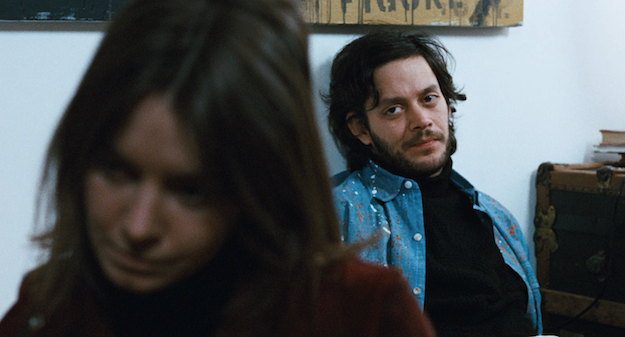
1468647557_2

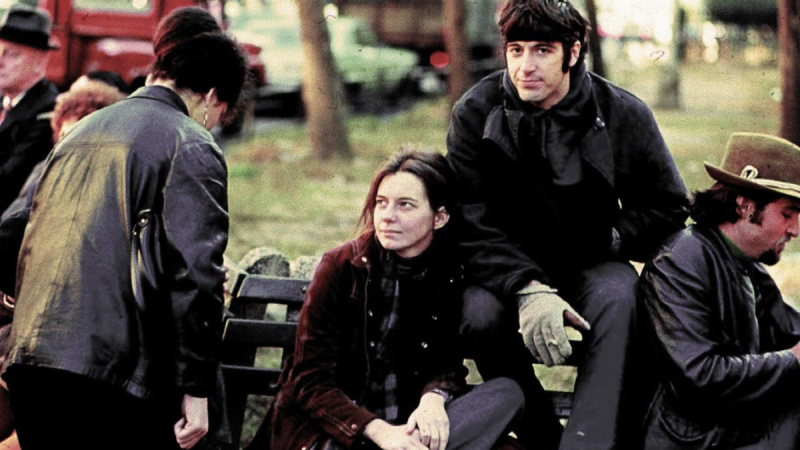
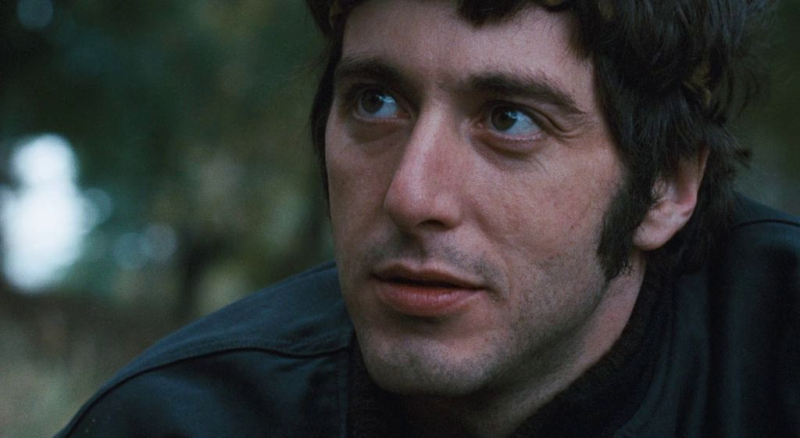
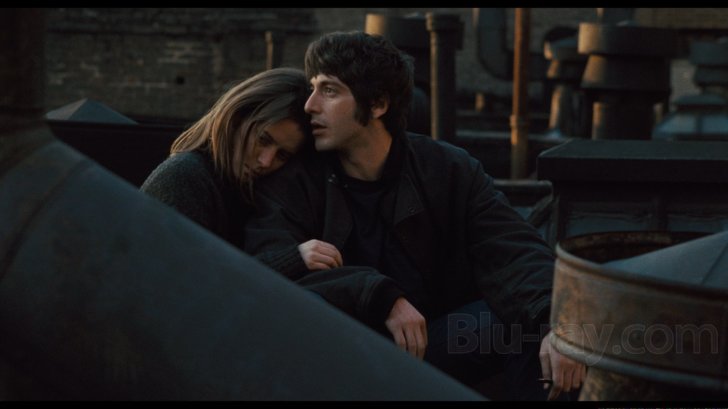
That young woman on the subway, Helen (Kitty Winn), will become connected to the young man with the scarf, Bobby (Al Pacino), pulled in by his sweetness and charm, his streetwise beauty, his bad boy strut that’s overcompensating a bit – he needs to seem tougher and cooler than he is – and eventually she’ll be seduced by the heroin that’s keeping him together.  The drug will rule everything in their lives, where they live, how they work, who they’re friends with, and the effects of the drug, that warmth that spreads through you and cradles you into narcotic consolation, must be there. You feel adrift and alone enough, the overwhelming hug of heroin becomes more important than your boyfriend’s hugs – and if your boyfriend is doing it too, he understands the persistent need – he needs it too. So finding your drugs and fixing each other makes you the Bonnie and Clyde of junk, bonded, together until the end, you think. Until the stuff makes you rat the other one out.
6a00d83451cb7469e201b8d2b26d01970c-800wi
Bobby not only gives Helen his scarf, he visits her in the hospital (“I come for my scarf” he says sweetly, not at all coming for his scarf but to see this “terrific looking chick” again). The bleeding has become so bad that she checks herself in and she lies in bed thinking of her next move. Fort Wayne, Indiana she tells Bobby, that’s where her family lives. Presumably, she’s at the end of her rope in New York City, dating an artist (a memorable Raul Julia in a small role) and hobbling to the emergency room by herself. But Bobby’s outside the place waiting for her (sometimes that means nearly everything if someone is simply waiting for you) so when she walks out of the hospital and sees him there that is . . . it.  She’s fallen for the guy. The Panic in Needle Park is, after all, a love story, and the beginning of Helen and Bobby is poignantly romantic, the sincerity of how Bobby (the way he looks at her with his beautiful brown eyes) feels towards pretty Helen who looks like a “nice” girl (the idea of what that means anyway), the quiet, artistic girl everyone probably had a crush on in high school. Helen’s a little more complicated than that stereotype, just as Bobby’s not merely the bad boy, he’s not just a nice guy either, and the performances by Winn and Pacino get that – they are everyday people and addicts and they are absolutely compelling to watch

Panic-2-590x320

Schatzberg’s gritty, documentary-style picture, his second movie (shot with cinematographer Adam Holender, who also shot Midnight Cowboy), doesn’t flinch from the needles in arms, crying babies rolling on seedy mattresses and wiped-out junkies, of all ages, passing out on park benches or mumbling about election years causing the panic of product (“What election?” “I don’t know man, some election.”) Schatzberg had done a lot of living himself at that point, an acclaimed photographer of fashion, street and portraiture (he famously shot Bob Dylan’s cover of “Blonde on Blonde”), the man had snapped everyone from Edie Sedgwick to Andre De Toth to the Rolling Stones to Phil Ochs to LaVern Baker and more. His first film, the striking, experimental character study about a troubled ex-model, Puzzle of a Downfall Child, was based on a model he knew and starred an actress he also knew quite well, and shot beautifully (an excellent Faye Dunaway). With Panic, the director showcases his talent for street photography and filming faces and (as I stated in my piece on his third filmScarecrow), he loves Pacino (this was Pacino’s first starring role, and it’s brilliant). Pacino’s gum smacking, his expressive face, his charm that’s sometimes dumb and sometimes tender, his anger, his guile, his doped-out stupors – it’s all expressed in a performance that’s both touching and maddening. And likable. You get why Helen is drawn to him. And you get why he’s drawn to Helen. Winn, wonderfully understated and a little shy, has those faraway eyes that evoke, simultaneously, a fresh start and some kind of terrible past. They both look like people you might know.
6a00d83451cb7469e201b7c92806a2970b-800wi

In an interview with Dazed, Schatzberg was asked about the picture’s unflinching realism. He said: “At that time in New York in the 70s, you could see people shooting up in the alleyways. Joan Didion and John Dunne adapted the book ‘Panic in Needle Park’ for the screenplay [by James Mills]. Needle Park was Sherman Square, at Broadway and West 70th, and it was popular because it was where young white addicts could get drugs without going to Harlem. Keith (Richards) was funny – I knew the Stones, I’d photographed them a lot, once dressed as women – and they were in Cannes when I was there with Panic in 1971. Keith said to me, ‘Hey, are you on the hard stuff?’ pointing to his arm, and I said ‘No.’ He said, ‘Then how come you can make a film like that?"
Panic_in_needle_park

Schatzberg made it by observing other addicts (with Pacino), and probably from people he’d met shooting and running clubs, and, as a great photographer, simply looking at life around him. He shot it in Sherman Square (called Needle Park) where the film’s junkie family congregates, going on about their own dramas and stories, present and past, telling, often, banal stories or talking nonchalantly about things that would shock others with horror. The lifestyle and this family start catching up with the couple and Bobby’s burglar brother, Hank (an incredible, creepily handsome, lizard-looking Richard Bright) wants Bobby to work with him after Bobby intends to marry Helen (this is after she starts shooting up, I guess Bobby thinks this makes it official). Helen tries to work at a diner (she’s useless, she can’t get hot chocolate and jelly donuts right) and she walks off the job. A lot happens – Bobby ODs and almost dies, he gets arrested, he starts handling distribution (a big deal to him), Helen sleeps with Hank (she tells Bobby later who really wishes she’d kept that information to herself), and Helen hooks. As all of this is happening they’re under the eye of a Narcotics Detective, Hotch (Alan Vint), who keeps telling Helen that all junkies will eventually rat each other out and he encourages her to rat out Bobby. Hotch always seems to be there, not just to bust them, but to puncture the romance, the whole idea of together, forever – in dope sickness and in health.
6a00d83451cb7469e201bb09cb25fd970d-800wi

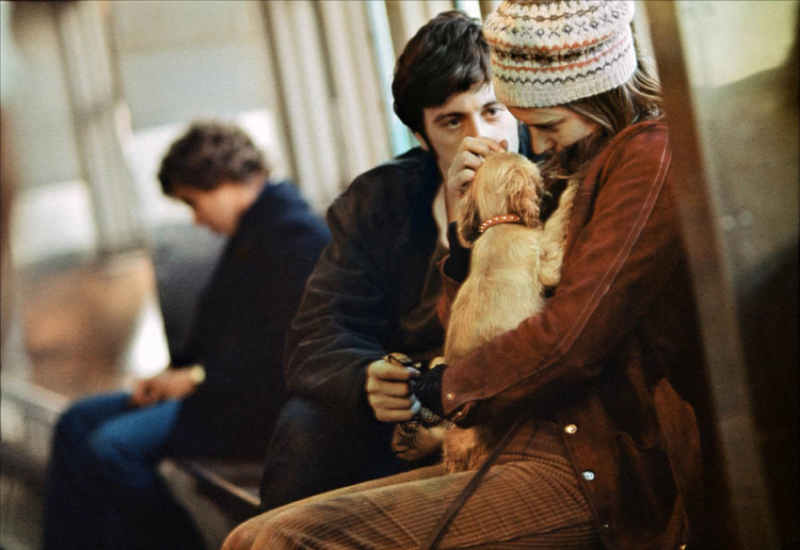
After a lot of hell, and with future hell ahead of them, they buy a puppy, and you know that poor puppy isn’t going to have a normal family life, or a long life for that matter. Roger Ebert, who lauded the movie, didn’t like the puppy bit at all and wished the film had axed it. I’m not sure why, other than it’s a heartbreaking interlude on a ferry where, yes, after Bobby and Helen fix in the bathroom, the puppy jumps off the boat and drowns. Helen cracks and who can blame her? It’s certainly obvious Helen wants that puppy for something innocent and warm to hug, another form of family, another creature to stave off loneliness, a thing to care for when she can barely take care of herself, but that obviousness is because this kind of bad decision-making based on emotion, that need to simply hold something sweet, happens all the time. If not a baby, a puppy. And you can almost hear another junkie telling the story, as if this scene was shot in flashback – the saga of the short life of the puppy, an anecdote rambled on about before nodding off on a park bench. I thought of the cat in Trainspotting, a much more elaborate story, but another bad decision: the cat bought for the girlfriend who rejects it and then the poor guy stays in his apartment with HIV, alone, not taking care of that kitty. He winds up dying from the cat – toxoplasmosis. The difference, and perhaps, unexpected tragedy being that the young man doesn’t even die from an overdose – his condition worsens, brought down by the sweet little kitty.

6a00d83451cb7469e201b7c9280696970b-800wi

But the unexpected ending of The Panic in Needle Park is that both Bobby and Helen live. You’re practically waiting for one of them to slip permanently into the abyss and, for a brief moment before expiring, feeling what one of the characters calls the greatest of all highs – death.  But they don’t. And that feels strangely more depressing. Most likely the two are just going to continue on with the same routine. There’s no kind of closure. Helen has ratted out Bobby who winds up in the slammer but in the end, she’s there for him, whether for love or for desperation or for just not wanting to be alone. Or for all of those reasons.  So, there’s Helen waiting for him, the only person to greet him. Almost like romantic, sweet Bobby was waiting for poor Helen when she was released from the hospital, after he visited her playfully looking for that scarf, only now they know each other, there’s no romance in this reunion. Maybe that will dissolve once they shoot up again and they’ll feel good for a while. But for now, Bobby simply says, “Well?” Helen walks along with him. Well, she’s not alone.

From my piece published at The New Beverly
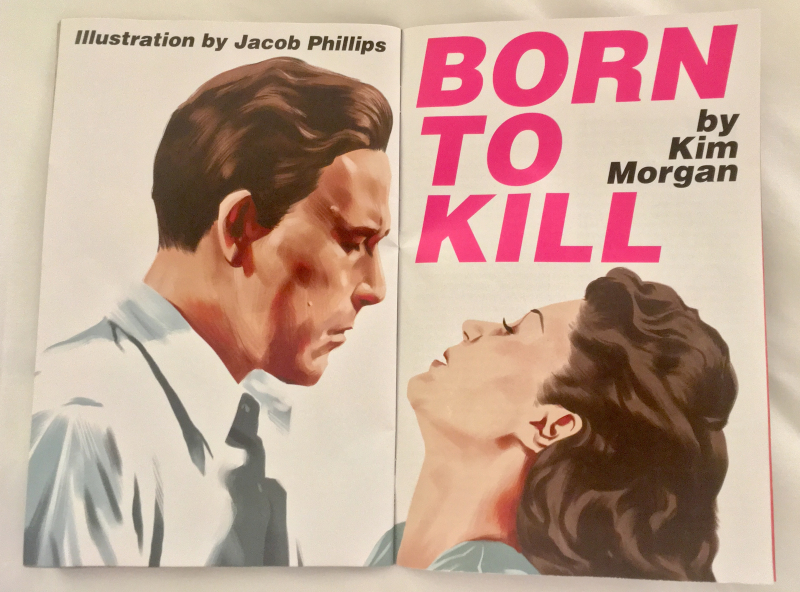
Kill Or Be Killed: Born to Kill

6a00d83451cb7469e201b8d29f4f95970c-800wi

Baby they were born to kill … My essay on Robert Wise's "Born to Kill" starring Lawrence Tierney & Claire Trevor as supreme equals: two fiendish, ferocious creatures. Read it in Ed Brubaker's newest Kill or Be Killed — out now! Order here: Here's a preview:

Between man, woman and movies, you can discover fair practice, of course, but can you find it with such hard- boiled honesty? Not often enough. So enter that brilliant bastard Lawrence Tierney and cool, cool Claire Trevor in Robert Wise's uncompromising, savage noir, Born to Kill to present such a romantically rotten pair with such strangely satisfying equitability. We’ve heard of the femme fatale time and time again – to the point that it almost bores me. Those sweet faced destroyers of dupes. Even the sweet-faced smart dupes who know what they’re in for but don’t care – their lust overrides all. The characters don’t bore me, mind you, it’s just their easy categorization. Many femme fatales are struggling – they suffer with dreams men have, that the world is there for the taking. But the world is not there for the taking, and not always for men either, but to dream of such a thing? That’s abnormal in “normal” society – and I think that pisses them off. Why must they be one of the … normals?

Smile Though Your Heart Is Breaking…

6a00d83451cb7469e201b7c914e933970b-800wi

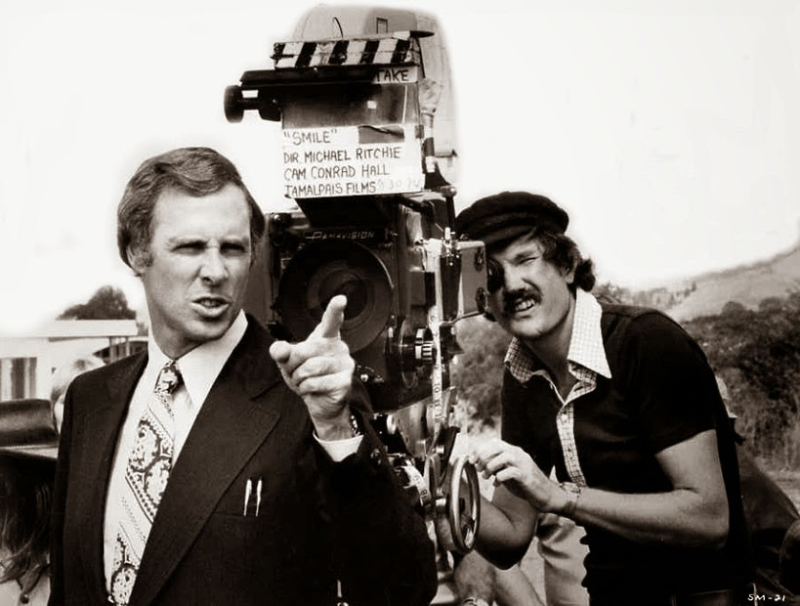
One of the most memorable moments during filming had nothing to do with the movie, but it also had everything to do with the movie. There was a rumor that President Nixon was going to resign. [On that night] we stopped filming. We were onstage at the auditorium and we wheeled in a TV. Everyone watched it and there was a profound silence. It wasn’t a time for cheering. But there was a feeling that we were really doing something, in fact, that was about what this country had gone through.” – Michael Ritchie on his movie Smile

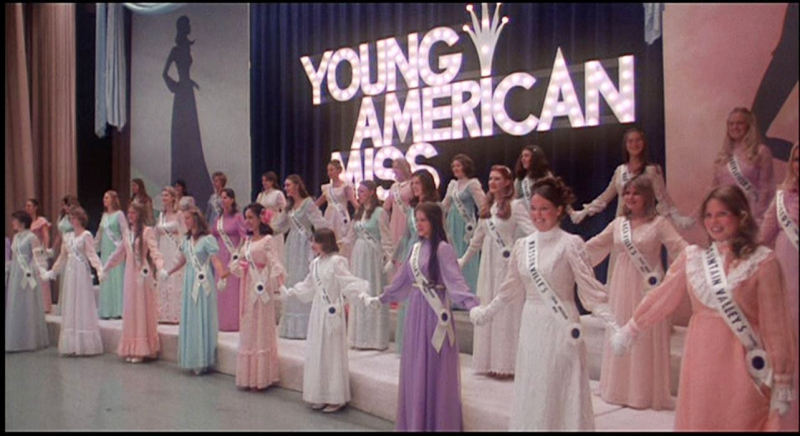
There’s a scene in Michael Ritchie’s satire Smile that fills me with such unexpected emotion, such sympathy, that it stays with me all the way until the end of the movie. It involves Bruce Dern playing a “good” guy – or a guy who prides himself on being a “good” guy in that way people who think they’re good often do. You know, the kind who boast about “helping others,” and encourages everyone else to do the same, and you wonder, do you? Do you really help others? The kind of people you usually don’t trust if you’re a cynic and nod your head while they offer you endless bromides of encouragement. His name is Big Bob Freelander and he’s a successful RV salesman in the town of Santa Rosa California. His son (Eric Shea), naturally, goes by Little Bob. He’s also the lead judge of a national beauty pageant called The Young American Miss, an event that descends on his town every year and something he takes quite seriously. When he’s handed a gold name tag to honor his top judge status (all other judges get silver) he is genuinely proud of this distinction. His profession, the pageant, his name, his values, the décor of his home – these are things that in many comedies, would constitute for a bullseye painted on Big Bob’s back. “Mock me.” But Ritchie (with writer Jerry Belson) isn’t interested in easily demeaning this very American man with his very hopeful American ideals (who, in fact, is trying to help his friend), even as Ritchie’s gently ribbing everything surrounding this man’s life. Instead, he finds it quietly heartbreaking.

Dernsmile

The scene I mentioned involves his best friend, Andy (Nicholas Pryor) who has spent most of the movie in a dipsomaniacal state, disgusted with his life, sick of the town, sick of his wife, Brenda (Barbara Feldon) and hateful of the beauty show. He isn’t buying any of the banalities dished out to him or his suburban existence where, as the camera catches in a perfect shot, a freezer full of TV dinners. He’s not really down with tradition, like creepy rituals involving a chicken (just watch the film), and most especially his wife’s obsession with the beauty contest. Since his wife is the pageant’s crisp, professional Executive Director, this is extra vexing, as his entire life, one he does not want, is centered on this spangled entertainment. And, he makes trophies for a living, if that’s not driving his depression home any further. He’s in the middle of an existential breakdown and he’s turning 35 – that time you start humming along with Peggy Lee’s “Is That All There Is?” with zero irony.

6a00d83451cb7469e201b8d29f3597970c-800wi

Andy is an intriguing character because, in many ways, we’re supposed to relate to him most – we can see why he’s going crazy in this town, we can see why he can barely stand his wife who won’t sleep with him (we can also see why she’s not turned on by a guy who is wasted all the time). He’s the town drunk screaming for us all – what is wrong with you people? But, Smile is not that easy. It’s not using Andy as simply all-knowing shorthand, digging into the banalities of everyone else’s secretly sad lives. What makes him or us so better? Filled with such human characters – from the various judges to the personalities of the teenagers competing in the pageant, to the horny little boys trying to sneak a look at the girls, Smile studies people within this milieu with a kind of documentary detail that humanizes even the most overt assholes. The picture has been compared to both Robert Altman’s masterpiece Nashville and to Christopher Guest’s great Waiting for Guffman, but it’s less ambitious than Nashville, and a lot nicer and deeper than Guffman. It’s also something that feels distinctly Ritchie – the Ritchie of Prime CutThe Candidate and The Bad News Bears – movies that are alternately funny and pessimistic, joyously profane (like The Bad News Bears) while being brutal, adult and smart.  You feel that Ritchie gets these people – and he did – he once judged a beauty pageant himself.

6a00d83451cb7469e201b7c914e908970b-800wi

But back to Andy and that scene. Near the end of the movie, Andy’s had it, his wife has had it with his drunken self-pity, and he threatens to kill himself  – he’s gonna blow his brains out, possibly ruining the fine carpet in their well-maintained home. He shoves the gun in his mouth but Brenda’s contempt causes him to change his mind – he shoots her instead. She isn’t injured badly, and she’s not going to make a thing about it because this should be kept out of the papers! But Andy is placed in a jail cell and he’s talking to Big Bob about his predicament. Bob counsels him:

Bob: Andy it’s very simple. All it takes is a drop more perseverance. A drop more optimism and a drop more energy. Simple.

Andy: Hey. Hey wait a minute. I’ve heard that before.

Bob: Heard what before?

Andy: That drip-drop crap. Brenda read that to me.  That’s right out of the Young American Miss Program.

Bob: A good philosophy is good philosophy and I don’t happen to be a snob about where I get it from. And I can tell you one other thing, as your best friend talking to you right now. Quit wallowing around in all this self-indulgent, self-pity and get out there and start helping others.

Andy: Bob. I’ve finally figured out what you are. You know what you are? A goddamn Young American Miss.

135469b

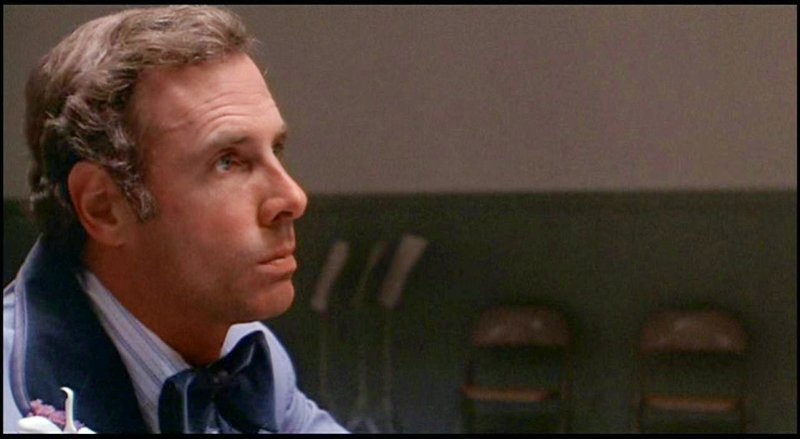
This is the part of the movie where you might think: exactly. Andy has called out Big Bob. In a meaner, easier picture, we might think, good for Andy. Not with Smile. Instead, I felt for Bob. Not only because Andy hurt his feelings, but also because he made him think a bit more (not a bad thing) and sometimes people just don’t want to think, they’d rather escape in their glittering duties – and Dern shows that so beautifully. Bob suddenly turns very inward – we see Dern flinch and without saying a word, he just has this look on his face – of sadness, of emasculation, of offense. But mostly he just takes in what his friend has said, and you can see it got to him. Dern is so excellently layered in this movie, so suddenly afflicted by this conversation, that for the rest of the film he seems troubled and disbelieving of himself. In a previous, beautiful scene, he talks about a time before he was married, when he was nearly set up on a date with Elizabeth Taylor – it’s something he’s wistful about, a kind of glamour he’d never reach, a woman he’d never have (and, in a nice scene, he does talk to his wife about taking a vacation), but it’s not pathetic or silly, it’s just one of those bittersweet moments of a guy living a rather mundane life. So hearing Andy compare Bob to a pageant princess is one of those quietly devastating moments that, when watched in a certain kind of mood, will take you aback and make you think about much of Bob’s attempts to stave off … sadness. And you catch yourself a little, suddenly surprised by how moved you are by Bob. As Pauline Kael said of Dern’s character: “Big Bob speaks in homilies that express exactly how he feels. He’s a donkey, but he doesn’t have a mean bone in his body.”

6a00d83451cb7469e201b7c914e973970b-800wi

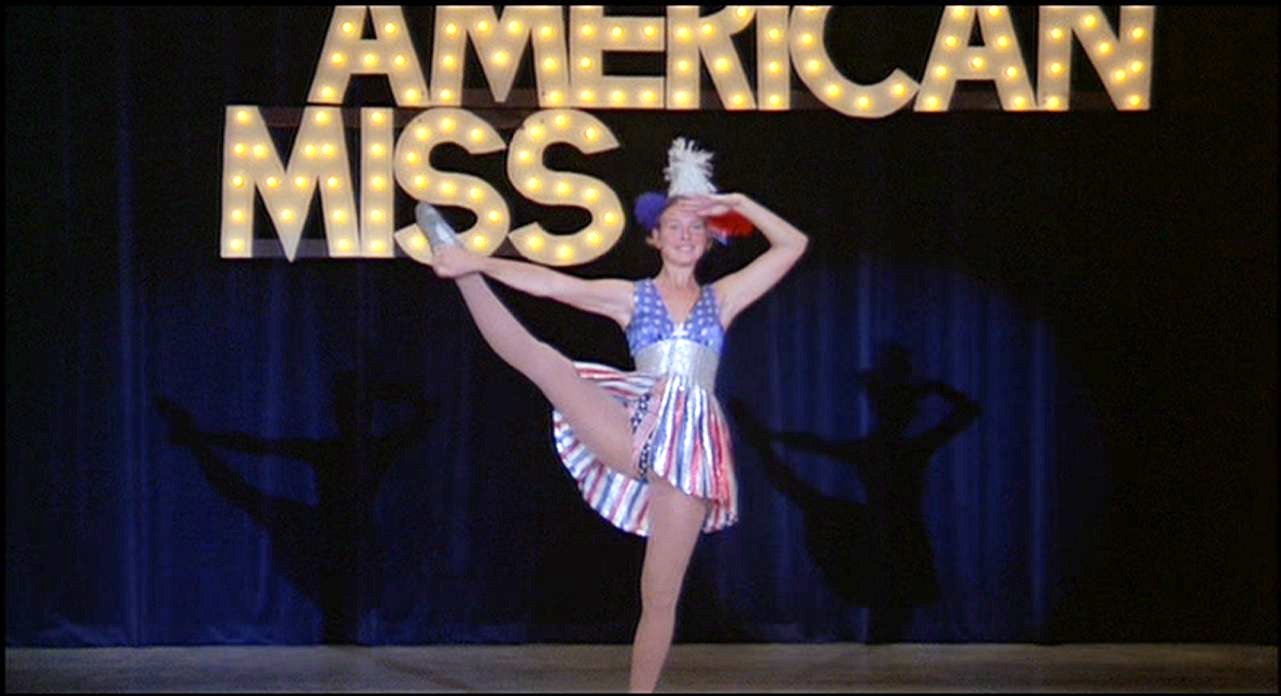
The entire movie plays with your emotions like this – laughing at the comedic aspects of the flesh show (there’s a not funny, disturbing aspect of this in Richie’s terrific Prime Cut when he lingers on livestock and women), while feeling an undertow of sadness regarding these women’s hopes and dreams. You’re smiling while a girl warbles “Delta Dawn” and then honks her saxophone for her talent portion of the contest and you laugh as another instructs the audience how to pack a suitcase (I happen to think that’s a perfectly acceptable talent). But then you feel for a contestant trying to get through a question and answer session in which she’s told to be herself, but of course, that’s not what’s she’s being told at all. And you sense her stress. You are exhausted by Miss Salinas, Maria Gonzales (Maria O’Brien), who uses her Mexican-American heritage to get a leg up in every situation, and then you see how really shitty the girls are towards her. So what if she’s always making guacamole? What the hell is wrong with that? Joan Prather as Robin is the contestant we follow most closely (she’s Miss Antelope Valley), since she seems to mirror how we feel – ambivalent about it all, serving more as the audience’s eyes than drunken Andy’s. She also rooms with Miss Anaheim, Doria (Annette O’Toole), the teenage veteran who offers advice to Robin, like, say, how having a dead father (as Robin does) could help her in the competition. I love that these two really do become something like friends, and that Doria’s not painted as the pageant hungry villainess; she’s just trying to get through life like everyone else. Doria figures if boys can get scholarships for sports, why can’t women be prized for their charm and beauty? Robin, a little more philosophical and, likely, more political, wonders why boys should get scholarships for sports in the first place

Young American Miss 1975  Smile

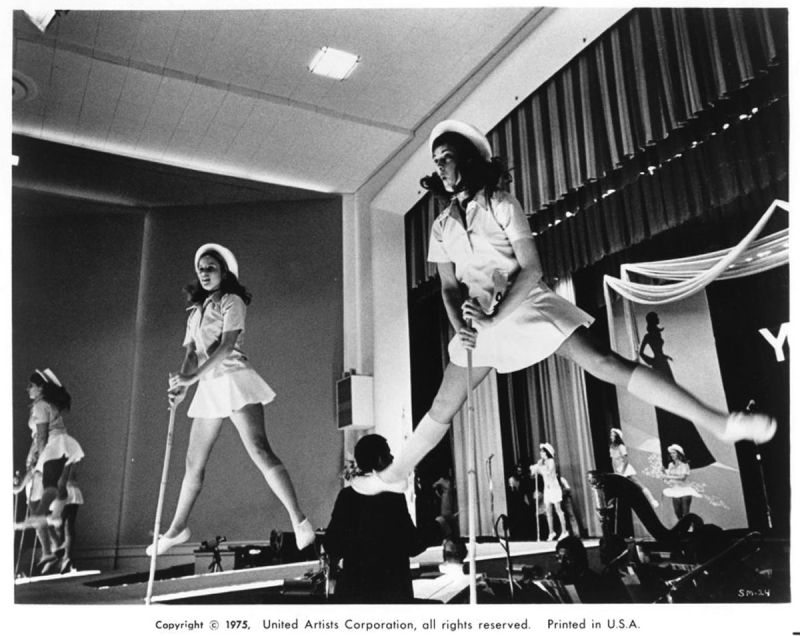
The pageant scenes are filled with amusing, acerbic observations (and young actresses like Melanie Griffith and Coleen Camp), chiefly with the star choreographer played by real life dancer and choreographer Michael Kidd who brings a wonderfully tough, often comically dyspeptic presence – too sophisticated for the town, his Broadway and movie career in the rearview mirror, he’s doing this just for the money. He’s perfectly fine not getting along with the harried, annoying pageant official (Geoffrey Lewis), and he’s late on the job all of the time. So what. He’s also nicer than we think – the hotshot hard-ass dance guy actually cares more about the girls than Lewis’s character does.

6a00d83451cb7469e201b8d29f3621970c-800wi

Ritchie (with cinematographer Conrad Hall) captures so many details  – the TV dinners, the lodges, the caged mechanical bird in Bob’s house, the portrait in Brenda’s home (of herself) and in an especially well-crafted scene, the nude polaroid that slowly reveals itself while Bob’s son, Little Bob, swears he didn’t take that kind of a photo. Of course he did. That photo also ends the movie in a telling detail – the nudie the kid is busted for and sent to a psychiatrist over, adorns a police officer’s car visor. The cop casually eats a Twinkie and takes a peek at the topless young woman – what’s more creepily All-American than munching on junk food and leering at teenagers from a position of power? And it’s not a surprise, really, that the cop would have the photo, after all, in a sad moment, Bob tries to bond with the servicemen rolling the flag when the pageant is over. Good American that he is, Bob informs them that he too served in the First Infantry Division: “We held the Chosin Reservoir,” Bob says. They ignore Bob’s affiliation and history and brush him off, remarking crassly to each other: “Boy did you see the knockers on Miss Imperial County.

6a00d83451cb7469e201b8d29f363e970c-800wi

Smile contains numerous scenes that are either as obvious as the cops and the military (so much for the red, white and blue), or potently understated with small, telling details saying so much about how these 1975-era characters (1974 when the film was shot) contend with suburbia and the outside world. Current events are at the periphery of these character's concerns and lives (abortion in brought up in one scene), and yet this a very 1970s film – you can sense the era’s creeping cynicism working into this town and hanging over it like a pall. As Nat King Cole brilliantly sings “Smile” (composed by Charlie Chaplin, lyrics by John Turner and Geoffrey Parsons) opening and closing the film, the song could initially seem ironic – if you’re not paying attention to the words or the great man singing them. No, the song “Smile” is direct and to the heart, and becomes so touching it’s almost too much to bear: “Smile though your heart is aching/Smile even though it’s breaking/When there are clouds in the sky, you’ll get by/If you smile through your fear and sorrow/ Smile and maybe tomorrow/You’ll see the sun come shining through for you…” Dear lord. Nat King Cole is right. What else is one supposed to do? You can’t stay drunk all day. Well, you can, but, as Big Bob says, “A good philosophy is good philosophy and I don’t happen to be a snob about where I get it from.”


Originally published at the New Beverly

Kill Or Be Killed # 10: Big House U.S.A.

6a00d83451cb7469e201b8d29df367970c-800wi
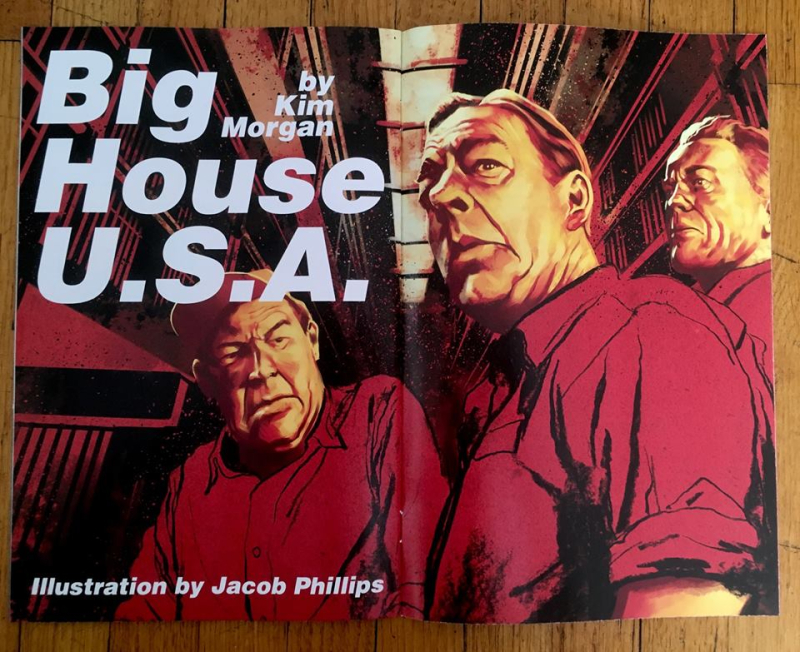
Pick it up! Issue #10 of Ed Brubaker's Kill Or Be Killed is out. In this one, I ponder Ralph Meeker and Ralph Meeker in Big House, U.S.A. (with art by Jacob Phillips). Here's a preview

You don’t want to run into Ralph Meeker in the woods. Not if you’re a kid. Not if you have asthma. Not if you’re rich. Now, that’s a real specific set of requirements, and this is regarding just one movie (the one I’m writing about, Howard W. Koch’s Big House, U.S.A.), but when cast as captor, Meeker could be so powerfully feral, so cunning and so caddishly sexual (and in some cases, so touchingly vulnerable), that his effect is immediate. Oh god, who is this handsome devil? This is wrong. I don’t know? Is this wrong? On the adult, female side of it, see the Meeker-holding-women-captive stories like Something Wild with Carroll Baker, Jeopardy with Barbara Stanwyck and The Fuzzy Pink Nightgown with Jane Russell.  These pictures all have varied endings, happy or curious or god knows what will happen, but all show Meeker getting away with his transgressions.

6a00d83451cb7469e201b8d29df346970c-800wi

In the masterpiece, Something Wild, he’s much more sensitive and complicated, romantic and creepy, seriously inappropriate and seriously damaged (Meeker was a brilliant actor who really wasn’t cast enough to showcase his range, a shame), but in The Fuzzy Pink Nightgown, he’s just flat-out the romantic lead, even as a kidnapper. And in Jeopardy  . . . we truly wonder if Stanwyck would go off with him at the end, just for a second, even as he’s made her life a living hell by kidnapping her and cruising through Mexico as she’s desperately trying to save her husband. “I’ll do anything for my husband, anything!” she says, deep emphasis on anything. But in all three movies, he really does wind up helping these women from their direct threats (he saves one from killing herself, he saves another’s husband, and he saves Jane Russell from a cynical movie studio-controlled life devoid of true love, something like that). And yet, in all movies, even a comedy, a final, unsettlingly erotic feeling lingers – a subversive kind of desire has been unleashed, a dangerous desire. You could see offense in these pictures, but Meeker is so intriguing and provokes such mysterious, unexpected feelings, that you find yourself pondering your own desires while watching him. It’s this kind of specific Meeker-style cad-provocation that makes him something of a genius. No wonder he was the perfect, and in my book, the only Mike Hammer. He helped a woman at the beginning of that movie too (Kiss Me Deadly) – and then the whole fucking world blew up.

But in Big House, U.S.A. (1955) Meeker helps a kid – and his transgression is one of those cinematic taboos that dares as much as Michael Haneke did with Funny Games 42 years later: Are we gonna kill the kid? After all this poor child has gone through? Are we really gonna kill the kid? Yes, we’re gonna kill the kid.  Sorry, audience. This isn’t a nice movie. This isn’t a nice world.

6a00d83451cb7469e201b7c913aa3c970b-800wi

Read it all via ordering a copy here.

Martin Landau: The Eyes Had It And More

6a00d83451cb7469e201b8d29dcd5e970c-800wi

An excerpt from my essay on the great Martin Landau for Sight & Sound Magazine… 

There are actors who have beautiful eyes, dramatic eyes, fantastically soulful eyes, and then there are actors who have eyes that burn with such multifarious fires that you somehow both know exactly what those eyes are saying and yet have no idea. Eyes that reveal and eyes that hold secrets. Those eyes could be tricking you: they could be harbouring depths of misery, sleepless nights of guilt, yearning or sadness, or they could be sleeping soundly, comfortable with their icy, sociopathic treachery.

In his best roles, that’s what Martin Landau possessed: a kind of fearful complexity that played relatable, mysterious, intimidating, emotional, scary and vulnerable – often all at once. When Landau expressed a splintered psyche, he was both chilling and sympathetic, and in some cases he challenged our presumption – making us recognise darker aspects within ourselves. For an actor, that kind of complexity is much harder than it looks. But for Landau – a man who came from the Actors Studio and who took his craft seriously – this kind of well-honed but unforced understanding of human behaviour (both externally and internally) was important. Don’t show it all. Real people hide. As he said in 2010:

“People do not necessarily reveal what is going on – only bad actors do. Bad actors try to cry, and good actors try not to. Bad actors try to laugh, and good actors try not to. Only bad actors play drunk – good actors play drunks playing sober! They don’t want everyone in the room to know they’re drunk, and if you’ve ever seen a drunk pick up a glass to his mouth at a bar, it’s the most studied, controlled thing you’d ever see, as opposed to the sloppy kinds of drunks you see played everywhere. There’s a real amount of bad acting around that is considered good acting, and I see at the Actors Studio every week stuff that far excels what I see on Broadway or television or film."

Read the entire piece here. And RIP, Mr. Landau.


Sofia Coppola’s The Beguiled

6a00d83451cb7469e201b8d28cfaa5970c-800wi

"I found him in the woods. Miss Harriet had given me permission to hunt for mushrooms as long as I promised not to go beyond the old Indian trail, which is just before the woods begin to slope down to the creek. Well all that land belongs to the Farnsworths but they never have used it for anything, I guess, which is fine with me. I prefer to have places like the woods kept just the way they are. Anyway, on that afternoon – during the first week of May it was – I didn’t find very many mushrooms, but I did find him.” – Thomas Cullinan, The Beguiled

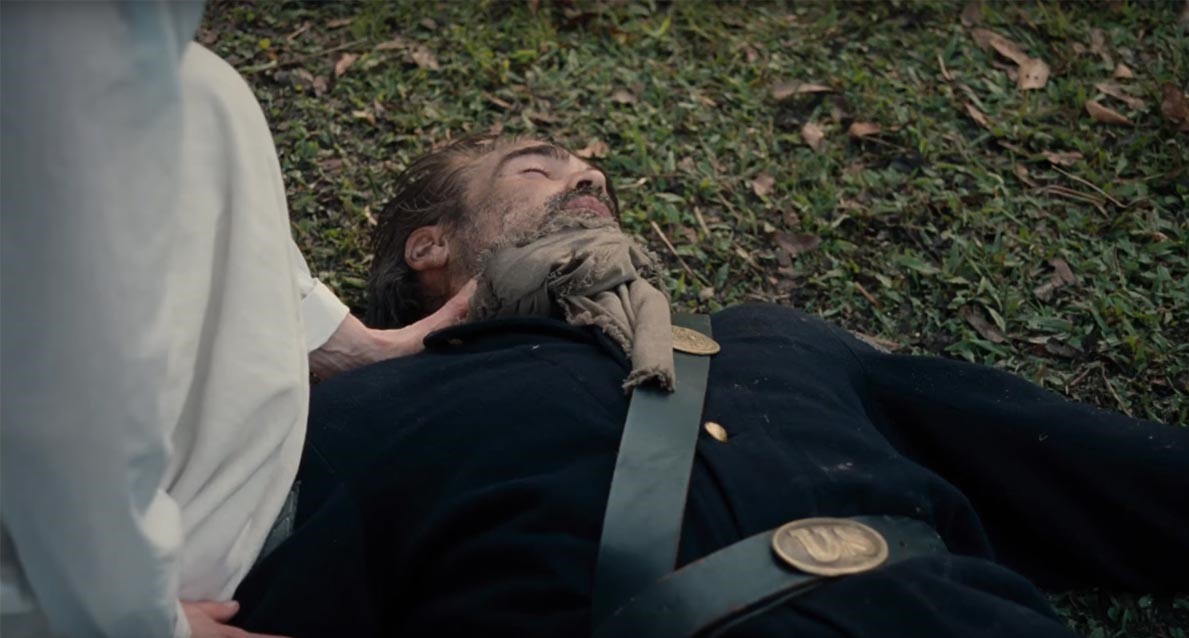
At the beginning of Sofia Coppola’s The Beguiled, a girl picks mushrooms in the woods, happily humming to herself, grabbing the curious little fungi that peek out at you from above ground. Mushrooms are strange creations in nature – pretty and fleshy and always unique, they seem to just sit there innocently after they burst forth from the earth – but if you pick the wrong one (or the right one, depending on your intent) and eat the little thing, you could fall down a psychedelic rabbit hole filled with pleasurably mind expanding or terrifying (or both) sensations. Or, you could die. Their potential toxicity makes mushrooms a bit exciting and even dangerously alluring since, if you were of the mind to do so, you could use those strangely shaped buttons to deceive a person. Or mess with their life. Eat this side of the mushroom to grow larger, or the other side to grow smaller, says the caterpillar to Alice.While collecting the delectables, she stumbles across a mysterious man, and one who is deemed the enemy, all bloody and wounded and dirty, almost entangled with the trees and bramble and soil. It’s a beautifully poetic moment – simultaneously ominous and fairy-tale-like – and Coppola shoots it with a kind of intoxicating, frightening excitement. You needn’t know anything of this girl or her secluded life among only woman to feel the particular power of this scene. This is not just a man, this is an upset to order, positive or negative. Nature, sex, morality – it can be unruly and tough to untangle, no matter how hard you try to control it in yourself or others. And love? Good luck. As Katherine Mansfield wrote: “If only one could tell true love from false love as one can tell mushrooms from toadstools.”

6a00d83451cb7469e201b8d28cf99a970c-800wi

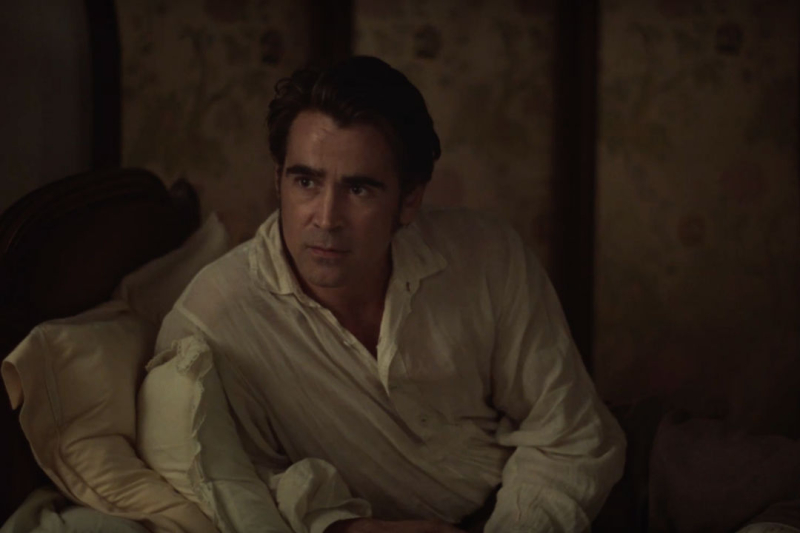
The time is during the thick of the American Civil War, and the place is rural Virginia, dangerous territory for the man who is near-death, deeply wounded – Union Army Corporal John McBurney (Colin Farrell).  This man has deserted the battlefield (and admits it later, knowing he’ll be perceived a coward, but honesty seems a clever calculation), after he sold himself to the Army (and for $300). Selling himself more than suggests this man has done quite a few things to simply survive, and in that way, he’s sympathetic. But no one is so easy to read in Coppola’s hypnotic, eerie, at times swooningly erotic Southern gothic, an adaptation of Thomas Cullinan 1966 novel (first made into the excellent 1971 Don Siegel picture starring Clint Eastwood and Geraldine Page). Wisely, and refreshingly, Coppola allows us to decipher how we feel about these people with mood, style, stolen glances, and movement, often very slow – even open wounds are something to ponder as they’re sewn up and busted open (like bodices), as is the melodrama that is, in brief, stark moments, vociferous and at other times, quiet and gorgeously muted. It’s a brilliant fever dream in Coppola’s hands – rooted in the messy emotions of desire, the interpersonal games we play, our longing for at least a break from loneliness and fear, and not necessarily through physical independence, but for a kind of psychic freedom.

The-beguiled-2

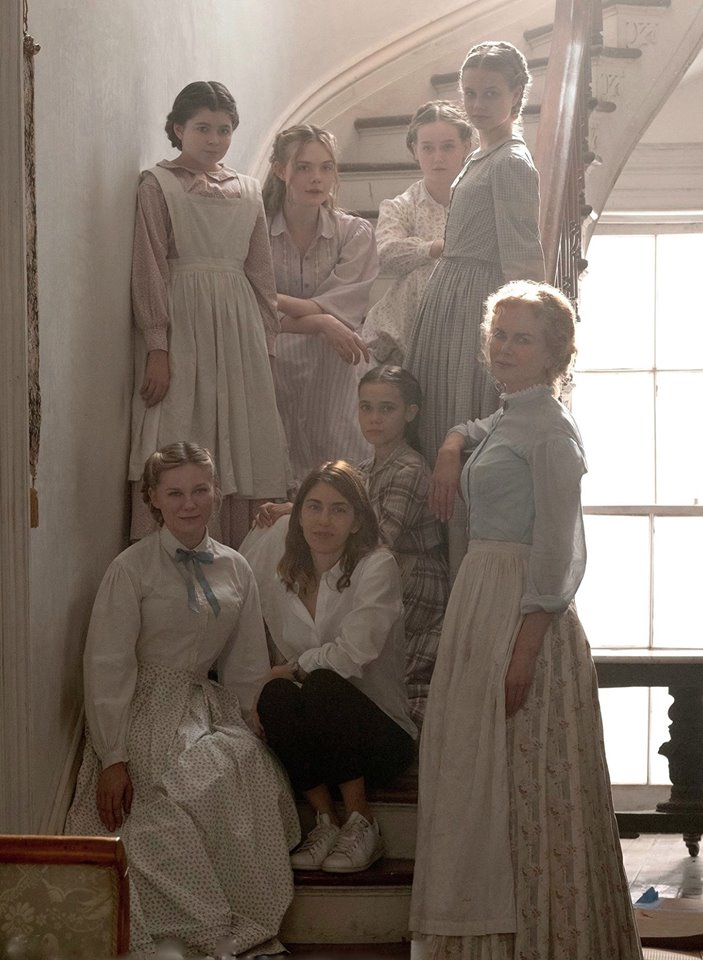
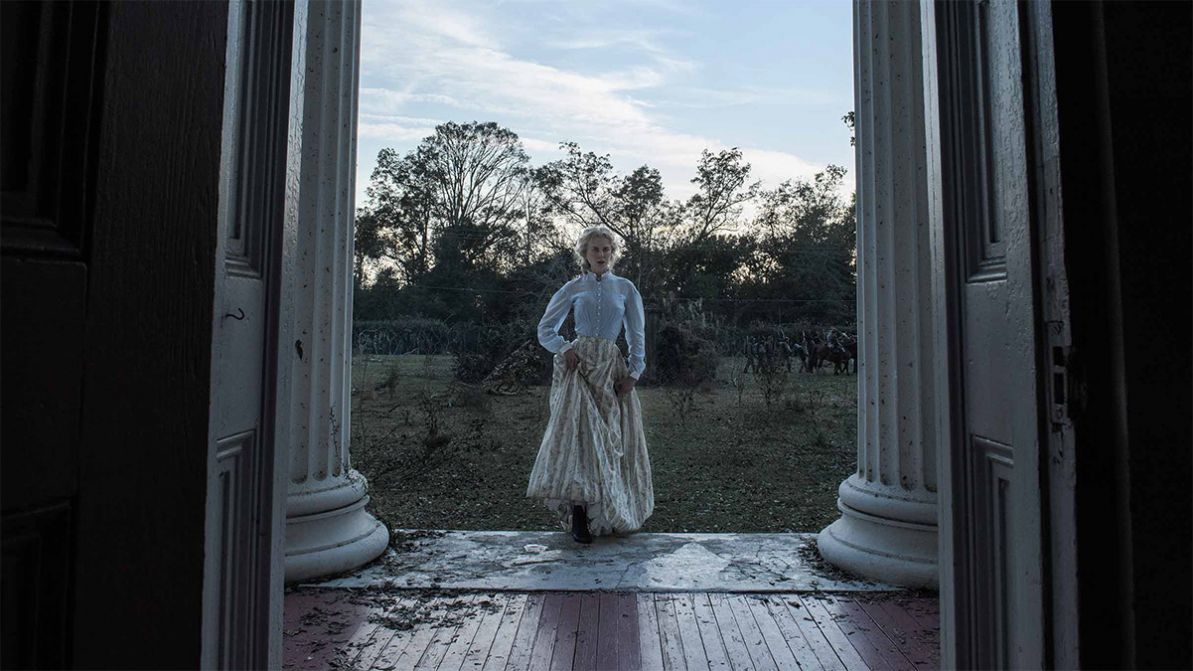
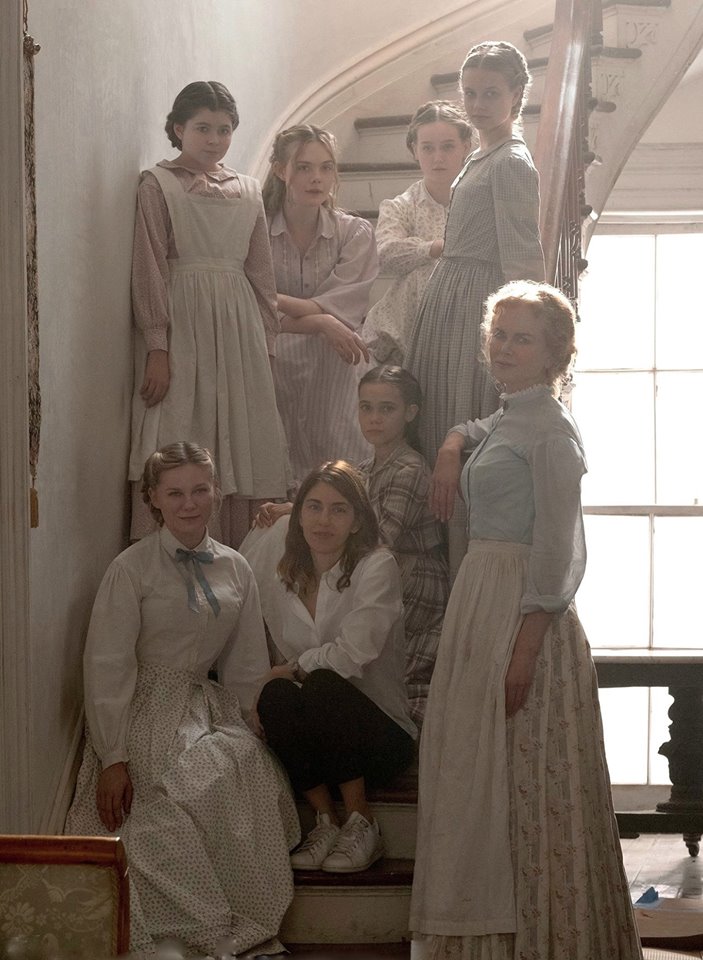
Wonder and fear begin the picture – as McBurney is begging for help, and from a little girl one would think is merely skipping through the forest. She’s an easy target and his only hope. But don’t underestimate little girls who pick mushrooms. That girl is ever-curious pre-teen Amy (Oona Lawrence), who, after her initial shock, empathizes with the bleeding man and assists the soldier, no matter what side he is on (a “blue belly”), nearly dragging him with all of her little girl strength back to where she lives – The Miss Martha Farnsworth Seminary for Young Ladies. The house is a large, rambling plantation with white columns and overgrown foliage, a place once stately but still beautiful – like the man, it seems to be intertwining with nature. There are no men and their female slave who had once lived there has taken off as well. These are women and girls alone, cloistered, even, with their own unique personalities and opinions of one another, not all good. They’re trapped, but they’re also self-sufficient, and all seven of them help each other to keep up the grounds as best as they can, cook, do laundry, while continuing their schooling (only inside the house), conduct music recitals and lessons in good Southern manners. You can feel the war raging around their shaky sanctuary – canon fire can be heard in the distance so much that it sounds as expected as the weather. It also punctuates the powder keg of emotions these women have been stifling inside of themselves.

6a00d83451cb7469e201b7c902bd13970b-800wi

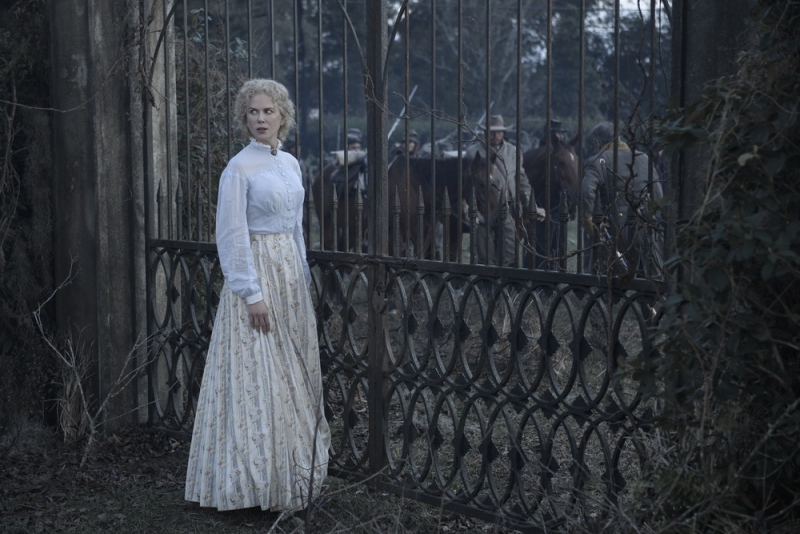
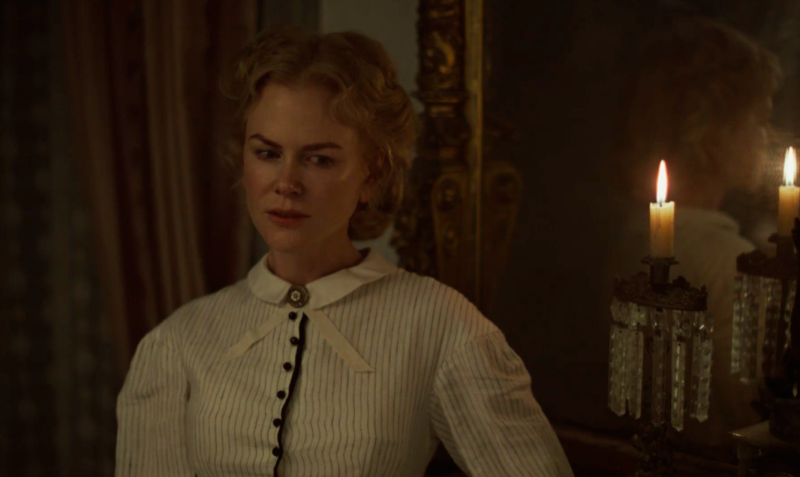
With the approval of the strict, intelligent and subtly scary matriarch (scary, so far, in that she is the one who wields all of the power), Miss Martha Farnsworth (Nicole Kidman), McBurney is dragged in and tended to. His arrival is reasoned as the good Christian thing to do, but we already sense other motivations, one being the curiosity and excitement of this exceedingly handsome, clearly charismatic intruder/guest. Martha sews his wound (it’s a strangely lovely scene – matter of fact more than maternal) and in one of the film’s most erotic moments, she carefully bathes him while he lies in bed at her mercy. Watching Martha rub down his chest and nearing his pelvis, her usual flintiness now clouded with allowed intimacy and the thrilling act of looking at this man’s body (something she’s not done in quite some time) is intriguing – Kidman’s inner emotions are not only sexy but oddly tense and fascinating to observe. They’re even a little sad. She must repress.

6a00d83451cb7469e201b8d28cf9e9970c-800wi

When McBurney is more ambulatory and able to talk (and flirt, Farrell does so with charm and sensitivity, it’s easy to see why the women take a shine), he’s clearly caught the idea that manipulation will keep him alive. It’s not predatory, necessarily; after all he’s helpless to his injury and to the fact that he could be turned over to confederate soldiers. He works Amy as the one he likes best (she saved him, so why wouldn’t she believe it? And why wouldn’t we for that matter?) but sets his adoring (or manipulative) eyes on Edwina (Kirsten Dunst), the teacher whom he sizes up as different (this pleases her – everyone wants to be the special one). Edwina is a delicate beauty but her vague desolation and lonesomeness seem to have made her sag a bit, like she’s slumping through this stifling mansion one day after the other, life is just passing her by. Dunst portrays this with a complicated mixture of world-weariness (of a world she misses) and dreamy ennui. But McBurney’s attention makes her sparkle, causes her to dress a little prettier, wear certain pieces of jewelry and think about attraction – and those around her start to notice.  But then, all of the females have been energized by the visitor and start to adorn themselves, pay him room visits and flirt, chiefly Elle Fanning’s teenage Alicia, whom some could consider a tempestuous brat, but … have you ever been a bored, teenage girl? She’s curious and basking in her youthful force because, that’s what living and learning is about. Many girls would act just as she does. And many can be really powerfully good at it.

The-beguiled-3-1250x703

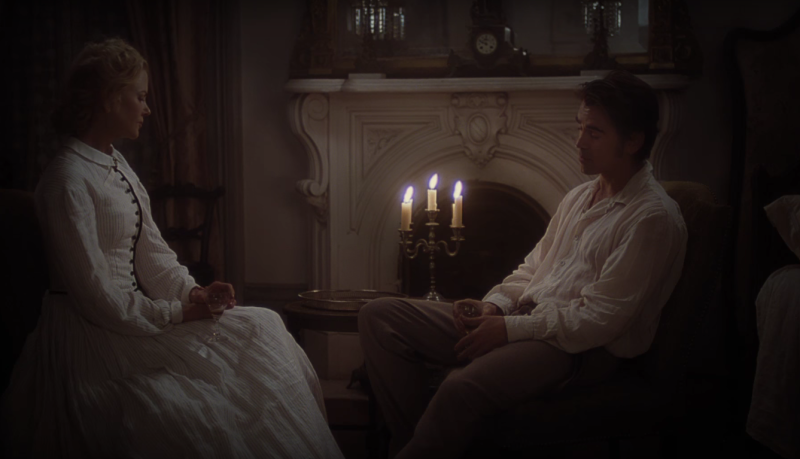
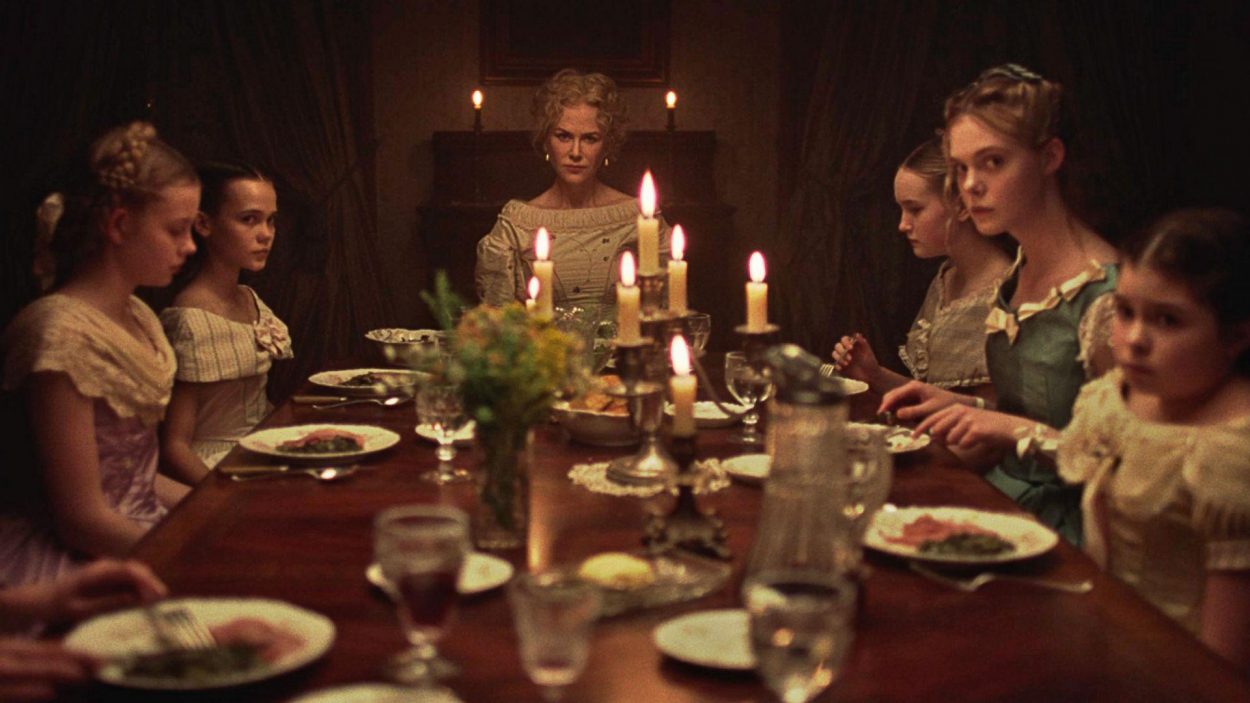
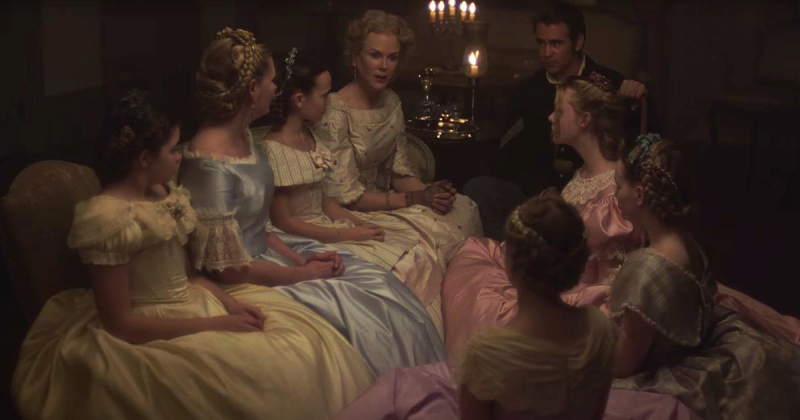
Once McBurney is sitting at candlelight dinners with the females dressed so fetchingly, watching their recitals and with his leg healing nicely, helping out on the grounds, the women begin to compete more openly (there’s a humorous scene about all of those involved with the creation of a pie he likes – and making sure McBurney knows who contributed what to that pie). Farrell sits pleased as the charming, delighted wolf – he knows he’s got them under his spell – and is able to start playing them. This is also when things begin to get extra-thorny and sinister, for all involved. Shot with a gossamer beauty (by Philippe Le Sourd), where warm, candlelit interiors are picturesque and slightly scary; where the outside world has a smoky, gauzy pastoral beauty but feels dangerous (it is dangerous), The Beguiled is positioned inside an alternate universe that’s not too far removed from the reality of the time. From the women’s dresses, to the moss on the trees, to Farrell’s wounds, these are photographed with totemic import – these things mean something to all involved.

6a00d83451cb7469e201b7c902bd52970b-800wi

And Coppola never heightens any of this meaning or drama toward the ridiculous, even as disastrous and spectacular as it all gets: lust and spurned lust causing a push-down-the-staircase rage, literal, re-opened wounds (this is not a movie about healing), and then, a loss of something quite important to a man (or anyone, but it seems more symbolic here, in understatement), with Martha demanding, “Bring me the anatomy book!” I loved the slow burn of the picture how, even with characters acting with such dubious intent, Coppola refuses to simply demonize either side of the gender divide. When McBurney professes his love to Edwina, you feel the danger in this statement, and worry for her, but you are just waiting for this outburst of passion. God, even if it’s a lie. Let Edwina feel something. And Farrell is so compelling, so convincing, you believe it, for a moment, and you don’t fault him for such machinations. He’s got to save himself too, and he’s using his masculine wiles the way femme fatales stereotypically do. Coppola positions the movie from the female’s point of view, yes, but it’s inherently humanistic and emotionally honest. It’s also droll and witty. She’s not afraid to be funny and recognize the humor of this predicament, and how awful we all can be. We recognize how far some will go, men and women, within this trapped, highly symbolic milieu.  The Beguiled isn’t really asking us to take sides – it’s allowing us to figure that out for ourselves – or take no sides. Why do sides need to be taken?

1487369508_focusfeatures_thebeguiled_sofiacoppola_colinfarrell_nicolekidman_kirstendunst_ellefanning_unit_1-1194x671

Returning to the fairy tale aspect of Beguiled, I feel this in all of Coppola’s superb, stunning pictures, distinctly her own – the fracture and heart of the fairy tale (The Virgin Suicides and Marie Antoinette especially, but even the castle of the Chateau Marmont in Somewhere or the kids breaking into the fantasy life they’re not a part of in The Bling Ring). Like many girls (and boys), when I read fairy tales, particularly about princesses, I didn’t really think too long about the happy endings (unless they were weird and complicated, like when you read the real Brother’s Grimm) or the morals of the stories – I was instead intrigued by their ideas and images, often of isolation and imprisonment: a woman put to sleep in a glass casket for being too fair, or Rapunzel shuttered away in a tower. These locked-up woman who terrify, yes, jealous women, but more than that, they terrify because they possess a kind of dominance that must be stopped (Maid Maleen is another example – she was locked away for disobeying her father, shades of The Virgin Suicides).

When I re-read these stories as an adult, I think of how much these themes permeate the real lives of women. I think, in more current examples, of brilliant women who lived creative, later secluded existences, far too close to their mothers – elusive Dare Wright, Big Edie and Little Edie Beale. They are fascinating and full of questions. Who can blame them for being either scared of the outside world or wanting, really, nothing to do with it (and we don’t really don’t know what they wanted)? Dare Wright worked through her obsessions via ingenious pictures of dolls and bears. The Beales became mythic.

6a00d83451cb7469e201b8d28cfa8e970c-800wi

The women of The Beguiled feel mythic too. They may be bored and stifled in that house, but will they ever leave? They certainly adored men, and fell in love with men, but even as they desire, and in the case of Edwina, desire to run away, it’s not surprising they should feel, at first, fear, and then such extreme betrayal and distrust of a man – and finally decree revenge. If they’ve internalized society’s (and particularly during this time period) moralizing of the sexual female, that’s terribly sad, but the ending, both horrific and tragic, is simultaneously haunting and darkly droll. Coppola’s last shot is a twisting of the fairy tale heroine; only, it’s a man, wrapped and supine. There will be no princess to kiss him awake.

From my piece published at the New Beverly.

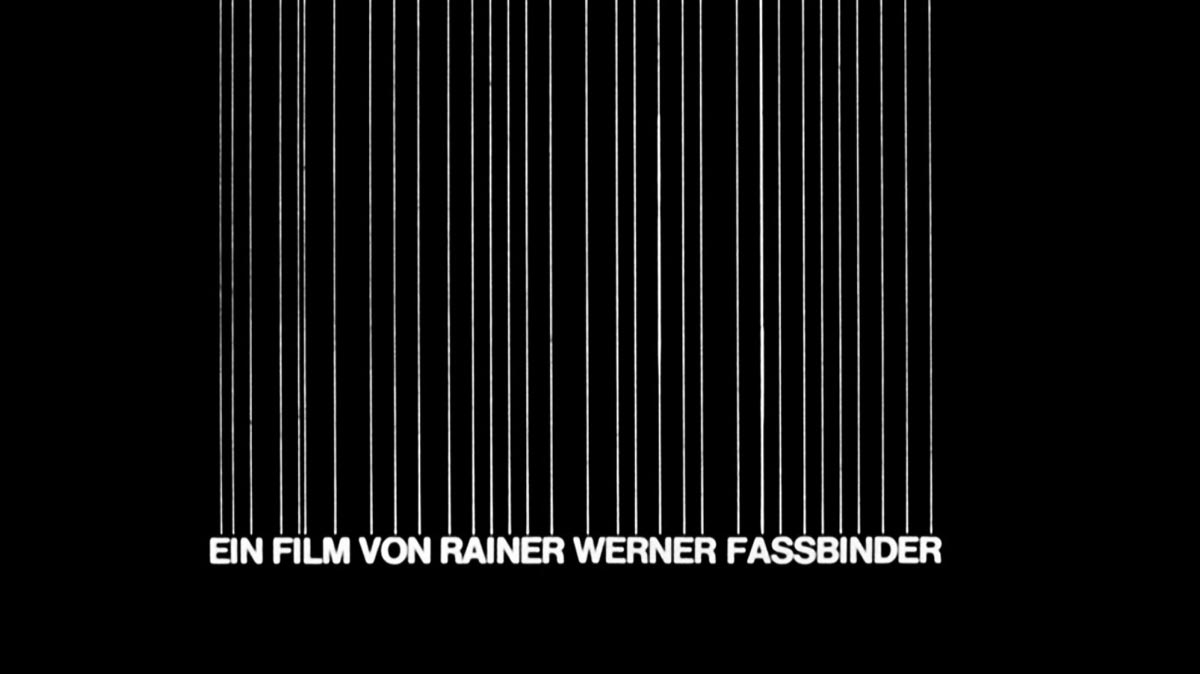
The Mirrors of Fassbinder: World on a Wire

6a00d83451cb7469e201b7c902141c970b-800wi

"There is a very beautiful story named World on a Wire. It talks about a world where you can create projections of people with a computer. And this brings about the question to what degree we are all merely projections, because according to this thought model; the projections are equal to reality. Maybe another, larger body has created us as a thought model? We are looking at an old philosophical model that produces a certain horror. With this movie I have attempted to work as perfectly and orderly as possible, using all available technical means.”  – Rainer Werner Fassbinder

World-on-a-wire-1

In Douglas Sirk’s All That Heaven Allows, Jane Wyman, lonely, separated from her “inappropriate” lover Rock Hudson, sits at a Christmas gathering, heartbroken and unhappy with her life. Her daughter, finally realizing her mother actually loves the soulful, younger gardener (finally?), feels for her mother, while her imperious, smug son settles on the couch and blithely talks of both going to Europe and selling the house. Her house. He makes a point to say “one person” doesn’t need such a big house with the word “one” stabbing Wyman right in her heart. The kids will be gone, and the widow is now looking at a life truly alone – love be damned. She breaks down and says to her daughter: “The whole thing’s been so pointless.” And then … her son presents mother with her Christmas present. It’s a television set. A man enters carrying the unit and “sells” her on this box of entertainment, this replacement human being. Wyman looks into the unplugged screen, despairing and even a bit frightened (this is her future?) and sees her reflection. The man proclaims: “All you have to do is turn that dial and you have all the company you want, right there on the screen. Drama, comedy, life’s parade at your fingertips.”

6a00d83451cb7469e201b7c9021395970b-800wi

Shot from the perspective of Wyman’s distressed reflection in the television screen, we see her visage trapped in a frame, peering at herself and the prospective imitation of life, unplugged but waiting, like the horrifying company a solitary pill-popping Ellen Burstyn will keep in Darren Aronofsky’s Requiem for a Dream. The expectation of sinking into the void of replacement reality to human life is not only one of the most heartbreaking moments within Sirk’s oeuvre, it’s one of the most horrifying as well. It’s also, intriguingly, an early disavowal of the alienating aspects of technology, Sirk using his famous replication mirror shots to emphasize the fear of simulated existence. Once that TV is turned on, her disturbed replicant face will be blurred by life’s “parade,” and she will likely succumb to its numbing, anesthetizing comfort.  We never do see that TV turned on and based on the film’s ending, we assume Wyman will shove it out the door like Craig T. Nelson in Poltergeist. But with World on a Wire, I feel like Sirk disciple, young Rainier Werner Fassbinder, sneaked into that gorgeous Alexander Golitzen-designed room when no one was looking, plugged that life-sucker in, and turned the nob to “on” – and with a hard click.

Maxresdefault

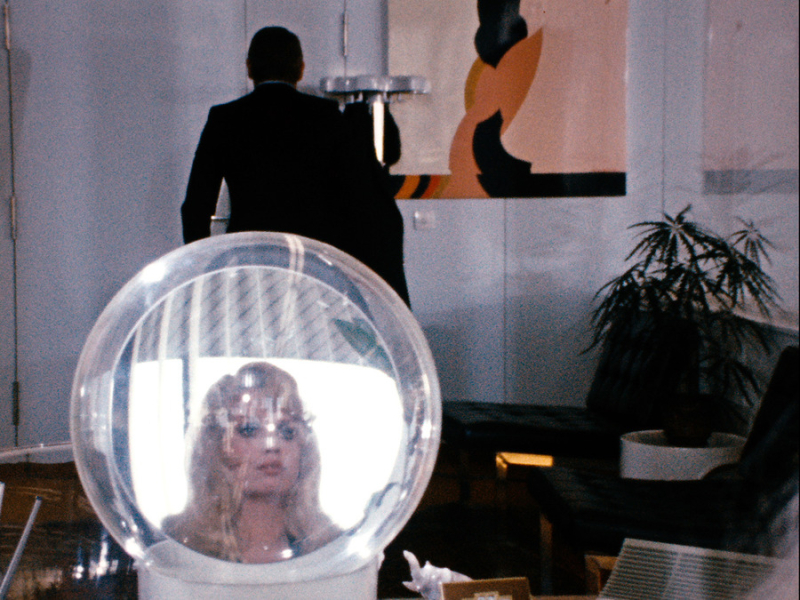
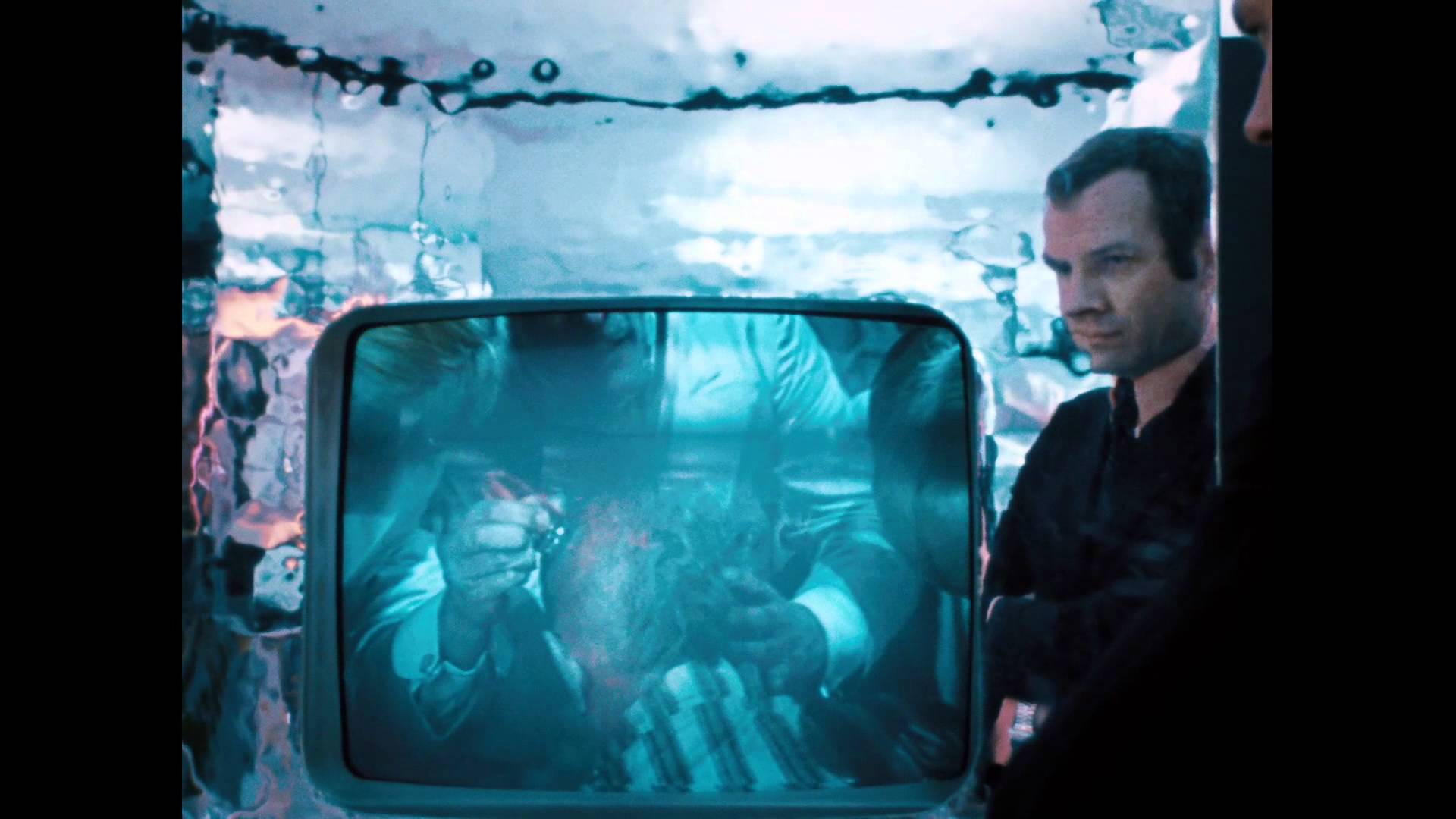
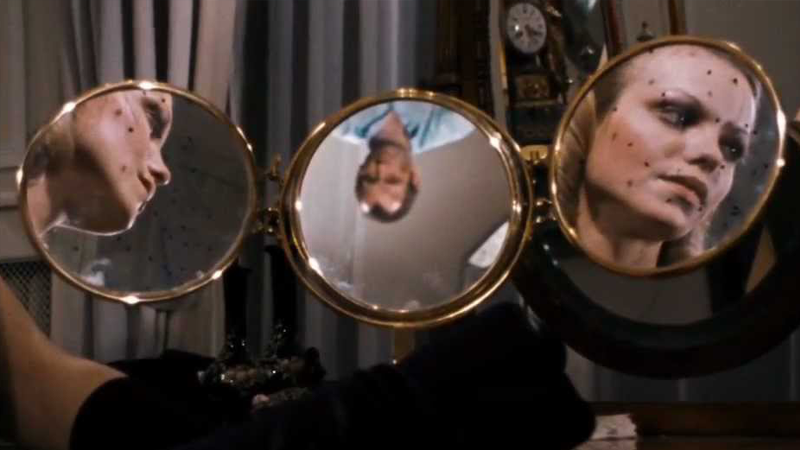
With that fantasy click, Fassbinder wasn’t just thinking science fiction when he made his one and only sci-fi epic, World on a Wire, he was likely, in part anyway, thinking of Sirk. Fassbinder and Sirk are often thematically and stylistically linked by critics, World on a Wire is no exception (and Fassbinder, serious devotee and student that he was, discussed Sirk himself). Jane Wyman could be inadvertently gazing towards another kind of future when thinking of the Fassbinder’s mirror shots – World on a Wire is a movie so crammed with mirrors and reflections, that the picture takes Sirk’s idea of a mirror’s view of a warped or opposite reality, and transplants its ophthalmic impersonations into science fiction; and most specifically, and fittingly, into a movie about virtual reality. Replacement humans. Fassbinder works with science fiction ingeniously, layering his prescient story and characters with themes many of his other picture’s explore — power dynamics in relationships, identity, societal perceptions, how we observe from inside a film as characters and outside of a film as voyeurs, how we style our lives, and how we inhabit the style around us.

6a00d83451cb7469e201b8d28c3d79970c-800wi

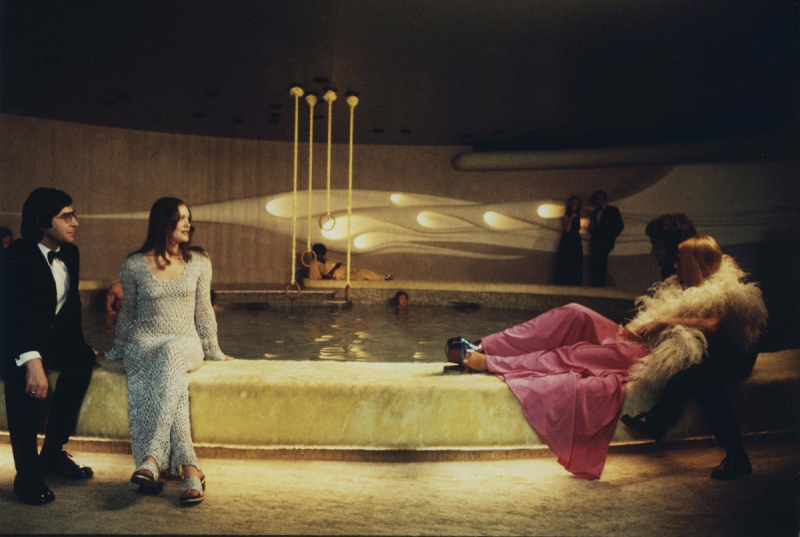
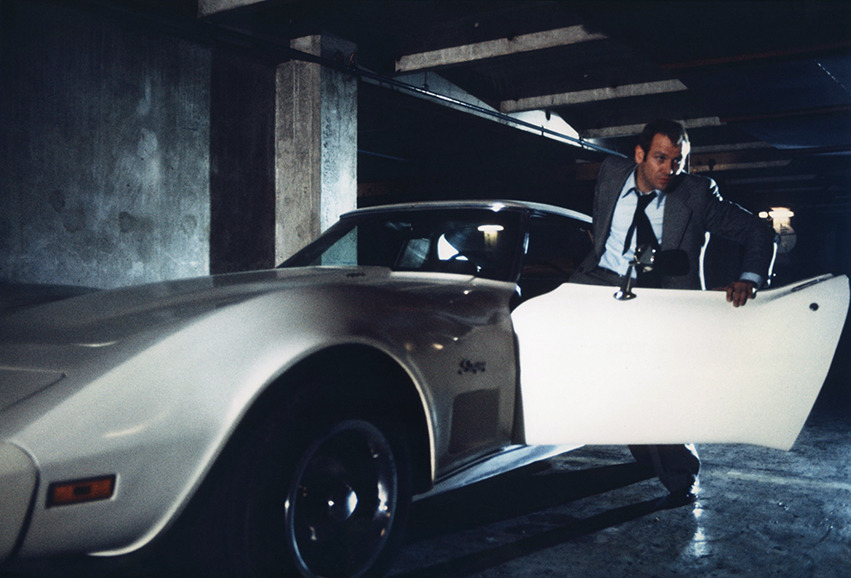
And, again, style. This picture is mad with style – as chic as Petra von Kant’s designs and her artfully crafted bedroom/set, it often looks like a work of installation art, in which characters at pool parties stand like mannequins or float like ghosts, shimmering blue water lighting faces, gleaming plastic surfaces, white statuary adorning 70s sci-fi/mid century modern rooms with pops of color from telephones, TV screens looking back at us, and of course, mirrors everywhere, sometimes as many as three or more in one shot. Women traipse around sexily, listlessly in gowns for day attire, men don fedoras and sharply tailored suits, our hero drives a white corvette, looking more like a noir hero or a suave super spy than his job title – technical director of the Institute for Cybernetics and Futurology.

6a00d83451cb7469e201b8d28c3d83970c-800wi

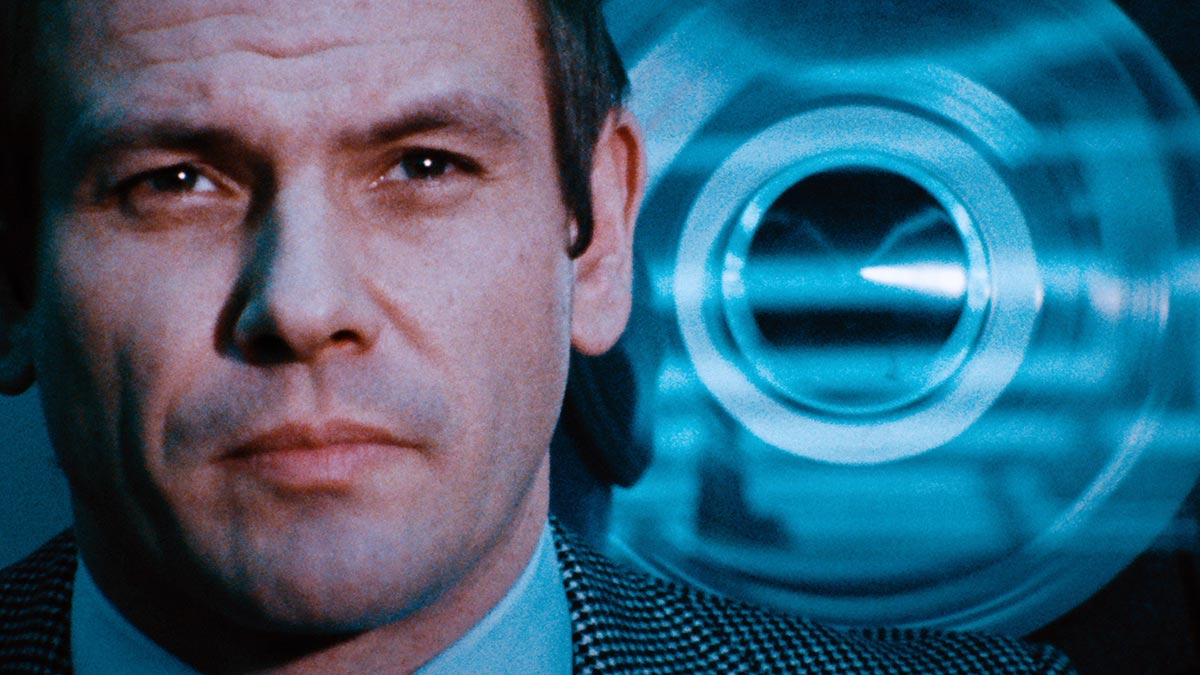
That hero is played by Klaus Löwitsch – handsome and charming, with a wry expression and a unique, subtle sense of humor – he’s a 70’s-styled noir protagonist (he’s been compared to Bogart, but I find him more of a cross between Dana Andrews and Ralph Meeker). Fassbinder uses Löwitsch’s physicality to wonderful effect here, even having the actor dive out of a cabin before it explodes (which is highly amusing). Or making him climb, simian like, over a wired fence (also amusing.) Much in this movie is satirical or strangely humorous while telling its story sincerely and chillingly, and in ways that bend what we perceive as homage or dead serious – it’s everything at once. We see Kubrick (2001), we see Godard (Alphaville, and with its star, Eddie Constantine, making an appearance), we see simulated Marlene Dietrich (twice, via Ingrid Caven, and once acting out the famous death in Josef von Sternberg’s Dishonored) and, as I said, we see Sirk. But this is a Fassbinder picture through and through.

World-on-a-wire-7

Largely unseen in the United States until 2010 after a dazzling digital restoration by the Rainer Werner Fassbinder Foundation, World on a Wire originally aired, not in theaters, but on German television in 1973 as a two-part tele-movie. And this is most certainly a TV movie made by Fassbinder – art directed like crazy (by Kurt Raab, who also acts in the movie), gorgeous 16mm, the film is shot by Fassbinder regular, cinematographer Michael Ballhaus, with such artful meticulousness, the camera moves and zooms and follows extended takes with fluid grace; the movie alternately waltzes and lurches in this gorgeous dystopian delirium. It’s weirdly hypnotic, and uncomfortably soothing, if those sensations can be possibly felt simultaneously. With World on Wire, they are.

6a00d83451cb7469e201b7c9021402970b-800wi

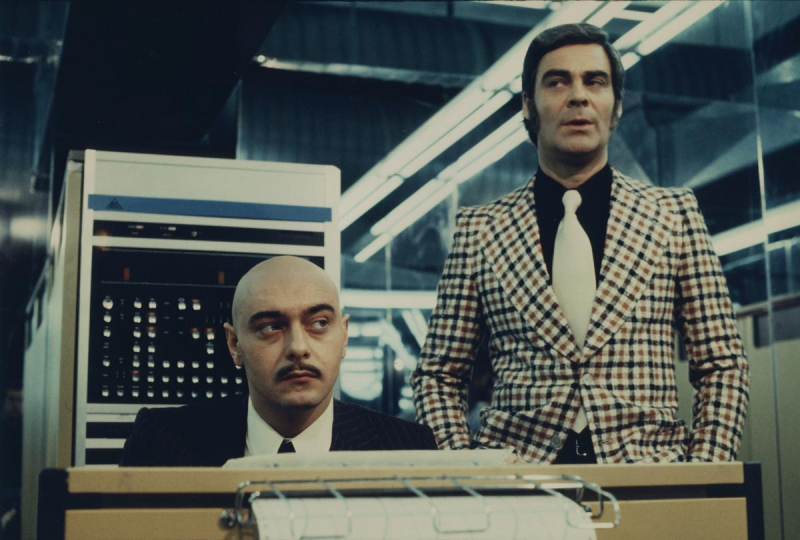
Adapted from the 1964 novel “Simulacron-3,” the three and a half hour series features Löwitsch as a scientist, Dr. Fred Stiller, who takes over for a mysteriously deceased Professor Volmer (Adrian Hoven) as the Institute director to a simulation program featuring over 9,000 “identity units.” The simulated humans live in the world unaware of their mirrored existence, playing humans, thinking they’re human and going about their business in what they perceive as one world – actually it’s split world, or existing in a hierarchy of real and perception – a top world and a bottom world. Stiller has already inherited a position under mysterious circumstances, but his existence becomes even more warped, stranger and sinister: mysterious disappearances, glitches in the identity units, corporate corruption and control, perceived madness on the part of Stiller, his terrifying, mind-bleeding headaches, assassination attempts, he’s even accused of two murders he didn’t commit. Stiller spends a good portion of the film’s third act fleeing, searching for an important contact to make sense of this real world and the simulated one. And he keeps running. He runs so much that he nearly gives up – once when the men with the white jackets (two extraordinarily creepy looking actors) come to capture him, he slowly dresses, and after enough time, jumps out of his room, exhausted (observing him barely make it out due to his own fatigue is disturbing and humorous). And another time when Vollmer’s daughter, Eva (an intriguingly somnambulant Mascha Rabben), pulls a gun on him; she hands it to him to reassure Stiller, and so he slowly aims it towards his head, distraught, but also as if he’s trying it out. It’s an act. With that, it’s played like how we’re watching someone think about the idea of this chunk of metal to their head, how it could blow out their brains, but … that’s too real? It’s not just as much as Stiller’s will to live that he thinks twice about it, but that it’s too much of a life or death choice, and within his own control. He does not pull the trigger.

6a00d83451cb7469e201bb09a524da970d-800wi

That Fassbinder was exploring the virtual world, and before The Matrix, Blade Runner, Tron, Videodrome, eXistenZ and other later pictures (Philip K. Dick was writing about these ideas early on) is another fascinating corner of the young, absurdly prolific genius’s mind. His interests and imagination were boundless (I’m not going to list all of the films he made before dying at age 37, but there were 40 features, not counting TV, shorts and plays) and so the idea of looking at reality through an alternate reality likely merged with the filmmaking process itself. Fassbinder was 27 when he made this series, and in a year that would produce three other works: Nina Helmer, Martha and Ali: Fear Eats the Soul. He assembled many of his recurring actors: Löwitsch, Barbara Valenin, Raab, Margit Carstensen, Ulli Lommel, etc., mixed with older German actors and interesting cameos – one from Rainer Langhans, which struck me as curious. Famous for being a member of Kommune 1, Langhans is almost known in rock lore for dosing Fleetwood Mac’s Peter Green during an infamous Munich trip that would reportedly warp Green’s mind and send him into madness. That Fassbinder chose Peter Green’s popular, soothing beautifully trippy  1969 Fleetwood Mac instrumental “Albatross” to not only fade out the first and second part of the series but to also score Stiller fleeing in his car, seems a intriguing coincidence, or perhaps he knew the story (maybe Langhams told him about it – I feel like Fassbinder would know this particular detail).

1512_015_Current_large

Whatever the case, life, lore, Fassbinder’s methods of madness with actors, his real life chaos and precision, it all swirls together perfectly in Fassbinder’s mind-bending fantasia. (Fassbinder also had excellent taste in music, and all of the music in World on a Wire is used effectively, often unexpectedly or referentially, from Strauss’s “The Blue Danube,” to Anton Karas’ The Third Man score, to Marlene Dietrich’s “The Boys in the Backroom,” to Elvis Presley’s “Trouble,” and Gottfried Hüngsberg score is effectively portentous.)

Alongside the prophetic ideas presented, the music, the look, the acting, the framing of shots, the inventive, stylized mise-en-scene – everything here – World on a Wire does not feel dated – even the old school synthesizer special effect sound punctuating a dramatic moment (or moments that aren’t dramatic – Fassbinder uses the resonance at times seemingly randomly) feels ironic and, yet, post irony. It’s funny and creepy, a B-movie effect and, yet, unsettling, as if just a sound can summon cinematic memories of childhood. Space aliens and flying saucers hovering overhead and the fears of being abducted or probed, which is not just a childhood fear.

6a00d83451cb7469e201b8d28c3db5970c-800wi

And, again, there are all of those Sirkian mirrors, reflecting another version of ourselves, a simulated reality that’s intermingled into our own perception so much that we don’t realize how bent that perception actually is.  The word “delete” is used in World on a Wire, the act of ridding a simulation, which struck me as entirely of the now. We delete social media accounts, comments and people, as entire relationships are conducted solely via computer; relationships that often seem as real and as messy as physical connections. Meanwhile, we frequently feel lonelier and more depressed as we scroll newsfeeds, observe other people’s lives while observing our own selves as presented online, real or not so real. Or what does that mean anyway? It becomes confusing. We are constantly plugged in but recurrently physically disconnected (Oliver Assayas also explores this in his brilliant Personal Shopper), and we find ourselves even questioning how much we would even exist without our curated online life.

Sirk said: “The mirror is the imitation of life. What is interesting about a mirror is that it does not show yourself as you are; it shows you your own opposite.” Presumably, like simulated humans, Sirk meant that we don’t know we’re seeing an opposite of ourselves, and that is either terrifying to consider, or another mysterious facet of our unfathomable selves. Does the idea of a splintered psyche have to be considered in an entirely negative light? I’m not sure, not in every instance, but that those shards of differences are crouching inside, that is unsettling, something that would blow our minds on a bad Peter Green-style acid trip. Who are you? Go away! (The Doors of Perception sometimes shut behind you.)

6a00d83451cb7469e201bb09a5252f970d-800wi

The Jane Wyman television “Who are you” reflection, trapped in a screen, is especially disconcerting to consider when thinking of today. And her heartbreak of losing love and her own sense of identity; her freedom to live as she desires, brings us to the disquiet and alarmingly calming dreamscapes of World on a Wire. As I dreamed up earlier, Fassbinder turned that TV set on, and then in, a fit of All That Heaven Allows anger in Ali: Fear Eats the Soul, sits next to the character who kicks that TV set in the face. But by that point the television is an ubiquitous fixture in a living room, not a strange new world. After all, World on a Wire was made for TV. So, there’s another level of projections to consider, beyond the tube. You’re staring into it now. You can probably see your reflection in the glass. “Life’s parade at your fingertips.”

From my piece published at the New Beverly
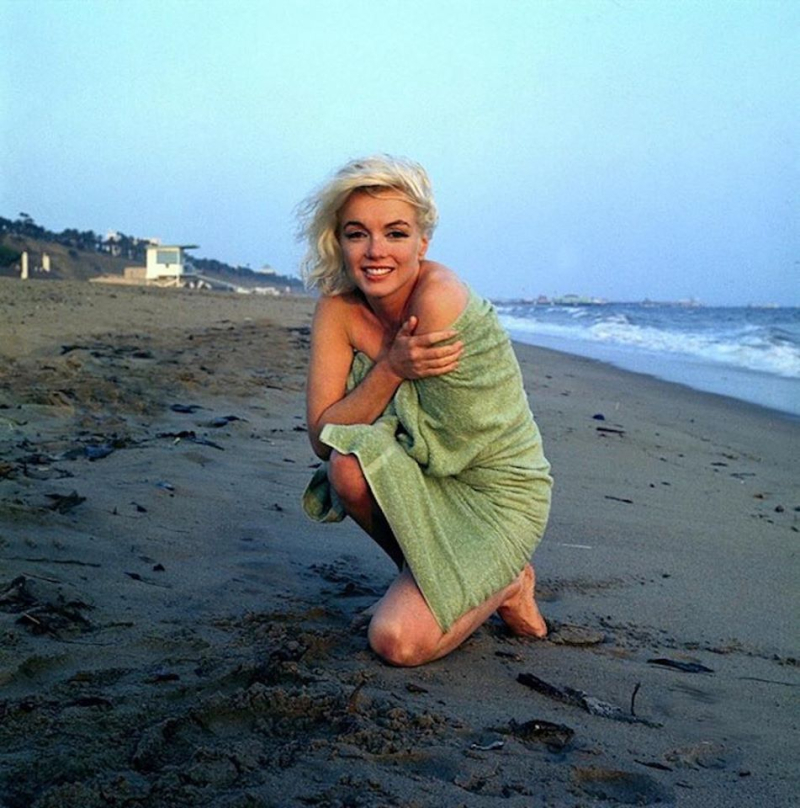
June 1: Happy Birthday Marilyn Monroe


6a00d83451cb7469e201b8d288533c970c-800wi-1

From a letter Thomas Pynchon wrote to his former Cornell friend and roommate, writer Jules Siegel, in the early 1960s — Siegel published a portion of the letter in a 1965 issue of Cavalier magazine. He wrote that, "Pynchon, hiding out from the world in Mexico City, wrote on blue-line graph paper to a suicidal writer friend":

"When Marilyn Monroe got out of the game, I wrote something like, 'Southern California's special horror notwithstanding, if the world offered nothing, nowhere to support or make bearable whatever her private grief was, then it is that world, and not she, that is at fault.'

"I wrote that in the first few shook-up minutes after hearing the bulletin sandwiched in between Don and Phil Everly and surrounded by all manner of whoops and whistles coming out of an audio signal generator, like you are apt to hear on the provincial radio these days. But I don't think I'd take those words back.
"The world is at fault, not because it is inherently good or bad or anything but what it is, but because it doesn't prepare us in anything but body to get along with.

"Our souls it leaves to whatever obsolescences, bigotries, theories of education workable and un, parental wisdom or lack of it, happen to get in its more or less Brownian (your phrase) pilgrimage between the cord-cutting ceremony and the time they slide you down the chute into the oven, while the guy on the Wurlitzer plays Aba Daba Honeymoon because you had once told somebody it was the nadir of all American expression; only they didn't know what nadir meant but it must be good because of the vehemence with which you expressed yourself."