Christmas With The Cobweb

6a00d83451cb7469e2022ad3a9585c200d-800wi

“On The Cobweb, I’d arrive on the set and there he’d [Vincente Minnelli] be up on the boom, zooming up to the drapes, and I thought to myself, ‘He’s really in heaven now.’ The bloody drapes. It was all about the goddamned drapes in The Cobweb.” – Lauren Bacall

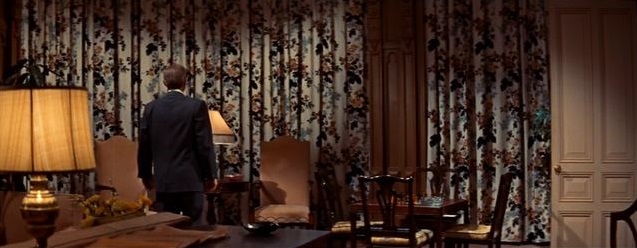
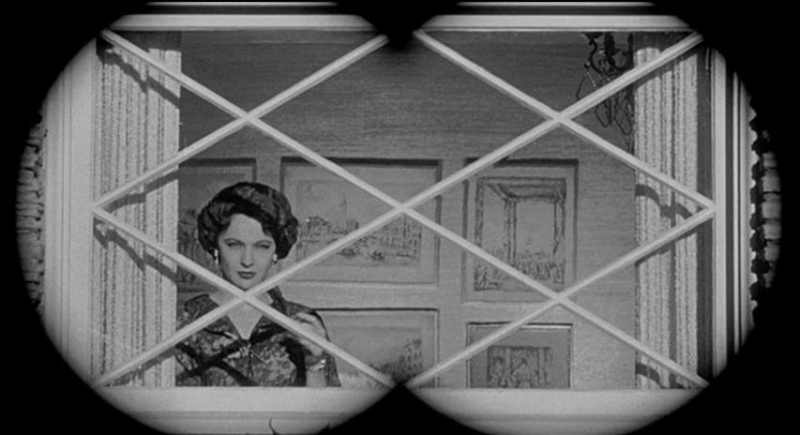
The drapes. The drapes in the library of the high-end private psychiatric clinic. Those dreary old Lillian Gish Miss Inch chosen drapes just hanging there for decades – taunting, not only the patients, but the doctors even more – enough to cause tense confrontations, enraged phone calls and … if you put your subtitles on while watching the movie, “fabric ripping.” Anyone who’s seen Vincent Minnelli’s The Cobweb (1955) knows what I’m talking about because those drapes and the trouble they cause – who will order them, what will they cost, which material will be chosen, colors, colors are so very important, who will design them, will it benefit the patients, will it help Gloria Grahame’s marriage, will it ruin her marriage, will those drapes ruin everyone, will people die – are the dramatis impetus of the entire movie. It sounds absurd – drapes – and at times it very much wonderfully is, but it’s an absurdity rooted in a reality in which something as supposedly inconsequential as window dressing pulls out heightened emotions in various people – people at vulnerable stages in their lives. Focusing on those damn drapes, something to prettify a room, to obscure outsider view, to showcase taste, it is also a focus that could create anxiety and depression. It also works to detract a person from their actual problems. I’m fine! It’s the drapes!

6a00d83451cb7469e2022ad383554e200c-800wi

What’s powerful about The Cobweb is that the coverings always unmask rather than obscure – which speaks to the filmmaker as well – color, patterns, furnishings, design were important to Minnelli, who shoots these details with such intensity you can practically feel the hues vibrating from the scene (Some Came Running, The Bandwagon, Meet Me in St. Louis, An American in Paris, Two Weeks in Another Town, are some examples – his Vincent Van Gough biopic, Lust for Life, was reportedly his favorite picture, not a surprise for a few reasons, some being Van Gough’s bold colors, thick strokes and then, his madness). In The Cobweb, swatches of vivid drapery fabric sitting on a table between two characters, indeed just the word “swatch,” has never felt so lacerating and intense. Whenever Gloria Grahame holds a swatch in her hand or tosses it on the bed, I get nervous. It’s not crazy to think this material would attract Minnelli. As Mark Griffin wrote in “A Hundred or More Hidden Things: The Life and Films of Vincente Minnelli”:

“For a decor-obsessed director like Minnelli, being handed a story in which interior furnishings play a pivotal role must have seemed like a gift from the cinematic gods.” ‘The Cobweb was a psychological story that appealed to me greatly,’ Vincente said. ‘The thing that attracted me was that it wasn’t about the inmates, although the inmates happen to be strange. It was about the doctors and the foul-ups in their lives… It was so rich in possibilities that I volunteered to direct.’”

6a00d83451cb7469e2022ad383550b200c-800wi

And he fulfilled all of those possibilities directing this movie (in Cinemascope, gorgeous Eastman Color, cinematography by George J. Folsey, a 12-tone score by Leonard Rosenman), with a cast that’s so star-heavy, you expect an Irwin Allen earthquake to shake up such icons. Nope, all Minnelli needed were drapes: Richard Widmark, Lauren Bacall, Charles Boyer, Gloria Grahame, Lillian Gish, Oscar Levant, Adele Jergens, Fay Wray, newcomer John Kerr (Minnelli originally wanted James Dean for the role) and Susan Strasberg inhabit this tony asylum –  the real one and the elegant homes and beatnik apartments – housed by the clinic workers and their wives. It’s fitting then, that the movie opens with the young, troubled artist, Stevie (Kerr) running down a road, only to be picked up by a doctor’s wife, Karen (Grahame), the neglected, kittenish and often angry stunner married to Widmark’s Dr. Stewart McIver. Their discussion? Color: Stevie says: “Red and green… Derain died last fall in a hospital. You wouldn’t know who he was …  He died in a hospital in a white bed, in a white room – doctors in white standing around – the last thing he said was ‘Some red, show me some red. Before dying I want to see some red and some green.’”

The-Cobweb-1955-1

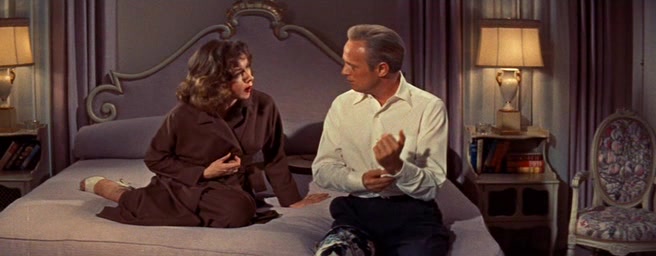
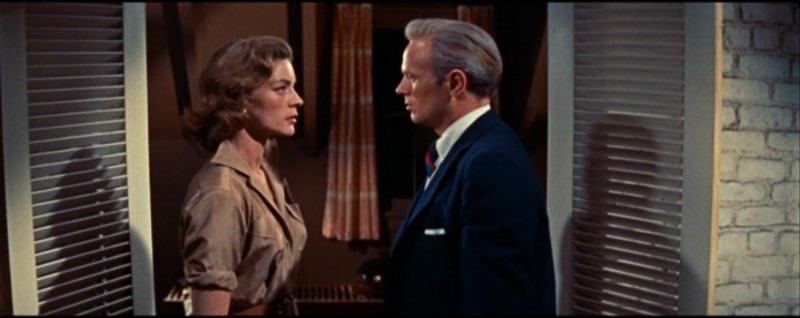
We get to the drapes before Karen even drops off Stevie – their ride to the clinic intercuts with Stewart discussing the new drapes with the dour, by-the-book clinic administrator, Victoria Inch (Gish), who is cheap, and sees no reason to be the least bit extravagant about curtains. Karen later notices the swatches and without telling her husband orders up the new drapes herself – and much more colorful and expensive drapes, to the later horror of Victoria. Karen’s action becomes a bigger problem when Stewart agrees with his patients and the clinic’s beautiful, slightly bohemian crafts director Meg Faverson (Bacall). Stewart and Meg are for the patients designing the drapes – chiefly Stevie. They think this is great therapy, something that will make the patients feel happier and satisfied and useful. But oh my god… the drapes. So much drama in the drapes. More time spent with Meg makes Stewart start falling for her, and less time with Karen makes Karen start unraveling even faster. The carousing medical director Douglas Devanal (Boyer) coming on to her after she strategizes with him and opens up about her marriage, doesn’t help. And it just goes on and on in circles – arguing about the drapes – until Karen becomes furiously proactive and drives to the clinic, hanging those drapes up herself. We should be proud of Karen at that moment, even if it’s destructive. My god, someone did something about the drapes!

We observe the patients, the so-called mad ones, and we see them lose it a few times, chiefly Strasberg’s agoraphobic Sue, and of course Stevie – once the new drapes are put up, he runs again, suspected dead. There’s also the acerbic Levant taking hydrotherapy baths and uttering darkly amusing, disturbing observations (some based on his own psychiatric problems – the movie was adapted by John Paxton from the 1954 novel by William Gibson). But the non-patients are the ones going crazy in The Cobweb and madness seems inescapable – nothing can seemingly contain it – certainly not those goddamn drapes. Grahame (who gives the picture’s best performance – pouty, insolent and vulnerable) talking in a phone booth to a grim Victoria during a symphony is so unusually dynamic, you can truly feel how “sultry” the air is, as Karen explains in the overheated booth. And they’re talking about … well, what do you think they’re talking about? The small, stuffy phone booth is an apt place to be arguing about drapes – these are characters contained in their marriages, their rigidity, their guilt, their losses, their need for expression, and all feel, to varying degrees, on the verge of exploding, of running, whether out of something or back into their own torment.

6a00d83451cb7469e2022ad3c90516200b-800wi

There’s hints of Charlotte Perkins Gilman’s “The Yellow Wallpaper” here (“It is the strangest yellow, that wallpaper! It makes me think of all the yellow things I ever saw-not beautiful ones like buttercups but old foul, bad yellow things.”) though Minnelli’s characters are stuck in an unstable rest cure in their own minds, with drapes and bright flowers and Gloria Grahame’s red lipstick, which at times looks almost running from the corner of her mouth – she always seems just a little mussed, not matter how beautifully dressed. Mussed seems appropriate as Minnelli cracks his characters over the head with the drapes and he never let’s go of those swatches for a second. Stewart says, Before we know it, we’ll have so many drapes around here we’ll wrap the clinic up in them.” He’s almost right. By the end, someone will be wrapped in those drapes. Literally. For comfort. For calm. Watching Karen wrap Stevie up in the dreaded drapes like a blanket – oh, god – it’s not so calm. And, yet, the drapes have served some kind of utilitarian purpose. Which, seems at this point, well, insane.

Who Killed Teddy Bear?

6a00d83451cb7469e2022ad382ae70200c-800wi

“I was a lesbian owner of a disco who fell in love with Juliet Prowse and got strangled on Ninety-third Street and East End Avenue with a silk stocking by Sal Mineo. Jesus, who’s not going to play that part?” – Elaine Stritch

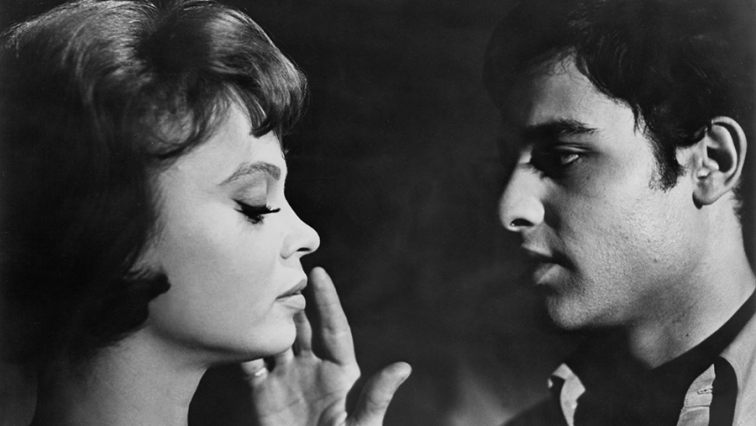
Joseph Cates’ Who Killed Teddy Bear is a movie that lives in its own kind of sickly stunning, neon-blinking 1965 New York City nightfall – a terrifying and terrified world that’s drawn towards deviancy while desperately running from it. A world that punishes perverts via men who become so obsessed with punishing perverts, that they become perverts themselves; and perhaps even more demented than the nutjobs they bust. A world that observes the beauty of the pursued, but relishes, indeed pants over the beauty of the pursuer, focusing very specifically on the physicality of the depraved. And that’s a depraved Sal Mineo, which is really something quite unique and disquietly beautiful here.

Juliet-Prowse-Who-Killed-Teddy-Bear-1965

It’s a world in which an independent, intelligent female disco DJ – all health and sweet sexiness – a single woman who should be free enough to walk to work or to dance with unabashed joy, finds herself terrorized by an obsessed stalker who torments her with upsetting, escalating obscene phone calls. He also watches her. And follows her. In fact, he works with her – she just doesn’t know it. Kind-hearted woman that she is, she’s nice to him.

But she, Norah (an impressive, lovely Juliet Prowse) is a brave heroine, and one based on the very real feelings women have when being stalked. She doesn’t want her world enclosed by a psycho. She doesn’t want to be constantly scared. She doesn’t want to check her back every time she leaves her apartment. She’s scared but it pisses her off that she’s scared. Because now she will have to check herself – that’s the world the movie also walks us through – Norah’s loss of freedom as this crazy life rages outside and around her, bodies dancing, hair swinging, to the music she plays. She can’t live her life trapped like this anymore.

6a00d83451cb7469e2022ad3c85cab200b-800wi

So then there’s the police – who wants to drag the police into all of this? As a woman she senses this will become a whole other drama, or useless. But she must involve them, and so the police detective who comes to help her, Lt. Dave Madden (Jan Murray), does not arrive in the form of the upright, steadfast F.B.I. agent Glenn Ford in the much tonier obscene phone call thriller from a few years before this one – Blake Edwards’ darkly beautiful Experiment in Terror.  No, the detective who comes to her aid is one who listens to disgusting cases on tape, of men saying sick-o things to female victims, and within earshot of his ten-year-old daughter (when his child sees Norah she asks her father if she’s a “hooker”). He also has books like “Sadism and Masochism: Vol. 1” and magazines like “Teenage Nudists” splayed out on his desk in full view of his little one. Research. Indeed it is research, but this guy really really loves his research. His own Police Captain is even creeped out by him and says: “Dave, you’ve gone over the line. You’ve joined them.” You’ve joined them.

But, as Dave protests, his daughter has to know there are perverts out there in the world and he’s not going to shield her from it, even if apparently, he becomes one himself. After all, his wife was raped, murdered and mutilated by a psychopath. Oh. Yeah, that part. As you can imagine, Norah is a little disturbed by all of this. But, hey, this is all she’s got right now. Her lesbian boss (played by a fantastically acerbic Elaine Stritch) makes a pass at her, and in a wonderfully shaded scene, nice Norah keeps saying, “If I’m wrong, I apologize.” She doesn’t want to offend this woman but she also wants to be left alone. Her boss does leave, and is then … murdered by her stalker. OK. Now what? And what the hell can she say to a police detective after he tells her that kind of backstory?

What the hell do you say or make of anyone or anything in this movie? It’s a potently bizarre little cookie, but it’s not entirely foreign in terms of our primacy and darker curiosities. If we’re truly honest about how much as viewers we are drawn towards darkness and depravity – in terms of watching it – and the mixed emotions of exploitation – Who Killed Teddy Bear? plays less like a trashy curio and more like the compelling character study that it is. I don’t really think there’s anything trashy about this movie at all, in spite of its reputation. Of course we are a little disturbed, and at times, thrilled and strangely delighted, maybe even nervous by the odd characters – chiefly, the stalker’s little teenage sister. She has been brain damaged after seeing him sleep with… their mother? A family member? (I’m still not certain) and falling down the stairs. There are incest vibes are all over these two, and yet, he’s always trying to protect his sister, unlike the weird-ass police detective who think his daughter should actually hear obscene phone calls as she’s going to sleep. But it’s not necessarily the lurid content of the picture that’s interesting in and of itself – it’s not there for cheap thrills or laughs – it’s the curious mixture of dual pathologies viewed with a tonally discomforting poignancy. That tonal discomfort and power is in large part due to the picture’s real star – the obscene caller, Lawrence, played by a brilliant Sal Mineo.

3bc08305da509538a526b27e120b089e

It’s one of Mineo’s greatest performances and shamefully not seen or discussed enough. Mineo’s large-eyed vulnerability so powerful in Rebel Without a Cause, Crime in the Streets and Dino, is heightened and morphed into a grown-up man here – primal and strong and damaged and, yet, disarmingly helpless. He’s sick in the head but something made him that way. That the picture is fixated on him sexually was a bold move for Mineo. Mineo said:

“I played a telephone freak, and we were having this hassle with the censors. In some of the shots while I was on the phone they wanted to sorta suggest that I was masturbating, but I couldn’t be naked. So I was just wearing jockey shorts. It turned out that was the first American film where a man wore jockey shorts on-screen.”

Those jokey shorts didn’t exactly help his career, in spite of some fine notices for his performance, which seems unfair watching it now. The lingering on his body, and instead of Prowse’s (which is how it would normally go), is fascinating, and it happens in ways that manage to not feel exploitative, but more artful, more leeringly thoughtful, if that makes any sense. In this movie, it does. (Even Norah tells him he’s got a nice body) We’ve turned our eyes on the stalker – we stare at him. There’s the tightness of his clothes, an extended, bare-chested work-out scene where he seems to be powering through perversion (or stoking the fires), there’s a pool scene in which his suit is much more revealing than Prowse’s, and a dance in which Mineo’s shirt shows off his midriff – these scenes are all here to take in, but we truly think about what we’re looking at, because, how perverse are we?

6a00d83451cb7469e2022ad3c85cdd200b-800wi

The movie turns the gaze back, makes us wonder what that weird police detective wonders (probably not Sal Mineo), and removes the idea of watching this movie to get an eyeful of Prowse. And, looking at how gorgeous Sal Mineo is – we ask, why must he be so sexually screwed up? Why can’t he just enjoy himself? Even Norah wonders this.

There’s a lot of wondering going on with Who Killed Teddy Bear? There is nothing like this picture – the closest I can compare it to is the pictures of Andy Warhol and Paul Morrissey or the novels of Hubert Selby, Jr. – there’s a downtown pulp and a gritty art to it – but it’s really in its own universe. The black and white cinematography by Joseph C. Brun (with Taxi Driver’s Michael Chapman as assistant camera) is gorgeous and experimental. I’m not sure why some find this picture junky – you can imagine Edie Sedgwick slinking into the frame and sizing up young Sal.

6a00d83451cb7469e2022ad382ae92200c-800wi

And Mineo takes this performance so much further. As I’ve written before about this picture, you might be thinking about beefcake, but it veers into a beefcake where violence and sex messes up a traumatized character’s mind, who happens to look like someone Lou Reed would sing about (someone like Little Joe). And then you’re thinking about Mineo, the actor, the characters he’s played before, and characters he is perhaps running away from as his career was changing. Take a look at your “switchblade kid” now. And, really, take a look. Everyone else in this movie does.

From my piece in Ed Brubaker's Kill or Be Killed

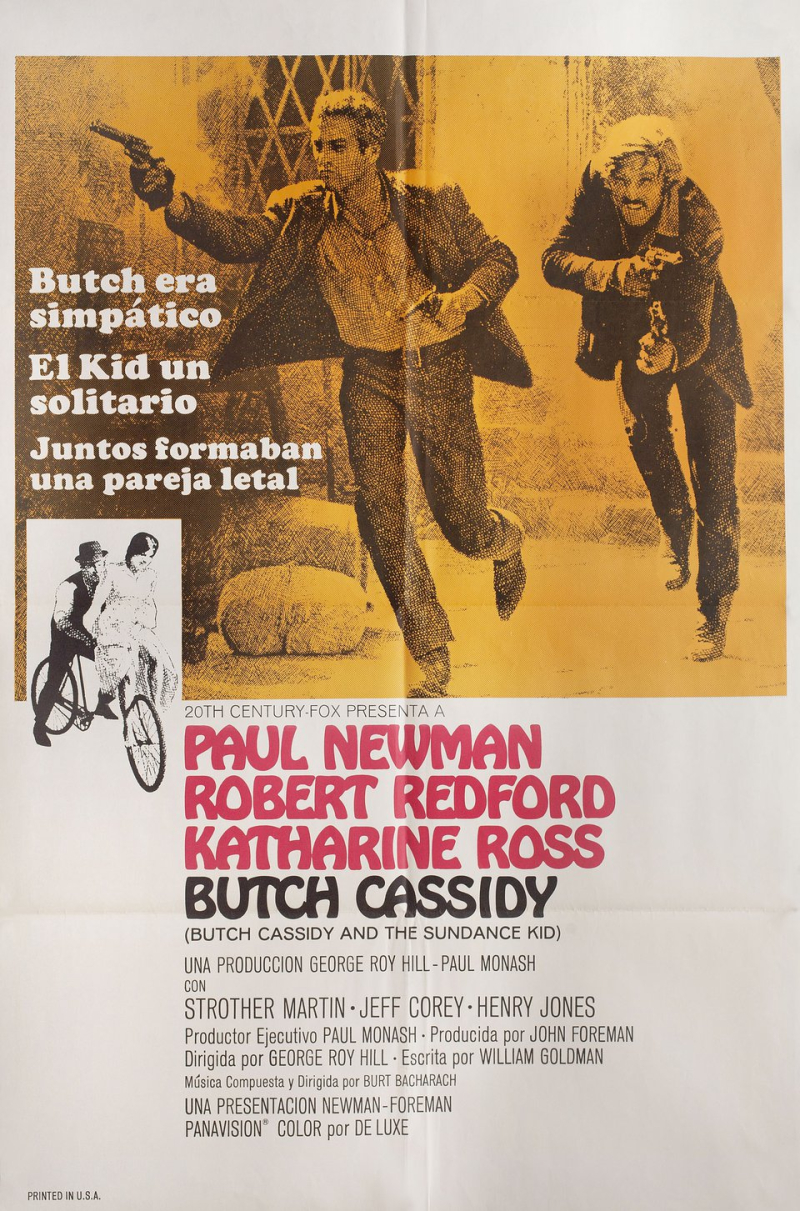
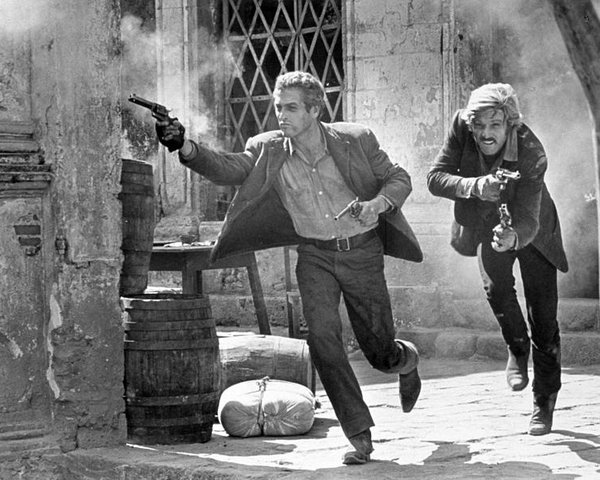
Butch Cassidy and the Sundance Kid

6a00d83451cb7469e2022ad382456f200c-800wi

The New Beverly has re-opened this December. The first movie they played? Butch Cassidy and the Sundance Kid, a favorite, and one I was pleased to write about for the theater. Here's my piece. Welcome back, New Beverly! Christmas came early.

"Every studio but one rejected it…The studio head said, ‘Well, I’ll buy it if they don’t go to South America.’ I said, ‘But they went there!’ He said, ‘I don’t give a shit. All I know is John Wayne don’t run away.’” – William Goldman

Butch: You know, when I was a kid, I always thought I was gonna grow up to be a hero.

Sundance: Well, it’s too late now.

Butch: What’d you say something like that for? You didn’t have to say something like that.

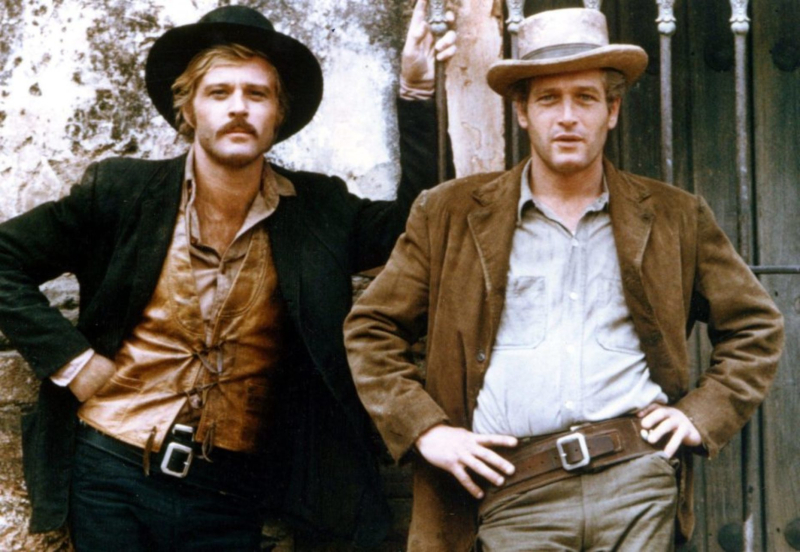
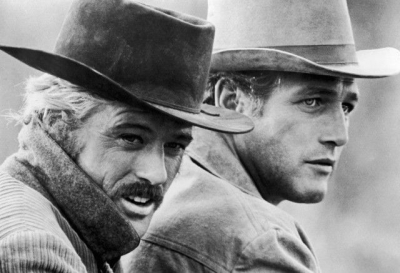
Newman and Redford. Butch and Sundance. We know those faces. Those beautiful, almost ridiculously handsome, rugged, wrinkly-eyed smiling, goddamn charming faces. And those eyes – those twinkly and soulful eyes – these guys were made for the cinema beyond their physical beauty – they said so much with their eyes and in such different ways, and with a power that is, like the western anti-heroes they are portraying, instantly mythic.
Accd63f215ad55def2e3637332af512b

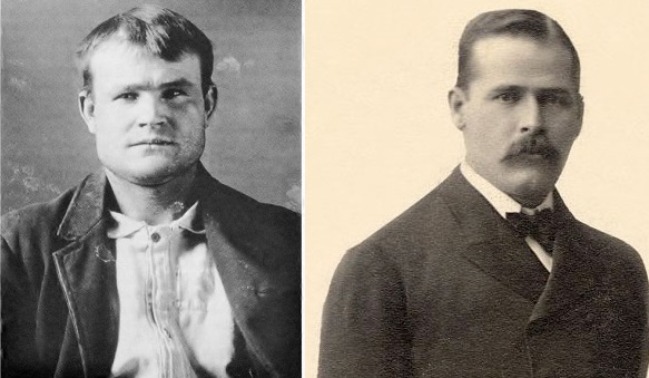
In fact, it’s Newman, Redford and William Goldman that made the men – Butch Cassidy and the Sundance Kid – truly mythic – the real-life pair, not a household name before the picture, could have been forgotten by the mainstream world had the movie, Butch Cassidy and the Sundance Kid, never been made. But no one will forget them now. And there’s something ultimately touching about that. These two guys living and dying as the last outlaws during the remnants of the Old West, men who were up against the modernization of the world (while taking advantage of it – until they couldn’t outrun it), are emblazoned in our minds because of technology – the movies. And not just the movie made about them, but the big screen mythology of the western outlaw that was occurring in their own time – Edwin S. Porter’s The Great Train Robbery came out in 1903 – five years before Butch and Sundance ended their lives in Bolivia. I wonder if they saw it? I can only imagine the possible glee (or anger – and screenwriter William Goldman thought of this too) on their faces. Even with the few photographs of the real life Butch and Sundance, I picture them sitting in the theater as Newman and Redford, smiling and elbowing each other, or angrily objecting (young Sundance, in fact, then Harry Longbaugh, as cited in Thom Hatch’s wonderful, The Last Outlaws: The Lives and Legends of Butch Cassidy and the Sundance Kid, wrote to a newspaper to set the record straight about his undeserving status as “one of the most dangerous outlaw in the West: “I read a very sensational and partly untrue article, which places me before the public not even second to the notorious Jesse James…”). There they are, in my mind, taking in the same kind of crime they had committed, listening to the audience oohing and awing in rapture.

6a00d83451cb7469e2022ad3a852a6200d-800wi

Think of it: Butch and Sundance, looking at that in-your-face medium close-up of Justus D. Barnes as he shoots his pistol point-blank. And the amazement in the audience! To think that one day Butch and Sundance would also be on that big screen – they likely never anticipated that. They too, would get their close-ups. And people would flock to see them. So, yes, I imagine their eyes, whether Butch and Sundance or Newman and Redford (now I am blending the two images – see how mythology melds in your mind?) pondered the thought.

And those eyes are lit up.

Director George Roy Hill opens the film with newsreel footage resembling Porter’s train robbing revolution, elegiac music playing along. This isn’t just a happy story, we are already warned: this won’t end well.

Similar to my imaginings of Butch and Sundance watching themselves on screen, the superb title sequence was originally conceived as a scene in the movie. As discussed in Art of the Title, Butch and Sundance and Etta all view this in a theater in Bolivia – and are upset by it. Considered too downbeat within the flow of the film, Goldman moved the silent film idea at the start of the picture, setting the viewer instantly within the myth – an excellent decision. It’s a wonderful, unforgettable opening, a touching meta-moment – we watch a movie within a movie about the end of our protagonists and their Hole in the Wall gang followed with the print-the-legend: “Most of What Follows Is True.”

6a00d83451cb7469e2022ad3a8529a200d-800wi

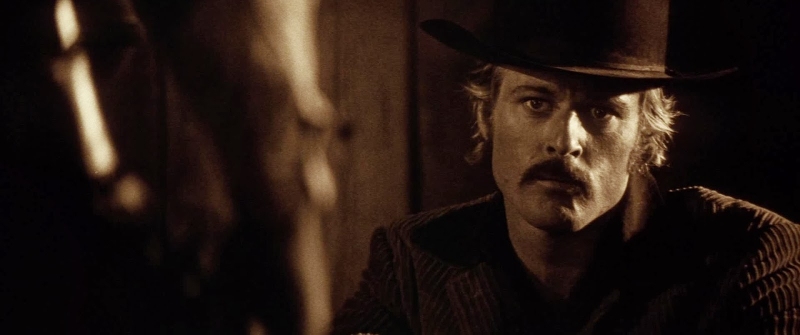
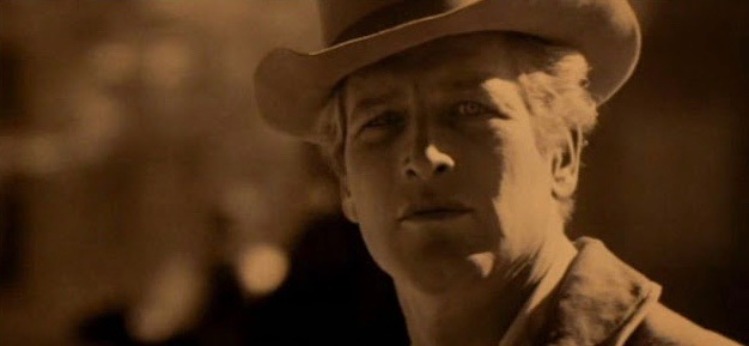
And then… that beautiful shot of Paul Newman as Butch Cassidy, shot in sepia. The rack focus from the reflection of a bank in a window to Newman’s face –  staring out at it – his eyes casing the place. Hill, cinematographer Conrad Hall and Goldman were clearly thinking of John Ford’s decree: “The main thing about directing is: photograph the people’s eyes”

There’s a lot of watching in this movie as Butch and Sundance are either casing or keeping an eye or being watched by others. The camera watches, their girlfriend watches, the viewer watches, the law watches, the super posse watches, they even have to watch themselves in a certain respect. And it seems the more everyone watches, the more everyone loves them – even if they hate them. It’s not superficial or a bunch of mush either, it’s not just physical attraction – it’s the chemical makeup of these two guys and what they project. In a Tracey and Hepburn way, in a Mirna Loy, William Powell way, in a Laurel and Hardy way… And as everyone watches, people see what they want to see, as Goldman’s screenplay introducing Butch puts so succinctly, so lyrically:

“He is Butch Cassidy and hard to pin down. Thirty-five and bright, he has brown hair, but most people, if asked to describe him, would remember him blond. He speaks well and quick and has been all his life a leader of men; but if you ask him, he would be damned if he could tell you why.”
6a00d83451cb7469e2022ad3c7fc13200b-800wi

Butch approaches the guard at closing time and asks what’s happened to the old bank. Butch says, rather disarmingly, that it was “beautiful.” The Guard tells him that people kept robbing it. “That’s a small price to play for beauty,” Butch opines. And from that gorgeous line comes the gorgeous intro of … Sundance. Another close-up, another shot fixed on the eyes – this is almost two minutes of Robert Redford playing poker, and we just keep looking at him, and for so long that it feels cinematically daring. Who is this guy? Well, we all know now, but at the time, we are looking at a true star-is-born moment. The Sundance Kid will never be forgotten because of this image and because this is Redford as what we know and think of as ROBERT REDFORD (the all caps ROBERT REDFORD).  There’s so much mythmaking in this moment that it feels beyond cinema. There’s a reason he’s called a star.

6a00d83451cb7469e2022ad3a852be200d-800wi

Hill insisted on this majestically lit Conrad Hall close-up and to hold this shot at length because he wanted the audience to know that we are staying with this guy through the entire movie. This isn’t just some actor playing poker, some guy who will get shot in the first five minutes, this is one of the two who we will be following, rooting for, and falling in love with alongside that well-established star, Paul Newman. To think that anyone needed convincing of Robert Redford seems almost absurd now, but then he wasn’t a huge star. And so, again, to watch the mustachioed 32-year-old stoically playing poker, hat brim low, eyes piercing the darkness, and thinking of all that Redford will become (not to mention the Sundance institute) underscores how important a film entrance like this was. Redford, whom Hill fought for as Sundance (producer Richard Zanuck couldn’t see it – until he watched the dailies and realized how very wrong he was), won out on casting, and the rest, as they say, is history.

Sundance_hed

The picture moves from sepia to full color, and we drink in Hall’s stunning compositions (shot in Zion National Park, Utah) as the men ride their horses, completely in tune with nature. Watching Butch and Sundance slowly ride through a stream is such a simple thing of beauty, so exquisitely and meticulously shot by Hall, that we’re simultaneously at peace and in awe. Hall’s framing carefully keeps them in balance and not dwarfed by the landscape, even as its majesty is all around them – this is where they belong, this is where they seem content. Amy Taubin, when discussing Redford in a brilliant essay, described a scene later in the picture when the two are on the run:

We see a close-up of Sundance as he surveys the terrain below, and from his point of view we see a sweeping moving-camera shot of vast stretches of plains and hills, dappled by the sun. Sundance is on the lookout for their pursuers, but his gaze is also smitten by the beauty of the landscape. No actor other than Redford could have turned, however briefly, a bittersweet comedy about two charming bank robbers into a tragedy of disenfranchisement.”

6a00d83451cb7469e2022ad38245ae200c-800wi

I love her description there – “a tragedy of disenfranchisement” – she’s so right. As Butch and Sundance ride to their way to their Hole in the Wall gang hideout, we are already lamenting any kind of loss they may feel away from those beautiful surroundings.  As the two men talk, we immediately see that Butch, the leader, is the gabbier one, goofy, full of big ideas – not silly necessarily, there is some gravitas to him – he just doesn’t take life too seriously. Or he doesn’t let on that he does. Why? It could all go away in a flash. Death could be around the corner and he’s seen death, though Butch is not one to kill a man, (he, in fact, only killed one man in his life). Sundance is the quieter, deadlier, more serious one, he’s a thinker, but not without a dry wit of his own – and he’s a wonderful straight man to Butch. They ride and talk:

Sundance: What’s your idea this time?

Butch: Bolivia.

Sundance: What’s Bolivia?

Butch: Bolivia. That’s a country, stupid! In Central or South America, one or the other.

Sundance: Why don’t we just go to Mexico instead?

Butch: ‘Cause all they got in Mexico is sweat and there’s too much of that here. Look, if we’d been in business during the California Gold Rush, where would we have gone? California – right?

Sundance: Right.

Butch: So, when I say Bolivia, you just think California. You wouldn’t believe what they’re finding in the ground down there. They’re just fallin’ into it. Silver mines, gold mines, tin mines, payrolls so heavy we’d strain ourselves stealin’ ’em.

Sundance: You just keep thinkin’, Butch. That’s what you’re good at.

Butch: Boy, I got vision, and the rest of the world wears bifocals.

Butch says such proclamations without mere braggadocio – there is a touching blend of intelligence and insecurity, and, if I see it, I can make it happen, kind of attitude. And then of course when you know what happens in Bolivia, the enthusiasm is tempered with our own sadness. Because for such a buoyant movie full of life and fun, brimming with its counterculture heart and its New Wave approach to the Western (Hill is not doing John Ford, he’s not doing Sergio Leone, nor should he, he works with his own strengths, his own deconstructive/reassembling of the myth approach), and there’s a melancholic sense of loss to it all. The juxtaposition of their banter and behavior, modern at heart, and the characters’ collision with the machinery of modernity (they are already being phased out) makes me think of a much less Hollywood movie, a much more iconoclastic, rock and roll movie, Easy Rider (out the same year – 1969) – as Peter Fonda’s Wyatt, a.k.a. Captain America and Dennis Hopper as Billy, are trying to find any kind of freedom in the beautiful open America, only to feel it closing in on them. “We blew it,” Captain American says. And when Butch nears his end, he waxes sarcastic: “Oh, good. For a moment there, I thought we were in trouble.”
B004LQEYAG_butchsundance_UXFX1._RI_SX940_

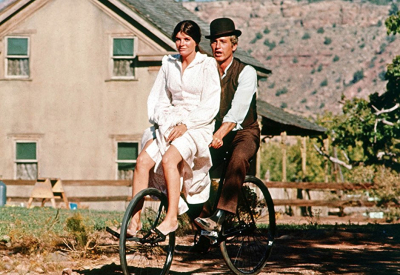
There’s a girl (a woman), and I would say, of course there’s a girl, but this is not the typical movie girlfriend. Sundance’s partner, beautiful, bright schoolteacher Etta Place (a luminous but nobody’s-fool Katharine Ross) lives, in a most unconventional relationship, with both Sundance and Butch. She sleeps with Sundance, but that doesn’t stop her from enjoying a romantic bike ride with Butch (set to B.J. Thomas singing Burt Bacharach’s earworm “Raindrops Keep Falling on My Head,” one of three musical interludes that should be corny, and for some, it is, but it comes off charming – I loved it as a kid when I saw it on TV and I still love it as an adult). That famous bike ride (the bike represents the future) with Butch clowning and flirting and cuddling up to Etta is perhaps the most joyfully romantic moment in the picture – and it’s not even with her actual boyfriend, Sundance (though we don’t know what’s been happening beyond what we see on screen, which is both incredibly sexy and romantic, Noel Coward and Ernst Lubitsch would approve). Etta wonders how it would have turned out had she met Butch before Sundance – would they have become involved? “Well we are involved, Etta,” Butch says, “Don’t you know that? I mean, you are riding on my bicycle. In some Arabian countries, that’s the same as being married.”

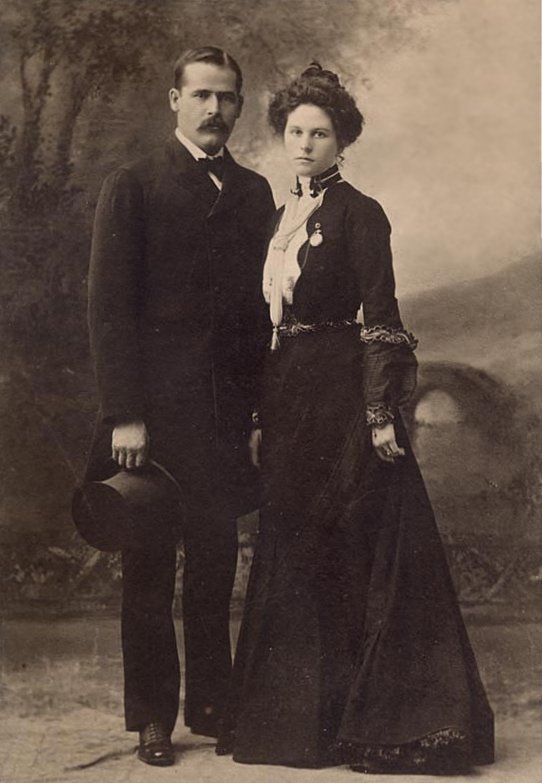
This Jules and Jim situation was somewhat modern in movies in 1969 and was certainly modern, indeed radical, back in the day, as Etta Place really did live with both Sundance and Butch, and likely aided in at least one of their robberies. Looking at a picture of the real-life Etta and Sundance, he suited up nicely, looking slick, and she, so very pretty, wearing a beautiful dress and a watch pendant Sundance gave her, with a soulful look in her eye, you wish there was an entirely separate movie just about this fascinating woman (And there is! There are two TV movies about Etta, one with Ross, I’ve just learned of, that look to extend the mythology – Etta and Pancho Villa? Not sure if they are any good but I now need to check these out – digging to see if there are others…)  Ross plays Etta with a warmth and intelligence and some mystery, and you want to know more about her. She’s a lover, but she’s also game, and she’s smart – she sees the end coming and gets the hell out of there. The real Etta took off as well – never heard from again – I wonder how long she lived? What was her life like? How much she missed those guys. Oh, she must have missed those guys.
6a00d83451cb7469e2022ad38245c9200c-800wi

And we’re gonna miss those guys. For as light as the picture plays – that touching sepia-toned montage of Butch, Sundance and Etta’s high time in New York City, the music, the smirking banter – we know that this almost unseen force, the super posse, which takes up a good final third of the picture, is weighing down on them.

Shot at a distance, the posse is like a machine, emblematic of the future… and the future is the one thing Butch and Sundance cannot shoot their way out of. The amusing refrain “who are those guys?” is funny but also haunting as, really … “who are those guys?” That’s a question many of us could ask when we’re trying to untangle exactly who is at the bottom of it when our lives are suddenly upturned and things are beyond our control.

The great Goldman surely thought of all of this as he spent years researching Butch and Sundance (real names, Robert Leroy Parker and Harry Alonzo Longbaugh – already fantastic names) as this would go on to become one of the most influential works of screenwriting – a gold standard for not just the buddy film genre, but for screenwriting in general.  Numerous filmmakers have been influenced by it including, not surprisingly, Shane Black, who said, “I studied William Goldman’s writing style, especially the scripts for Marathon Man and Butch Cassidy and the Sundance Kid. I found both of those to be really riveting, entertaining in their own right, as if you were reading a condensed novel good for one sitting.”
6a00d83451cb7469e2022ad3c7fc4a200b-800wi

It does read like a condensed novel – and you can understand why Goldman went lyrical with these men – their lives were not just mythic, but incredibly real – they came from hard working, religious backgrounds where the American dream is always out of reach. Both Butch and Sundance watched their parents work themselves to the bone, never getting ahead, and, after attempting backbreaking work themselves, decided – this is not for me. What is the point of this? Working without joy, working without profit? Why do this?

Much like the audience the film would amass, these two antiheroes were turning on, tuning in and dropping out

Goldman’s brilliance and dedication shine sin the way he subtly added layers of their biography and truth to the story without subverting the flow of the narrative, and you get glimpses of their past in pointed remarks or even double-meaning jokes. At one point Butch says to Etta, “I swear, Etta, I don’t know. I’ve been working like a dog all my life, and I can’t get a penny ahead.” And Etta answers:  “Sundance says it’s because you’re a soft touch and always taking expensive vacations, buying drinks for everyone, and you’re a rotten gambler.” Butch quips: “That might have something to do with it.” In Sundance’s poker playing introduction he’s asked the secret of his success: His answer “prayer.” The answer is both ironic and earnest – coming from a religious background, prayer, even if rejected, likely never left him.

6a00d83451cb7469e2022ad3c7fc52200b-800wi

By the picture’s end, we know they’re gonna die (we know it earlier, in fact, as the film’s opening newsreel footage reads “The Hole in the Wall Gang, led by Butch Cassidy and the Sundance Kid, are all dead now …”), though we’ve been so charmed throughout the picture, and the chemistry between Newman and Redford that we may have forgotten. In a beautiful circular fashion, the movie opens with the legend – the film footage in sepia- and closes with the legend, the sepia freeze framing Butch and Sundance as they choose their fate in a spectacular kamikaze fashion. By allowing the soundtrack of the gunshots to continue over the frozen image of our heroes, Goldman and Roy Hill acknowledge the historical that these guys died (exactly how is up for question – they may have fulfilled a murder/suicide pact), but grants them immortality.

We want them to live – but we know their fate. And as an audience member, I think of the worried Etta stating to Sundance earlier in the picture, “They said you were dead.” And of tough, laconic Sundance, brushing past her with, “Don’t make a big thing out of it.” Quickly, the man changes his mind, and in his most moving, romantic moment, he shows his vulnerability and says, “No. Make a big thing out of it.”

We did. We do. And we will keep on making a big thing out of it.

Brubaker & Phillips & Criminal: Blood Simple

6a00d83451cb7469e2022ad37d457e200c-800wi

I’ve returned to the world of Ed Brubaker and Sean Phillips with their fantastic "Criminal" — running monthly, starting January 2019. My essay for this issue is on Joel and Ethan Coen's Blood Simple — look for it!

Blood Simple is a lonely movie. The movie sweats, cries and bleeds loneliness. The road the two lovers, Ray (John Getz) and Abby (Frances McDormand) drive down at night, opening the film, is lonely. Never mind that they are together and about to consummate their union in a hotel room – it’s a lonely road – as remote as Hank Williams’ “Lost Highway,” as friendless as Tom Neal hitching a ride in Edgar G. Ulmer’s down and dirty Detour …

Read the entire essay in January. 

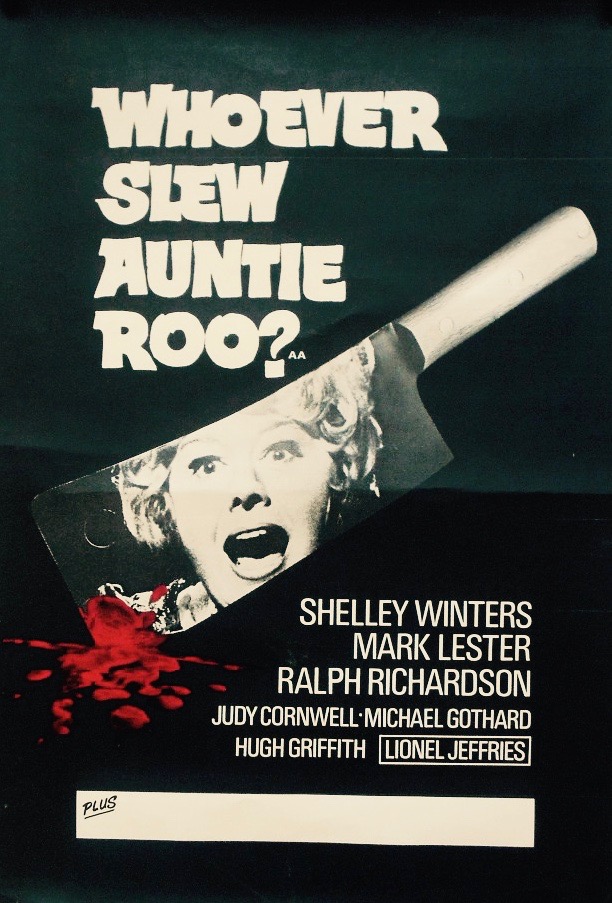
A Winters & Harrington Holiday: Whoever Slew Auntie Roo?

6a00d83451cb7469e2022ad39c97c9200d-800wi

“Shelley did it superbly, with perhaps the thought of her own daughter contributing to the sense of loss and horror she conveyed as the girl’s mummified body crumbles in her hands.” – Curtis Harrington

Auntie Roo is a sad woman. And Christmas would be dismal without the children. Not her children, but the children, the orphans. So, the children must visit. And Auntie Roo must entertain. She will shower the kids with presents and fill them up with treats and laugh and sing and it all sounds so sweet. And some of her loving generosity is sweet but … Auntie Roo is not well. She is, in fact, dangerous.

6a00d83451cb7469e2022ad376785b200c-800wi

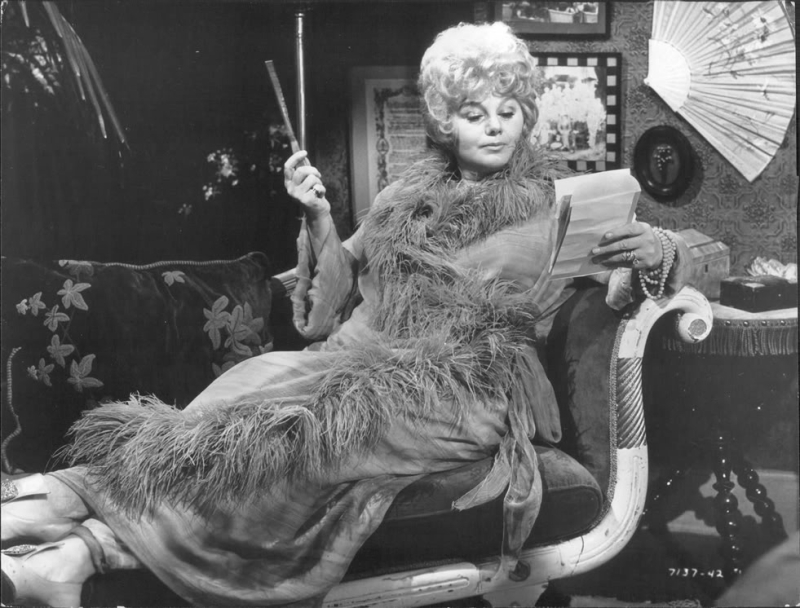
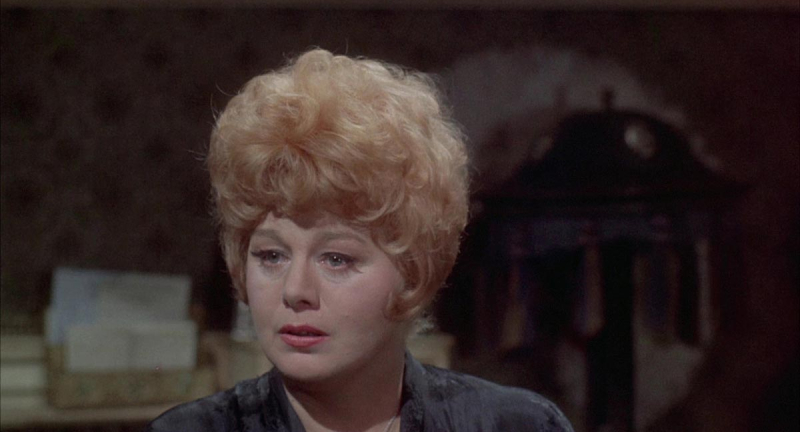
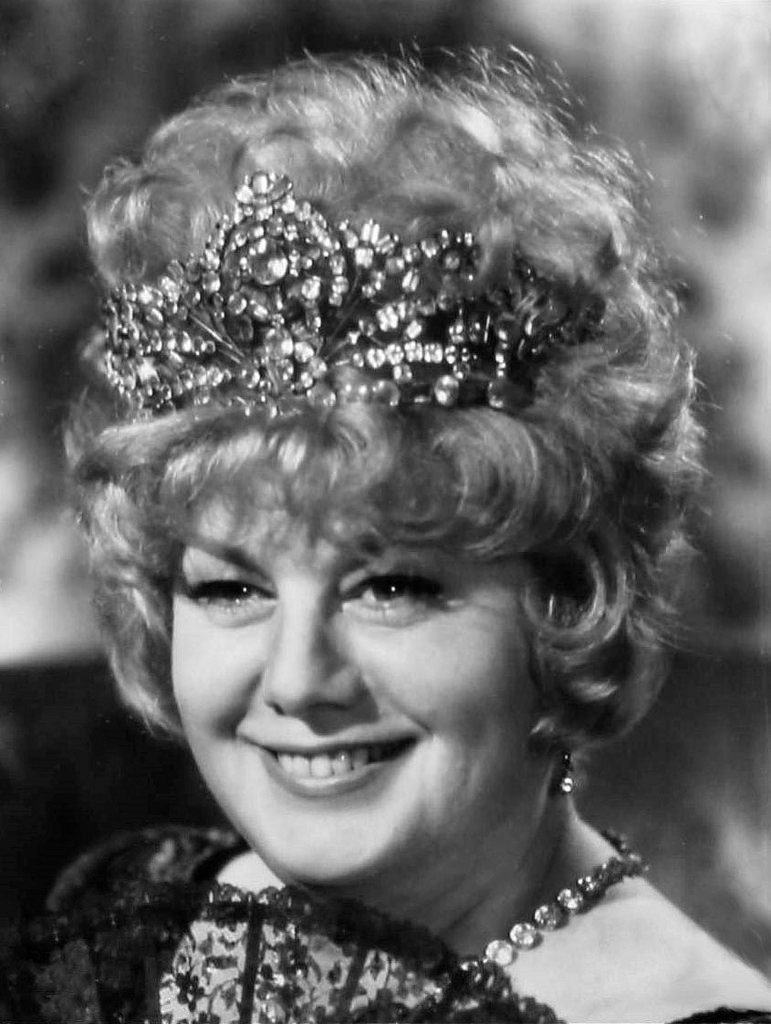
And yet, we don’t dislike Auntie Roo. Not entirely. As Shelley Winters plays this disturbed, lonely lady in Curtis Harrington’s dreamy-creepy Whoever Slew Auntie Roo?, we can only feel sorry for her, no matter how crazy and, at times, terrifying she is – snatching children, screaming for her dead daughter, tending to a mummified corpse… Yes, that’s right. Tending to a mummified corpse. We should be scared of her, perhaps even disgusted by this freaky soul, but we’re more perplexed and intrigued. And importantly, we (or rather, I) have sympathy for her. Much of our sympathy has to do with director Harrington’s sensitivity and insight towards the addled woman at the center of this dark fairy tale, and much of this has to with the performance of a brassy, bereaved Shelley Winters. She is wonderful here – weird, lonely, irritating, vulgar, funny, pathetic and very human – Winters fleshes out what could have been a one note crazy person with almost embarrassing vulnerability.

Banner-6-1073x609

Winters always had a very specific quality of a wounded obnoxiousness that was very much her own, and in certain roles, it could alternate from whiny and pathetic, to irate psycho, to hilarious dame within seconds. No one whines like Shelley Winters (“Ohhh…. I’m lonely!” she moans to Humbert Humbert). Her whining is funny and mortifying and sad and you cringe because it’s just so nakedly needy. You want her to stop and yet her timing is so perfect, you wince, and then you want her to continue. Continue the annoyance, Shelley! At times, she plays aggressively needy to the point of dominance. Like she knows she’s being irritating and does not give a shit – like she’s actually getting off on how annoying she is. In her most pitiful roles, she could feel suffocating to her co-stars and even to the viewer (think George Stevens’ A Place in the Sun), and we feel simultaneously terrible for wishing she’d go away and for her really, truly going away (in the case of A Place in the Sun – tragic Shelley dies). We can’t stand her, and then the poor woman does something or has something done to her that breaks our heart. Winters showcased a complexity and depth that went beyond “the cow…the obnoxious Mama…the brainless baba…” (as James Mason’s Humbert wrote of her in Stanley Kubrick’s Lolita). And she was brave to play such braying, potentially unlikable parts. Brave to be dumpy, brave to be annoying, brave to be braying.

A90467cb56cf174930188c712884b077

And she’s often given such little honor in her more piteous performances, which makes her watery death in Charles Laughton’s Night of the Hunter so poignant, both narratively and stylistically. Shelley is snuffed out, but she is composed in such a hauntingly beautiful shot, that liquid submersion, that Laughton granted her one of the most lyrical deaths in all of cinema. There she is sitting in her watery grave – her hair waving with the seaweed. It’s transcendent.

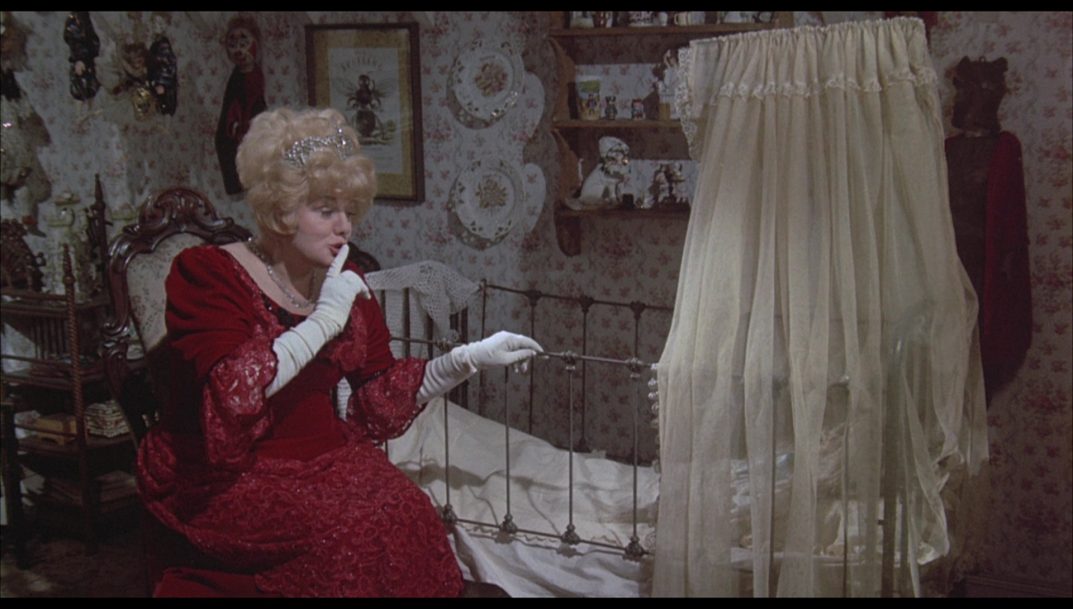
In Whoever Slew Auntie Roo? (set in Edwardian England) she is not afforded such beauty in death, but it’s not an ugly death and we’re not, in fact, hoping she will die, which is interesting. And the moment she’s on screen, we’re curious about her character right away, ready to see what Shelley will do next. Will she complain? Cry dejectedly? Yell at a man? No, her first moment is quite gentle – she is singing, and with nary a whine. Decked out in a maroon gown, a diamond tiara, a diamond necklace, and long white gloves, the sparkling, though faded and melancholic Rosie Forrest (a.k.a. Auntie Roo) sits next to a child’s crib alone, singing the British and Irish Folk song, “Let No Man Steal Your Thyme.” This surely wasn’t just some song Harrington plucked out for old time affect – it seems intentional in tune and lyrics. A song notable for its haunting refrain of “thyme” – a doubling that means your virginity or your purity, or a way of expressing time… Let no man steal either one:

6a00d83451cb7469e2022ad37678cb200c-800wi

“Come all you fair and tender maids That flourish in your prime. Beware, beware keep your garden fair. Let no man steal your thyme; Let no man steal your thyme. For when your thyme is past and gone, he’ll care no more for you, and every place where your thyme was waste, will all spread o’re with rue, will all spread o’re with rue. For woman is a branchy tree, and man’s a clinging vine, and from your branches carelessly, he’ll take what he can find, he’ll take what he can find.”

Will spread o’re with rue… Roo?

There doesn’t seem to be any suitors for Rosie nor does she appear to want one. No man will steal her time. Oh, but the right child – that is different. And it’s not like the world wants Rosie in that way anymore, which is a shame (she’s often fabulous), but the world isn’t a kind place to aging women in mansions who… dance, hold séances, wriggle into costumes for entertainment and, well, bray. Her husband, a magician, is gone forever (she’s a widow), and she lives in an enormous home favored by the town’s children of the town for looking like a gingerbread house. It’s a cheerful place, it would seem, but it’s really not at all – it’s shadowed with death and decay. You see that in the first scene too. After Auntie Roo sings the pretty but ominous tune, she peers into the crib to view a young blonde girl – a delusion – that’s what she thinks she sees (or wants to see). In actuality, it’s the mummified corpse (it had to be said again) of her dead daughter – a dusty gross thing she will place in a coffin. In a dreamy black and white flashback shown later in the picture, we see that her darling daughter suffered a tragic accident on the staircase banister – which seems absurd and almost funny but it’s told with such a fever-pitch of “Oh my god!” that it works. This needless tragedy has made the poor woman lose her mind, and you can understand why, though her methods of remembering the dearly departed are obviously troubling.

MV5BMzNhN2Q5OWEtYTRhMS00MThhLWI4ZmItZGIyNWYwMDM5MmViXkEyXkFqcGdeQXVyMjUyNDk2ODc@._V1_

But back to that mummified corpse – the picture presents the revelation as a shock but somehow it doesn’t play like one – not to me anyway. I think, what else would Auntie Roo be singing to? As the picture surveys the creepy room with its dolls and stuffed animals (shot by cinematographer Desmond Dickinson, whom Harrington wasn’t pleased with – you can see how a moodier look would have been preferable and the cinematography hampers the film a bit) a corpse is not a stretch – even in the first scene. And this could be to the picture’s detriment, but it’s not. The movie works more as a character study and less as a horror movie (which viewers likely expect), or even as a straight-up psycho-biddy – a.k.a. movies in which aging actresses go insane, commit murder or serve rats for lunch. The psycho biddy, hagsploitation or the more preferable, respectful term – Grande Dame Guignol – is a genre I love, no matter how varied the quality of pictures are among them. Some are borderline exploitative, some quite sensitive, but most are full of intriguing insights and psychodrama with fantastic, operatic performances by actresses – movie stars— who don’t just chew the scenery, but tear up the screen, bravely showcasing the unfair horror of aging from a perspective of such intense female fear (and male sexism) that some of these pictures border on the surreal.

6a00d83451cb7469e2022ad3767861200c-800wi

My god, it should not be so scary to age, but in Hollywood, that kind of fear twists into the darkest places imaginable, both absurd and entirely believable. There’s an uneasy feeling to some Grande Dame Guignol – that the films are seeking revenge on such beautiful stars, that audiences, and particularly men, enjoy watching such iconic beauties looking so ravaged and crazy. That they love to see the mighty fall. I love watching them, not because of faded beauty, but because the women are powerhouses and still striking and electric on screen. To me, these actresses are so fearless, so charismatic, and interpreted these parts with such specific style and soul (if we count this movie as one of the first – Gloria Swanson – in Billy Wilder’s Sunset Blvd. is truly her own work of art – and still gorgeous, I might add), that I can only look at their visages with respect and sometimes awe. Shitty men reveling in their demise? I don’t know except, fuck that and fuck those guys. One should admire these actresses for taking these parts and never coasting, giving these films their all (like Joan Crawford in William Castle’s incredible Straight-Jacket). Bette Davis and Joan are the Grande Dames in Robert Aldrich’s Whatever Happened to Baby Jane? and, my god, what performances. What a look and edge Bette crafted – her Baby Jane Hudson is so in your face and shocking that she’s as punk as Johnny Rotten. To rebel and stir it up as a young man? That’s to be expected. To rebel and cause audible gasps an older woman? And as an older actress? That takes some serious guts.

Auntieroo5

With Whoever Slew Auntie Roo?, Harrington delves into this aging, strange, sad woman and two strange, sad children who enter her life with scares not always coming from crazy Roo. The woman can’t let go of her tragic past, she can’t stand to be alone, and the children, chiefly the brother, wants to keep his sister to himself.  In his typically esoteric and compelling way, Harrington updated the “Hansel and Gretel” story wherein the mean lonely witch isn’t always so mean, and the nice abandoned kids aren’t always so nice. It’s a fascinating way to tell the story – with so many shadings – it’s never that simple.

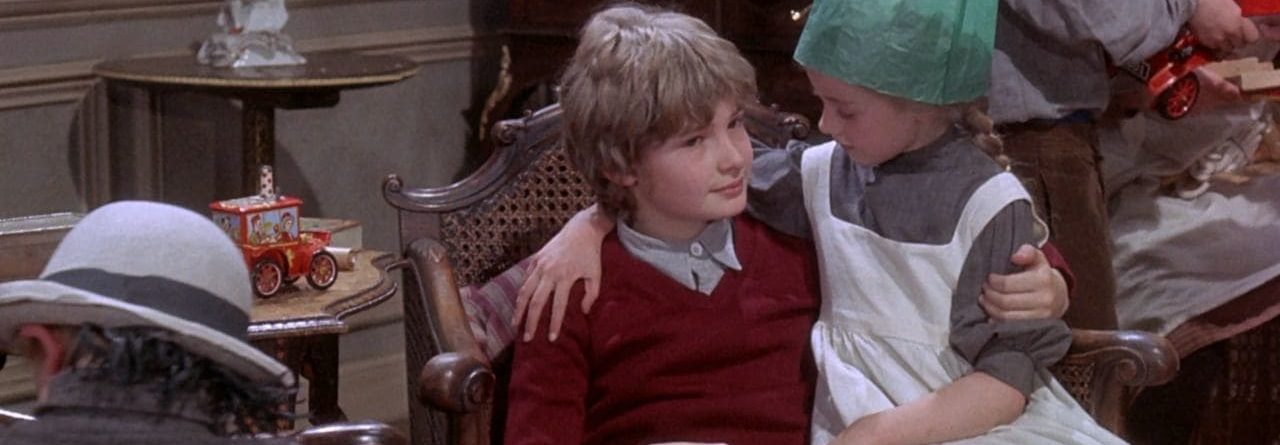
The meaner kid (though that’s too easy a word to describe him) is orphan Christopher Coombs (Mark Lester), who has a vivid imagination, enough to frighten the other children at the orphanage where lives he with this little sister, Katy (Chloe Franks). He’s close to his sister, and he looks out for her, but he’s an odd child. He seems a bit… obsessed with her. But like obsessive Auntie Roo, he doesn’t want to be alone (though he would never believe he had anything in common with that woman). Every year a handful of the most well-behaved kids in the orphanage are allowed to spend Christmas at Auntie Roo’s impressive gingerbread-looking house, only Christopher and Katy are punished (for Christopher’s willful imagination), and not allowed to attend. But they sneak in anyway. They’re discovered and reprimanded, but sweet-psycho Roo accepts them – chiefly because she thinks she recognizes her deceased daughter Katherine in young Katy. Could she be? And if not, perhaps she can make her be. This is when things start going even nuttier.

6a00d83451cb7469e2022ad3bc3880200b-800wi

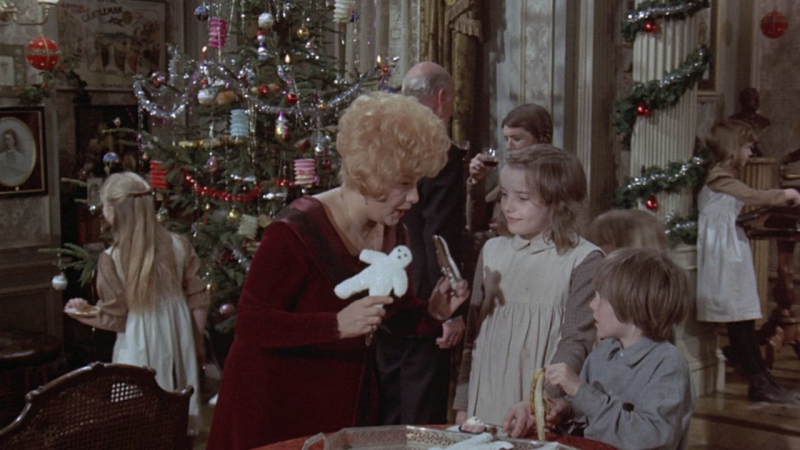
Auntie Roo is charitable with the all of the kids – she throws them a lavish Christmas morning complete with loads of presents under the gorgeous tree. What orphan wouldn’t want to spend the holidays with Auntie Roo? She even sings a song and dances for them— to Gilbert and Sullivan’s “Tit Willow.” But Christopher is suspicious – he sees Katy and himself as a version of Hansel and Gretel and this woman is going to keep them, fatten them up, maybe even eat them. It’s a unique device – Christopher imagining and narrating in his head these scenarios of Roo being a witch. He even climbs into her dumbwaiter and spies on her – she’s singing “Let No Many Steal Your Thyme,” and he witnesses Roo placing her daughter’s corpse in a small coffin, wearing all black and a black veil. Well, that is something. His imagination doesn’t seem so mischievous or wrong at this point – and it’s not. Auntie Roo may not be a witch, but she’s certainly alarming. But no one is going to listen to Christopher because, like the eye-rolling a “daffy” older lady often gets, many people don’t respect children, or believe them. With that, Roo and Christopher are somewhat united, and this is part of the picture’s complicated magic.

Auntie-roo-9-1What I love here is that cultured, innovative, cineaste Curtis Harrington (his entire life was fascinating) – shows such respect and even reverence for certain actors (and all kinds of artists), and actresses in more specific cases, that he understood them for being beautiful, odd-looking and even fading. In older actresses, particularly movie stars, he still saw and appreciated their charisma. From his adoration of Marlene Dietrich (and her mentor, Josef Von Sternberg, of which Harrington wrote a monograph of in the 1950s), to Simone Signoret (whom he worked with in Games and spoke highly of his entire life – she warned him that she was “fat” before starting the picture), to Gloria Swanson (his star of the TV movie Killer Bees, of which he said: “Gloria showed only love and acceptance toward the bees as we poured them on her skin. Kate Jackson, on the other hand, shuddered and was repelled by them.”), to Bette Davis, whom he wanted to work with, and many others. Harrington found these older actresses vital, still interesting, still stars. And in this picture, he allowed Winters a little more depth than a casual moviegoer might expect from a movie within this genre – although, as said, these actresses always gave a lot within the Grande Dame Guignol.

6a00d83451cb7469e2022ad39c988e200d-800wi
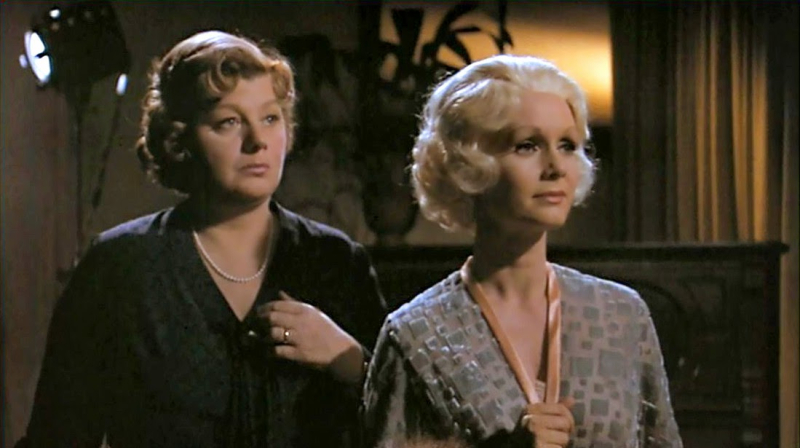
And he allowed her to be something many can relate to –  lonely. Not just pathetic, not just silly or scary, but lonely. Yes, she’s frightening, she’s even funny at times, but she’s grieving and she’s going insane. But Harrington isn’t exploiting this predicament for laughs or easy terror, just as he wasn’t with his fantastic What’s the Matter with Helen?(another one of the greats in the genre Grande Dame Guignol) featuring stellar performances by Winters and Debbie Reynolds (who looked gorgeous). Watching Winters end that picture playing “Goody-Goody” on the piano – with that madness, desperation and sadness in her smile, is truly haunting and incredibly sad. It’s one of Harrington’s greatest pictures among such interesting work, and he really got Winters, no matter how much off-screen drama occurred with the actress.

6a00d83451cb7469e2022ad376788a200c-800wi

Here’s how much he got actresses/movie stars: In his excellent autobiography, “Nice Guys Don’t Work in Hollywood,” he wrote a lovely recollection from the time he was working with Jerry Wald, after he’d directed his avant-garde short films and before his hauntingly beautiful Night Tide was made. One day, he took in the astounding star appeal of Joan Crawford. Harrington talks of watching dailies of an older Crawford in Robert Aldrich’s masterful Autumn Leaves, which he called a “revelation”:

“For the first time, I became aware of what the term ‘movie star’ means. The word ‘star’ in the context of a top movie personality is very appropriate, since astronomically speaking, a star is a body that is illuminated from within. This illumination from within is what I witnessed that day in a projection room at Columbia Studios. The shoot had taken place during the summer. The camera was set on a close-up of Joan Crawford between takes, looking very wilted and ordinary, fanning herself in the heat. Then the clapboard was thrust in front of her, the clapper lowered, and a voice said, ‘Scene eighty-four, take three.’ In that split second, I witnessed an ordinary, exhausted woman center all of her energies and come vibrantly alive as Joan Crawford, the Movie Star. It was a metaphysical experience.

Autumn_Leaves_11-1

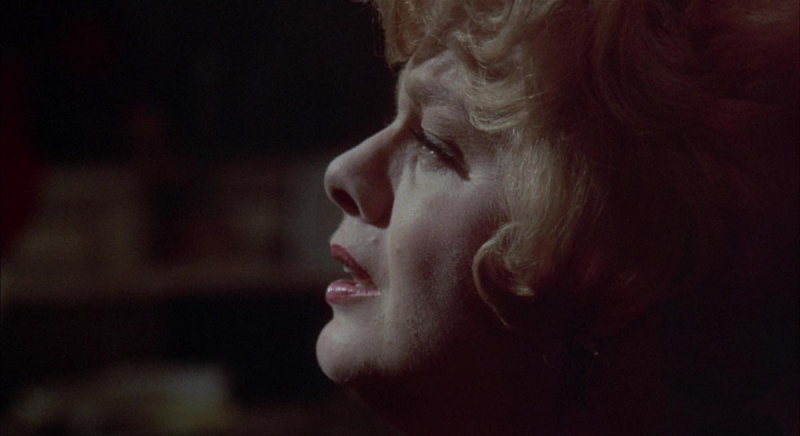
Metaphysical. I’m not sure he felt this strongly about Shelley Winters – she was never Joan Crawford – but he understood Winters’ power and star quality and unique neediness. And he understood her pathos. As Roo holds a séance conducted by fake psychic Mr. Benton (a great Ralph Richardson) with Auntie Roo’s shifty, psychopathic butler Albie (a creepy Michael Gothard) included – they have been tricking her – and you hate them for it. You don’t laugh at her, you realize what awful people are exploiting her. One of the servants, Clarine (Judy Cornwall), is providing the ghostly voice of Roo’s dead daughter, making Roo hold on to hope even more, and Benton to rake in even more dough, that bastard. They’re so unscrupulous, such scumbags, that they don’t feel a thing when a beseeching Roo hollers out for her child: “Oh, Katharine stay! Stay my darling. Please forgive me! Forgive me! Give me another chance! I love you so much! Oh, Katherine! I need you, stay with me! I’m so lonely, stay with… Katherine!!”
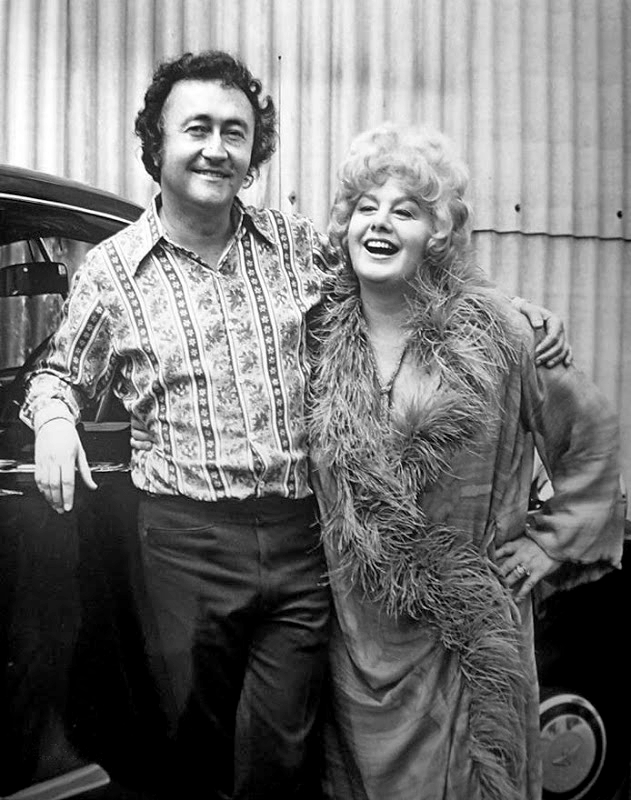
6a00d83451cb7469e2022ad376788f200c-400wi

Dear lord. It’s an intense scene – Shelley howling her desolation (she does this a lot throughout the movie, horrifying and sometimes darkly funny). But after this outcry, the picture does a quick, smart cut to Katy shot from outside of a doleful window at the orphanage, from which she is staring into the grey and depressing landscape. Katy doesn’t know it yet, but she will become Roo’s obsession, and the picture hints that perhaps she is some kind of reincarnation of Roo’s dead daughter. And, so, after Auntie Roo’s Christmas get together is over, Roo really does snatch Katy. Christopher was right in his worry and, yet, you still don’t like him all that much. He’s always scaring people, his sister included, and he doesn’t seem like a good influence on her mental state. He manages to break back into Roo’s house to “save” his sister and I always think, maybe Katy would be better off with Auntie Roo. And, indeed, at one point, Katy does tell her brother that she’d rather live with Roo.

6a00d83451cb7469e2022ad39c9911200d-800wi

Christopher is having none of this and plans their escape while stuffing Roo’s jewels in the back of the teddy bear (reminiscent of Pearl’s doll in Night of the Hunter), Roo gave to Katy (it was her daughter’s before, and the stuffed animal even sits at the séance). But the kids are soon caught and then stuck with Auntie Roo – enduring her combination of creepy sweetness (some of it genuine, some I don’t know what the hell she’s doing) and horror (watching Christopher watch Roo eating is something else – hilarious and bizarre). Christopher has had to survive, and you can’t blame the kid for being hardened and crafty and even a liar and a thief – but there’s a gleam in his eye whenever he sets to antagonizing Auntie Roo, and it looks murderous. Like you can see it – that his future will lead to violence and sociopathy. Though he certainly hates Roo for a solid reason (kidnapping), and he really, truly views her as a witch (he takes his fairy tales seriously, but then perhaps, he takes them seriously when convenient), you feel his fairy tale also fits his purpose of destroying someone. Burn the witch!

ELV46YNSh7CJxkKxcwkjnS7pIJB-1280x445

You can feel the rot in this kid and Lester plays Christopher with such mystery and contempt that the horror shifts – who are we rooting for here?  We should be hoping the kids are free but… we don’t want to see Auntie Roo obliterated. I don’t, anyway. And though these kids must escape, he and Katy take to some drastic, cruel measures to get the hell out of there: they lock Roo in a room and set it on fire. Yes, they burn poor Auntie Roo to death – and that lovely gingerbread house goes up in flames. Whoever Slew? Now we know. But no one else in the movie does.

When Dr. Mason (Pat Heywood) understands what the children have been through, he says: “Poor little devils, they’ll probably have nightmares till the day they die.” Maybe they will. Maybe. Christopher, with his refrain of the story of “Hansel and Gretel,” closes out the movie with this: “Hansel and Gretel knew that the wicked witch could not harm anyone else and they were happy. They also knew that with the wicked witch’s treasure they would not be hungry again. So, they lived happily ever after.”

6a00d83451cb7469e2022ad39c9931200d-800wi

Well, I suppose. But I kind of despise Christopher for torching Auntie Roo. And this will sound wrong, but I do hope he wakes up to one of those nightmares Dr. Mason reckons will occur. Chiefly, one of Auntie Roo, or rather, Shelley Winters, standing there in that gown and gloves and tiara and mummified corpse child, singing softly:

Beware, beware keep your garden fair. Let no man steal your thyme; Let no man steal your thyme. For when your thyme is past and gone, he’ll care no more for you, and every place where your thyme was waste, will all spread o’re with rue, will all spread o’re with rue.

Originally published at the New Beverly.

Stella & Stanton: Fallen Angel

6a00d83451cb7469e2022ad3ab0419200b-800wi

June: “Why did you go to see that girl in the diner?”

Eric: “What girl?”

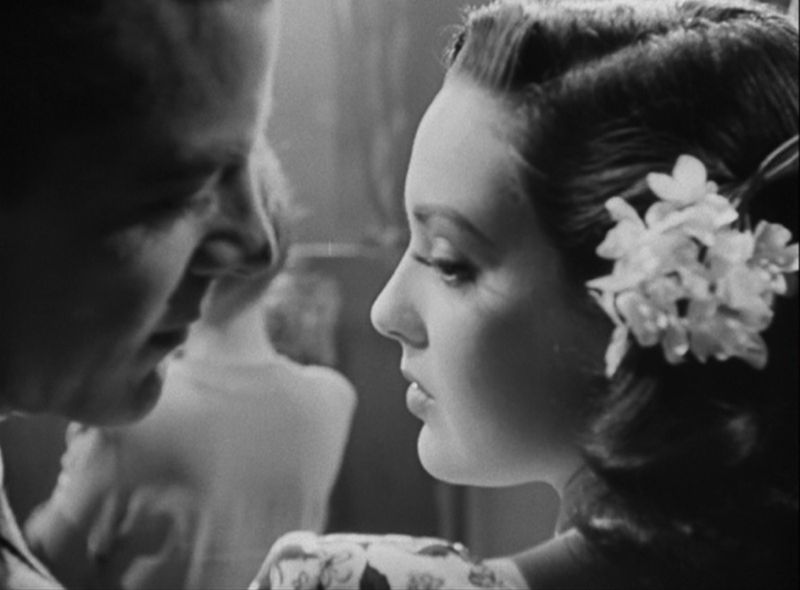
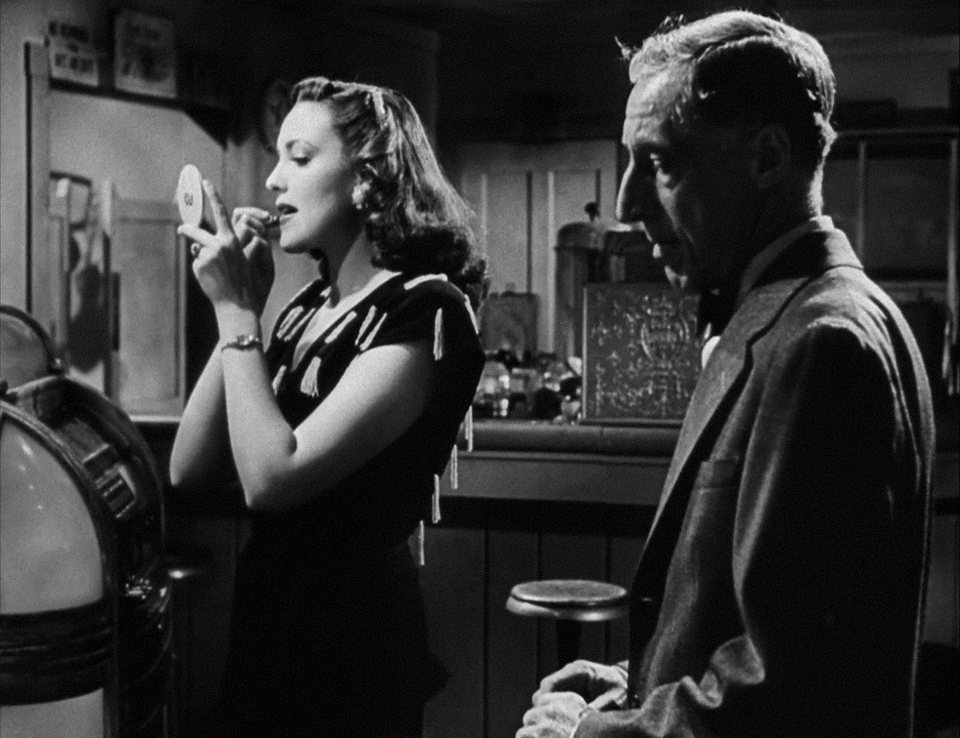
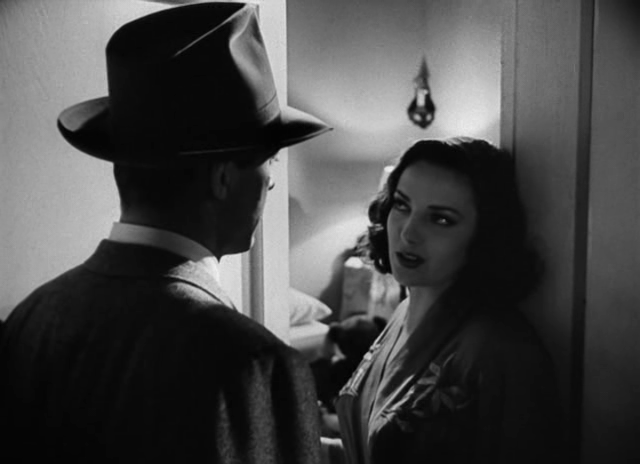
There’s a sickness hanging over Otto Preminger’s Fallen Angel that clings to every location, every set, every fluid camera move, and every off, but very human expression on the actor’s often haunted faces. And it's all heightened by the attraction to one woman — Stella. Oh, Stella (Linda Darnell), the young beautiful waitress at Pop’s Eats whom men want to save, paw, marry, or again, paw.  And of course, more than just paw. What a guy wouldn’t do for a tumble. And what a guy would do when he knows he’ll never get a tumble. But one of those guys isn’t just your usual lust-filled creep, one of those guys will be a murderer. And right away, we see the impending sexual doom — we don't know who or exactly what, but we see it.
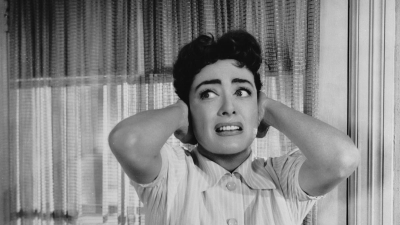
6a00d83451cb7469e2022ad3653265200c-800wi

When the movie opens and our hero (or anti-hero), the traveling con man Eric Stanton (Dana Andrews) steps off the bus and into this dark and misty California beach town, he walks into Pop’s, we take in this gorgeous image and feel it — suffused with sex and danger and seedy hometown rot — the entire picture, shot by Joseph LaShelle, is bathed in this scummy beauty. There’s just men in that diner, and they’re all wondering about one thing — Stella. Where is she? Why has she been gone for so long? Dear god, did she off herself? One imposing, gravely looking man, ex NY cop Mark Judd, (Charles Bickford) says, “Not Stella. Back in New York, I handled 31 suicide cases personally. Everything from poison to jumping in front of the Flatbush subway. Stella's not the type.” OK. So, what type is she, I ask the guy bragging about personally handling suicide? It already appears that nobody truly cares or bothers to actually understand Stella. They just want her to be something to them. And in Fallen Angel, she’s not the type all of these men want her to be. And this goes beyond Stella –  all of the film’s characters, male and female, go against their societal norms of “type.”

E9d50beabe416d5ab2da8770d9e1de31

We’ll be rooting (if that’s the right word) for con man Eric Stanton against the mysterious, almost kinkily violent cop, even when we know Eric is treating another woman (lonely June, played by Alice Faye, who doesn’t want to remain as innocent as see seems) like garbage, and we’ll be disgusted by kindly old Pops who runs the diner, just as Stella is. Pops (Percy Kilbride) hasn’t done a thing to her (on screen anyway), and yet, right away we understand why Stella spits at him, “You make me sick.” Pops has given her the feeble “I told you so” about some cad she went on a date with and he gets … “You make me sick.” Not, buzz off, Pop, or, stay out of my business. Her dismissiveness is seething with the interior dialogue of I know what you want. I know why you “care” so greatly about me and my bad date. I know why I have this job. Ick. Pop. His “paternal” affection might be the creepiest of all. Who knows what she’s had to endure or listen to while she’s re-filling the ketchup containers at closing time.

So, the moment we see her bitterly slump back into the diner, hungry and with tired aching feet — a low rent Laura returning from the dead (indeed, this was a follow up to Preminger’s hit, Laura, with the same leading man, and a similar story of one-woman obsession, only with down-and-outers and much more desperation) – we don’t think she’s trouble, we think these men are. Oh sure, check out the gorgeous supposed femme fatale in the beautiful, lush Darnell who was only 21 when she made this and yet feels like she’s had decades of shit heaped on her (it doesn’t take too many years for a woman to understand this). She’s matter-of-fact tough and fixated on money and marriage, but not really bad.

6a00d83451cb7469e2022ad38b56ca200d-800wi

Everything about her, from the weary way she walks around the diner and hands back change to customers –  this lady is sick of it all. And Darnell is so excellent here, that, like all of these men, we don’t want her to go out of town too long either. We want to see her on screen — in this diner — a limbo of lust. The filmmakers agreed and pumped up Darnell over star Faye, cutting out some of Faye’s scenes and even supposedly her singing number (!), something that upset Faye, mirroring the “innocent” she plays in June. June is the woman Eric marries in order to fleece her, so he can marry sexy Stella and give her what she wants over some tumble in her crummy little apartment — money. Eric even cuts his wedding night short and leaves his wife alone to see… Stella. He wakes up on the couch in the stately home with doilies and nice curtains that his new bride shares with her spinster sister, Clara (Anne Revere) and his wife … forgives him – what the hell is wrong with this woman? He also learns that Stella has been murdered. 

6a00d83451cb7469e2022ad3ab048c200b-800wi-1

This leads to who did it? Eric will be a suspect, as will June’s sister, as will Stella’s almost steady, Dave Atkins (Bruce Cabot) who gets an interrogation and beating so sickening and vicious by Judd (who is now handling the case) that we wonder if this is his disgusting thrill. (It is — he’s a sick man, quite literally) Even Pop is considered a possibility, not a surprise in this world (scripted by Harry Kleiner from Marty Holland’s novel), where everyone has motive beyond their obsession. Yes, there is Stella, but there’s loneliness, bitterness, impotence, and what the hell am I doing with my life? Do I matter at all in this universe? All of this existential angst narrowed in on this poor woman whose dark world seems only lightened by the song she obsessively plays on the diner’s jukebox and one that hovers over the movie, again, like a dingier “Laura” (the song — “Slowly” — perhaps a sexual pace she wishes men would follow). Another joy: in her introduction scene, Stella scarfs (though somehow daintily scarf) down a hamburger (she’s hungry, and she’s eating that thing, but she’s not gonna mess up that perfect lipstick), after walking in the night when a guy got too fresh. Watching Darnell eat that hamburger is such a real joy and so convincing you’ll crave a creepy Pop’s burger too – this hamburger won’t let her down.

6a00d83451cb7469e2022ad3653294200c-800wi

I’m not going to spoil the ending and reveal who did it. But I will say it wasn’t Eric. The double-cross to June wasn’t something he could probably really go through with and he certainly wouldn’t murder someone, as shifty as he is. I’ll ruin one thing though – June stays with him — even after he married her for money, left her alone on her wedding night and was in love with another woman the entire time. It seems like an easy resolution, the two of them driving off together in the end with June asking where to, and Eric answering, “home.” Now he’s a settled, domestic fellow with this nice little wife? Not a chance.

In fact, it’s one of the grimmest “romantic” endings I’ve ever seen. Eric has told June that it wouldn’t have lasted with Stella, and he’s probably right, but … this is the answer? Poor June, she’s not gonna have a good life. And Stella… why does she have to be dead? She’s the one with everyone’s number. She knows, like Preminger knows, like the writers know, what lurks in the heart of anyone putting on their best face: “You talk different, sure, but you drive just like the rest.”

6a00d83451cb7469e2022ad36532ba200c-800wi

From my piece in Ed Brubaker's Kill or Be Killed

Business: Murder By Contract

6a00d83451cb7469e2022ad3a0ae36200b-800wi

“Why are you miserable? Cause you haven't got any dough? And why haven't you got any dough? Because you're too scared to go out and get it yourself. You want it to come to you. Well, nothing comes to you, Harry. Nothing except one thing… death. Death comes to you… comes to everybody. Only everybody thinks they'll live forever.” Claude (Vince Edwards), Murder By Contract

In Irving Lerner’s Murder By Contact, Claude doesn’t like women. And more specifically, he doesn’t like killing women. Since it’s his job to kill people, presumably all kinds of people, this comes as a potential moral jolt when he announces his aversion to the two mob men facilitating the murder. Claude (he has no last name) has been hired to knock off a person named Billie Williams – this person is going to testify to a grand jury against a gangster – and Claude’s taken a train all the way from New York City to Los Angeles to accomplish the hit. He’s been leisurely about it. The moment he stepped off the train (in Glendale, I’m thinking he’s not going to be seen at a bigger station), he’s had the two men who picked him up drive his handsome mug all over the place— he wants to see the sights. It’s altogether weird, normal, sinister and funny.

C14e945932c3ef5fccf72429ecee3ce5

Claude wants to take in the Pacific Ocean. He wants to swim. He wants to go deep-sea fishing. He also wants to think. And he wants to make sure there’s no funny business going on. By the time he’s ready to accomplish his task, we’re nearly a half an hour into the picture and Claude has tested the men’s patience so much that they can’t figure him out. One likes him, he likes listening to him talk; he even dries his back after Claude swims (he seems a little in love with him, in fact). The other more cantankerous fellow who mockingly calls him “Superman” thinks he’s a pain in the ass and even weirder than the average contract killer. But they wait until he’s well-rested and ready and then finally, they venture up to the potential dead person’s house. Claude spies a woman walking in the living room. Is that his wife, he asks? That’s the target, the two men say. Claude panics. A woman? No one told him it was a woman. This is the part of the movie where you think Claude has a moral code when it comes to the opposite sex.

It’s not as simple as all that.

6a00d83451cb7469e2022ad380dbe7200d-800wi

Nothing is simple in Lerner’s lean, low budget 1958 masterpiece (shot in eight days), a noir of sorts, but something cooler (as in crisply composed) and modern that it’s hard to classify simply as noir. And it doesn’t need to be classified. More in common with films that followed it – the assassin as monk of Jean-Pierre Melville’s Le Samouraï, the assassin as organized list maker, working out to keep himself murderously awake in Martin Scorsese’s Taxi Driver (no surprise Scorsese reveres this movie and worked with Lerner) and the deadpan style of Jim Jarmusch – Murder By Contract is entirely its own dissolute creature.  A movie of sunny wide open spaces in which rot and existential dread cling to the jaunty, jaundiced characters like the smog we don’t see (it’s too bright), the light and L.A. neighborhoods (shot by Ace Lucien Ballard) and the anticipatory, evocative music (scored with a spare guitar by Perry Botkin recalling The Third Man – Scorsese has also cited this guitar score as an influence on The Departed) underscores that it is a movie of the late 1950s, when stability and a nice house were a yearned for and achievable American dream, but a questioned dream like – so many other things in a consumer-driven society.

You may end up, metaphorically speaking, like Claude’s target, the night club singer Billie (Caprice Torie) – depressed, stuck inside under guarded watch with the television blaring all day, eating your delivered soup and sandwiches, slamming the keys to your piano in anguish as you play a lovely classical piece only you care about. That’s no way to live. And this is no “femme fatale,” this is a woman sitting in a prison, smoking all day with literal killers (and now Claude) lurking all around her.  By the end of the film, as scared and as tough as she is, part of her seems like she doesn’t even give a shit anymore. This is her life now. Keep playing the piano.

MV5BOGZmOGUxNzQtYWYyNi00YTQ4LWIwMzAtNTVhNTQ1MjljMmQzL2ltYWdlL2ltYWdlXkEyXkFqcGdeQXVyMTE2NzA0Ng@@._V1_

Lerner, with a background in ethnographic filmmaking (one early 1940’s documentary stars Pete Seeger and features Woody Guthrie, among others) connected killing with business, a common trope in this kind of movie, but he (and screenwriter Ben Simcoe) took it one step further with the killer (played brilliantly by Vince Edwards, also in Lerner’s fatalistic City of Fear), yearning to make a fast buck so he can get to the unglamorous business of buying a house and settling down. It’s such a normal desire for such an abnormal character. Or is he so abnormal? He’s new to the game, no spotty past to speak of. He’s never been to prison, he doesn’t even carry a gun, he just wants to make large sums of money to fast track a more leisurely life. That he has to unleash a cold-hearted psychopath makes no difference to him. Business, he says, business:

“Now, why would a stranger kill a stranger? Because somebody’s willing to pay. It’s business. Same as any other business. You murder the competition. Instead of price-cutting, throat cutting. Same thing. There are a lot of people around who would like to see other people die a fast death or they can’t see to it themselves. They got conscience. Religion. Families. They’re afraid of punishment here, or hereafter. Me. Ha. I can’t be bothered with any of that nonsense. I look at it like a good business. The risk is high but so is the profit. I wasn’t born this way. I trained myself. I eliminate personal feeling…. I feel hot. I feel cold. I get sleepy and I get hungry.”

Murder by contract

Claude’s focus and methodical approach (Lerner and Ballard frame this beautifully) is partly what does him in. Women are hard to kill. They blur his focus. He spits: “It’s not a matter of sex, it’s a matter of money. If I’d-a known it was a woman, I’d've asked double. I don’t like women. They don’t stand still. When they move, it’s hard to figure out why or wherefore. They’re not dependable. It’s tough to kill somebody who’s not dependable.” He also says, “The human female is descended from the monkey, and monkeys are about the most curious animal in the world. If anything goes on, it just can't stand it not to know about it. Same thing with a woman.”

It’s an amusing speech, both awful and sexist and weirdly, not sexist at all. He’s saying, they – women – need to know things. That’s not really an insult exactly, and, yet, of course it is, coming from Claude because he doesn’t like them wanting to know things. Still, it shows that they’re not hard to kill because they’re stupid, but likely because they are observant, smart.  But then Claude is not an easy guy to read – even when he says he doesn’t like women – so who knows how much he actually hates women. Women may not be dependable to him but, without really knowing it, he’s describing women as complex, curious.

6a00d83451cb7469e2022ad3823e66200d-800wi

The movie showcases this with Billie and two other women – a sad, sloppy drunk painting the apartment she’s afraid of being kicked out of and a call girl who has endured who knows what in her line of work. Both drunk and call girl inadvertently help Claude, and Billie, in the end, tells him to leave, she won’t nark him out. These women are hanging by their fingernails to live in a world that is crushing them down and breaking their spirit, and whether or not Claude cares, the film takes the time to care. And they are outsiders, like Claude, who, in a bracing scene with a male hotel room service attendant, surely remembers what it means to be a wage slave. That Lerner gives all of these women enough time in their brief moments to reveal their shattered selves inside their outward, supposedly, untrustworthy exteriors gives Murder By Contract a depth that seeps into Claude, who, by the end, simply can’t kill Billie.

6a00d83451cb7469e2022ad35ad401200c-800wi

Does he have a crisis of conscience? And, if so, why does he suddenly feel something? He appears almost sickened when pulling off his tie and readying to strangle Billie, poisoned by a heart. Perhaps he’s spent so much time trying to kill her (in other unsuccessful attempts) that while watching her sad, trapped life, he now feels a connection to her that’s both empathetic and terrifying. The American Dream is now kaput. The guy who just wanted a damn house winds up dead under Billie’s nice home, trapped like a rat. Claude says earlier, “The only type of killing that’s safe is when a stranger kills a stranger.” Billie is no longer a stranger. In Murder By Contract, that revelation is now scary, tragic and strangely beautiful.

Originally published in Ed Brubaker's Kill or Be Killed

Aug Sight & Sound: McCoy, West & Fuller

6a00d83451cb7469e2022ad3a079f9200b-800wi

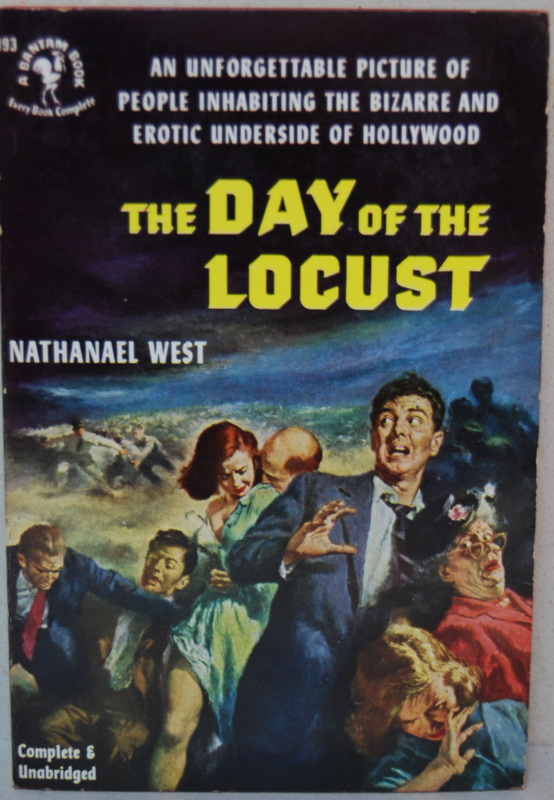
“It is hard to laugh at the need for beauty and romance, no matter how tasteless, even horrible, the results of that are. But it is easy to sigh. Few things are sadder than the truly monstrous.” — Nathanael West, Day of the Locust

I've got a few pieces in this August's Sight & Sound.

The cover story is a compendium of writers discussing novels and short stories about movies & moviemaking — I write about Horace McCoy's "I Should Have Stayed at Home" and nathanael West's "Day of the Locust."

6a00d83451cb7469e2022ad380a871200d-800wi

My other longer piece is on the great Samuel Fuller and his movies at Columbia — I write about seven of his pictures, including two of my Fuller favorites, Underworld USA and The Crimson Kimono, along with the charming It Happened In Hollywood, the very short (!) Adventure in Sahara, the needs-more-Fuller Power of the Press, and the impressive Scandal Sheet.

6a00d83451cb7469e2022ad380a8ce200d-800wi

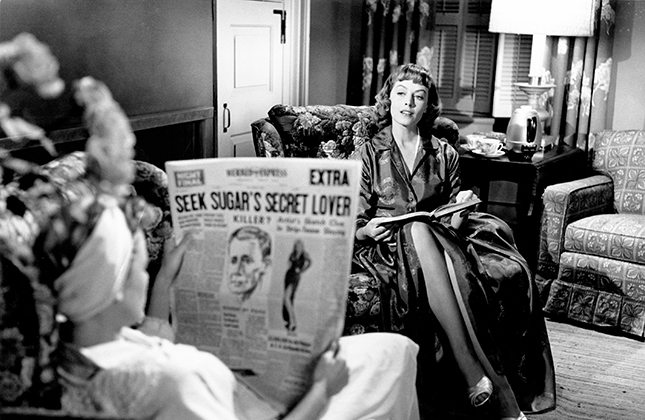
On shooting The Crimson Kimono's dangerous opening, in which stripper Sugar Torch runs for her life down a busy downtown LA street, Fuller reflected later about how no one on the street (these were not paid extras, but real people) gave a damn about this poor woman. In “The Third Face” he wrote of watching that scene with head of Columbia, Sam Briskin: “When I looked at the rushes with Sam Briskin, we realized that nobody, not even a passing sailor or a homeless drunk-was paying any attention to the big, scantily clad gal running along that downtown street. Nobody gave a damn. ‘What the hell's wrong with this country?’ asked Briskin.”

Pick it up

6a00d83451cb7469e2022ad3a07a2f200b-800wi

Elaine May and Mikey and Nicky

6a00d83451cb7469e2022ad39cd4b4200b-800wi

A shorter riff on this movie…

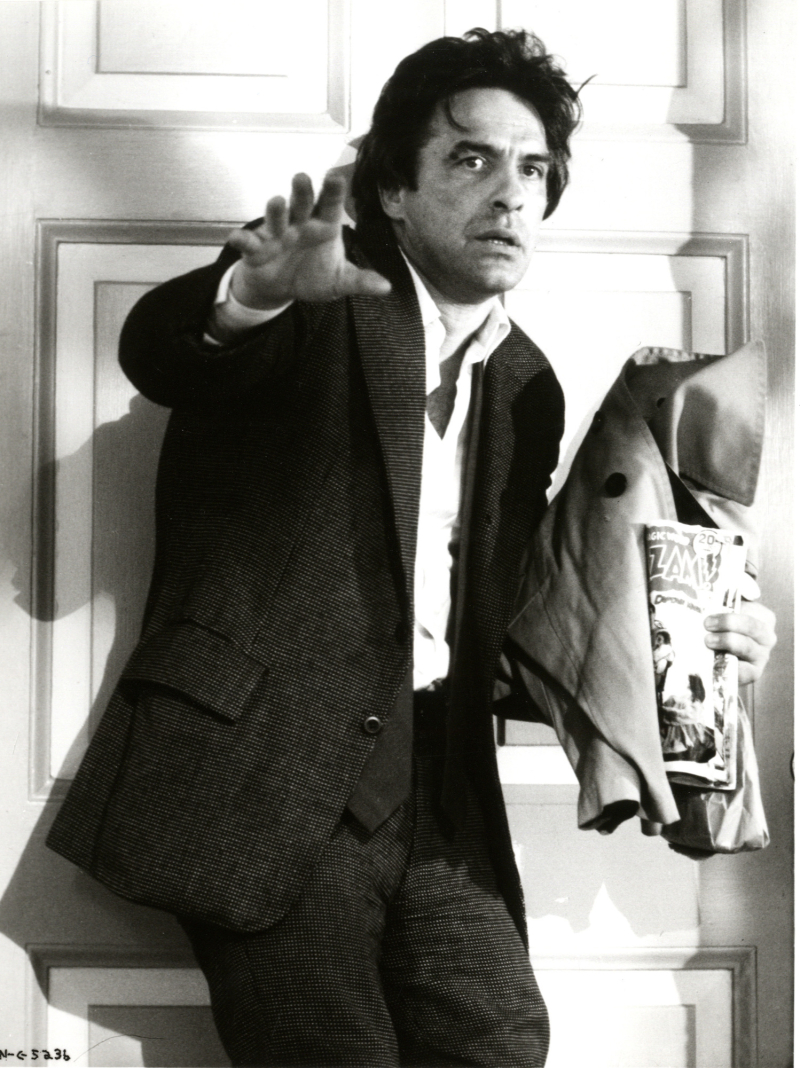
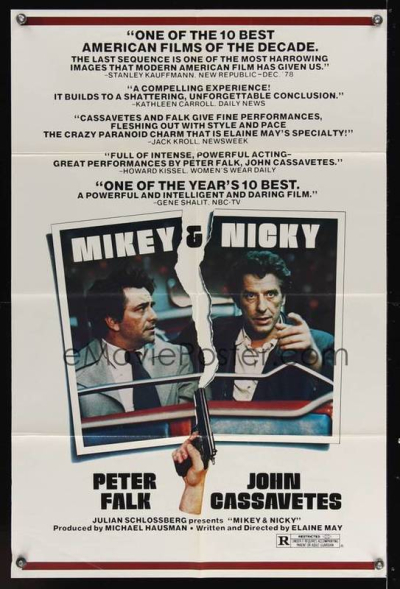
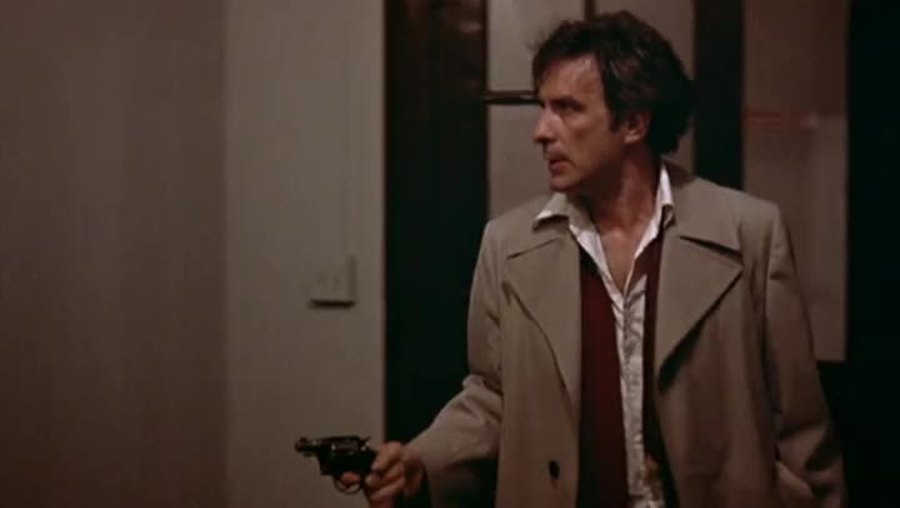
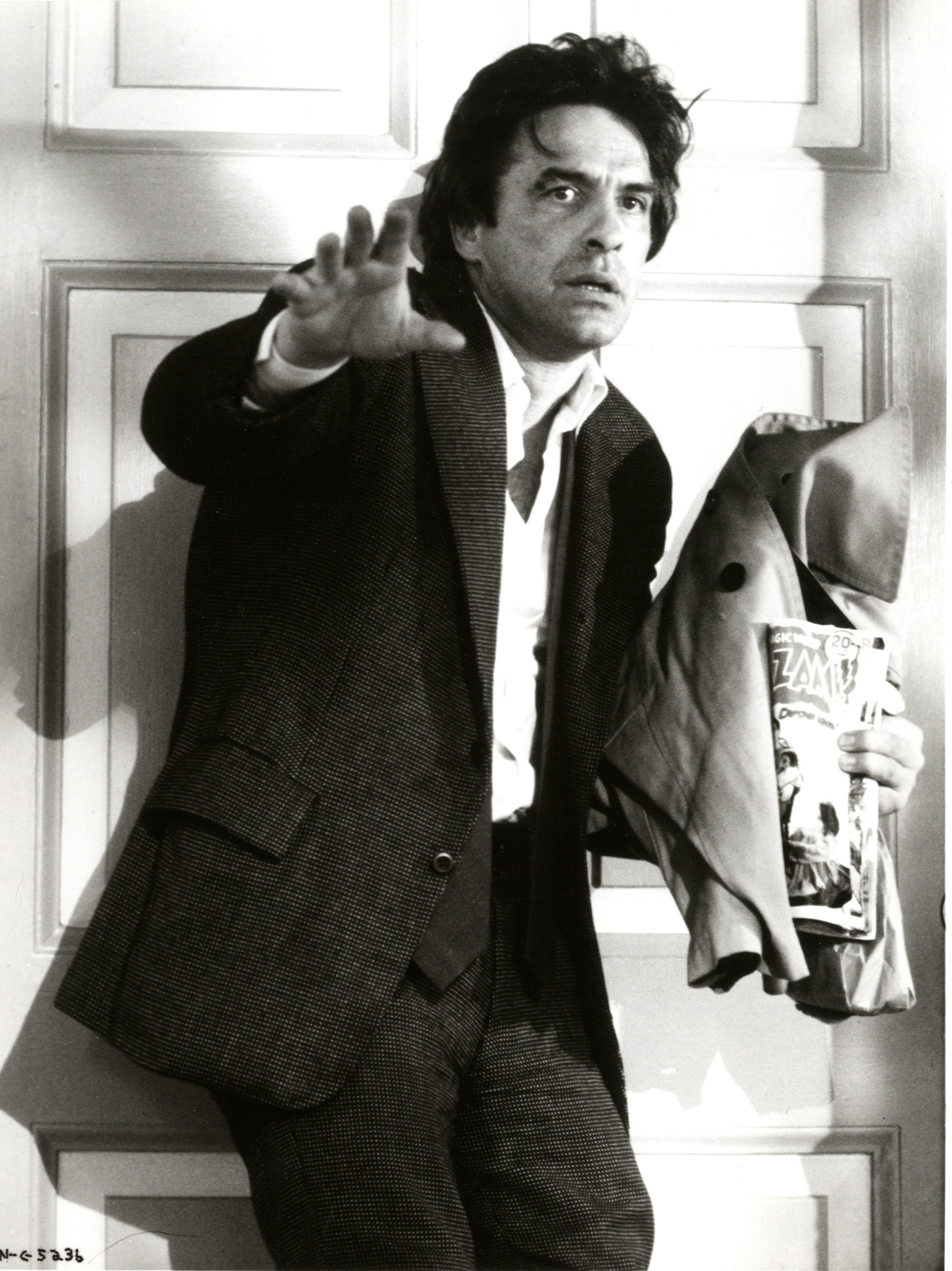
At the beginning of Elaine May’s Mikey and Nicky, John Cassavetes’ Nicky is holed up in a seedy motel room in Philadelphia, terrified and desperate. He’s in the midst of a nervous breakdown and looks like he’s been up for days with his messy, bed-head hair, handsome, haggard face and wrinkled white dress shirt sticking to his thin frame in an angst-filled, ulcer-ridden sweat. He’s stooped on a dingy bed and staring nervously rat-eyed at the dirty, chain-locked door, hoping no one busts through. He’s got a gun. Of course he’s got a gun. This place is the kind of fleabag hovel where people shoot through filthy locked doors or bribe front desk clerks who’ll look the other way when an offender blasts through those grungy openings and commit whatever bit of unpleasantness that happens on the other side. The joint is haunted with the lives of those who hide in the rooms, sitting on bed-bugged blankets full of dope, hope and desperate dreams. Nicky isn’t dreaming, his life is a wide-awake-nightmare. But he does have hope – he hopes to stay alive.

Picture-64He's got a good reason to be scared – he’s heard there's a contract out on him. He calls the buddy he’s known since childhood, Mikey (Peter Falk) and begs for help. Nicky knows Mikey’s going to come up, even if Nicky throws down a towel and nearly knocks Mikey with a bottle. You feel for him. Mickey reassures him, spending the entire movie with his pal. Mikey’s an old friend and Nicky can trust him. Oh… hold on. Can he? Is he on the level? When you eventually learn that Mikey is not  on the level (and you don’t catch this right away), and once you realize that the hit man (played by Ned Beatty) on Nicky’s trail is being aided along by Mikey, you start to piece together that this friend isn’t the one Nicky should have called. You’re on Nicky’s side. You think. Keep watching. No, you’re on both of their sides because, what kind of hell are these men trapped within? What kind of life is this? Is Mikey really going to deceive Nicky? Is Nicky maybe a sociopath?

Tumblr_nnqgex61jp1r1jmv0o1_1280

As the night wears on and these two talk, fight, hit each other and smack a troubled, sensitive woman, the friends reveal more and more about themselves and your emotions shift all over the place. Whatever alliances you had, whatever charm you’ve felt from these two guys, all that has been dragged around and sullied, dirtied up like that door in Nicky’s dumpy motel room. And May shoots it that way, never allowing a glamorous moment to enter the frame. You can practically smell the bars they’re drinking in. And yet, you don’t want to get out of this movie, you don’t want to unlock the door and make a run for it. You like being stuck with these two small-timers, you’re fascinated and drawn to them, and you wonder where this is all gonna end … who is going to make it through the night?

6a00d83451cb7469e2022ad37cf017200d-800wi
That is the genius of writer director May and her actor’s Cassavetes and Falk. In one night, in the ghostly urban environ of Philadelphia (a decidedly less romantic place than New York City or Chicago or Los Angeles, or at least May shoots it that way, haunting, at times oddly beautiful), we tag along with two scumbags who talk in junky beat-up bars and on city busses or in the streets and we are enlivened, anxious, depressed, disturbed and empathetic. By trusting the chemistry and brilliant interplay between Cassavetes and Falk, May not only shows her subjects as flawed, violent, vulnerable, selfish, guilt-ridden and manipulative men carrying around decades of resentment (as many friends do) but men who are constantly on the precipice of violence, emotion or literal, and violence ready to do them or someone else in. You feel jangly and uncomfortable watching these two – you are waiting for a shoe or two or three shoes to drop. Maybe on Falk’s head.

6a00d83451cb7469e2022ad37cf01b200d-800wi
There’s nothing noble about these guys – when they stop off at Nicky’s mistresses apartment, Nicky spouts some hollow “I love you” line so he can nail her on the floor, while Mikey’s hunched over in her depressing kitchen, waiting for them to finish and for his turn. When Mikey’s rebuffed, he smacks her. Just as feel like Mikey’s a real son of a bitch, you feel sorry for him minutes later (in spite of yourself) when he accuses Nicky of setting the scene up to embarrass him, to hurt his male ego. But then you start to believe Mikey when he claims she’s just a psycho and needs to be coddled with sweet talk before the act, and then you realize you’re buying this atrocious behavior. God, you’re right there on the street with them. Nicky breaks Mikey’s watch – his father’s watch, something that holds sentimental value. What an asshole, you think. But they’re both assholes. You want to keep on with them regardless. They’re so compelling that they make unlikable characters not, lovable, but magnetic and, at times, totally recognizable. It’s what people call a “high wire act” and the artists walk it bravely. Too bad some critics in 1976 didn’t think much of this movie ( not all of course) – a movie that now stands as one of the most underrated works of the 1970s. What were they thinking?

25051_3_large

This was considered, by some, a darker turn for May, who had directed the brilliant comedies A New Leaf (which she wrote) and The Heartbreak Kid (written by Neil Simon) prior to this, though it’s not like those two films were light comedies. The Heartbreak Kid is as bleak as anything in Mikey and Nicky (maybe even bleaker) but we don’t get to see the sunny beauty of Cybill Shepherd running around in a bathing suit to quell any of the acidity (though her brittle beauty is the catalyst towards selfish, terrible Charles Grodin marital doom). Instead we see the perpetually ruffled and combative Cassavetes’ protagonists (and of course May was compared to Cassavetes’ own films – Husbands being a chief picture) skulking around in a paranoiac frenzy. And she captured their movements, their words, their chemistry, creating a world that feels empty (the streets) and full all at once. Full of fear, full of possible love that probably won't happen. Full of deceit. What she does with the darkness, the bars, the hotel rooms and the talk – it's all perfectly realized — and she keeps you off kilter in a way where you can't take your eyes away from these two supposed low-lifes.

She shot a lot on this one. The movie carries a notorious production history (it’s been talked about retrospectively enough, but May notoriously went over budget, reportedly shot more film than Gone with the Wind and, at one point, reportedly hid reels somewhere in Connecticut). She didn’t direct another film until her vastly underrated, excellent Ishtar came out eleven years later. Well, that’s a shame.

31798.largeMikey and Nicky is also funny, grooving on the darkly comedic and very human rhythms of Cassavetes and Falk through which even their explosions of violence play as darkly humorous, at least for a moment, until you’re taken aback and saddened by the needlessness of it all. It’s painful and poignant and challenging and funny and finally, heartbreaking. The picture ends as you might expect it to and yet, it feels totally surprising, this rush of emotion you feel as Nicky bangs on Mikey’s much nicer door, nicer than the one in his crappy motel room. He’s yelling in misery: “Mikey, you son of a bitch! You bastard! You bastard! Mikey!” His life is nearly over and damn, you really feel it. You believe it. You believe every second of this movie. A line uttered earlier by Mikey is now, not so much funny as more awfully prophetic, circling back to desperate Nicky screaming at his door: “It’s very hard to talk to a dead person. I have nothing in common.” Maybe Mikey’s telling himself that at this anguished moment. Maybe not.

Originally published in Kill Or Be Killed

Kill or Be Killed: He Ran All the Way

Dgsmrn1UwAAOuH8-1
A bit from my piece in the newest Kill Or Be Killed:

By the end you see where and it’s not through some sunny field – it’s staggering in a gutter with Shelley Winters close behind. That Nick is brilliant John Garfield in director John Berry’s tough, poignant and doomed (on and off the screen), He Ran All the Way – a movie that opens with this beautiful loser tossing and turning in his bed, sweaty and convulsed in bad dreams. But he wakes up to something worse – reality – his mother (a harsh as hell Gladys George). After hollering at him for moaning in his slumber (no maternal instinct in this woman), she pulls open the dingy shades of his room and screeches: “If you were a man you’d be out looking for a job!” His reply? “If you were a man I’d kick your teeth in.”  This ain’t no happy family. But family will become something important to Nick in this picture – even if he has to force his way into one.

Read it all (my essay on "He Ran All the Way") in the newest and final of Ed Brubaker's "Kill Or Be Killed" — out now. Pick it up or order here.