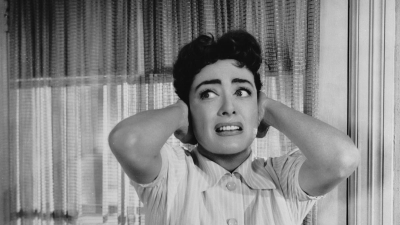
Stella & Stanton: Fallen Angel

6a00d83451cb7469e2022ad3ab0419200b-800wi

June: “Why did you go to see that girl in the diner?”

Eric: “What girl?”

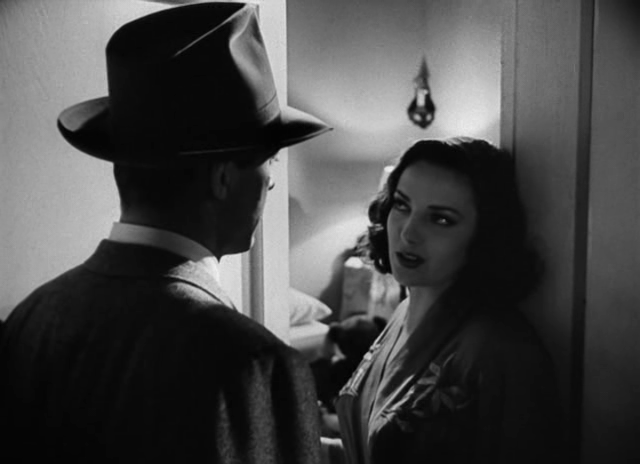
There’s a sickness hanging over Otto Preminger’s Fallen Angel that clings to every location, every set, every fluid camera move, and every off, but very human expression on the actor’s often haunted faces. And it's all heightened by the attraction to one woman — Stella. Oh, Stella (Linda Darnell), the young beautiful waitress at Pop’s Eats whom men want to save, paw, marry, or again, paw.  And of course, more than just paw. What a guy wouldn’t do for a tumble. And what a guy would do when he knows he’ll never get a tumble. But one of those guys isn’t just your usual lust-filled creep, one of those guys will be a murderer. And right away, we see the impending sexual doom — we don't know who or exactly what, but we see it.
6a00d83451cb7469e2022ad3653265200c-800wi

When the movie opens and our hero (or anti-hero), the traveling con man Eric Stanton (Dana Andrews) steps off the bus and into this dark and misty California beach town, he walks into Pop’s, we take in this gorgeous image and feel it — suffused with sex and danger and seedy hometown rot — the entire picture, shot by Joseph LaShelle, is bathed in this scummy beauty. There’s just men in that diner, and they’re all wondering about one thing — Stella. Where is she? Why has she been gone for so long? Dear god, did she off herself? One imposing, gravely looking man, ex NY cop Mark Judd, (Charles Bickford) says, “Not Stella. Back in New York, I handled 31 suicide cases personally. Everything from poison to jumping in front of the Flatbush subway. Stella's not the type.” OK. So, what type is she, I ask the guy bragging about personally handling suicide? It already appears that nobody truly cares or bothers to actually understand Stella. They just want her to be something to them. And in Fallen Angel, she’s not the type all of these men want her to be. And this goes beyond Stella –  all of the film’s characters, male and female, go against their societal norms of “type.”

E9d50beabe416d5ab2da8770d9e1de31

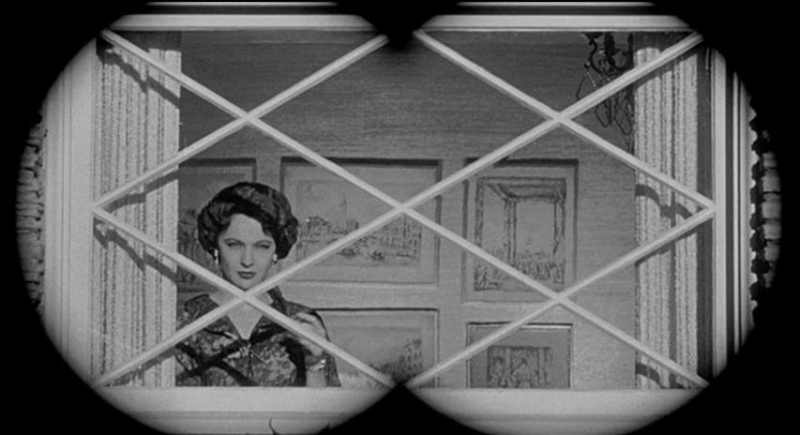
We’ll be rooting (if that’s the right word) for con man Eric Stanton against the mysterious, almost kinkily violent cop, even when we know Eric is treating another woman (lonely June, played by Alice Faye, who doesn’t want to remain as innocent as see seems) like garbage, and we’ll be disgusted by kindly old Pops who runs the diner, just as Stella is. Pops (Percy Kilbride) hasn’t done a thing to her (on screen anyway), and yet, right away we understand why Stella spits at him, “You make me sick.” Pops has given her the feeble “I told you so” about some cad she went on a date with and he gets … “You make me sick.” Not, buzz off, Pop, or, stay out of my business. Her dismissiveness is seething with the interior dialogue of I know what you want. I know why you “care” so greatly about me and my bad date. I know why I have this job. Ick. Pop. His “paternal” affection might be the creepiest of all. Who knows what she’s had to endure or listen to while she’s re-filling the ketchup containers at closing time.

So, the moment we see her bitterly slump back into the diner, hungry and with tired aching feet — a low rent Laura returning from the dead (indeed, this was a follow up to Preminger’s hit, Laura, with the same leading man, and a similar story of one-woman obsession, only with down-and-outers and much more desperation) – we don’t think she’s trouble, we think these men are. Oh sure, check out the gorgeous supposed femme fatale in the beautiful, lush Darnell who was only 21 when she made this and yet feels like she’s had decades of shit heaped on her (it doesn’t take too many years for a woman to understand this). She’s matter-of-fact tough and fixated on money and marriage, but not really bad.

6a00d83451cb7469e2022ad38b56ca200d-800wi

Everything about her, from the weary way she walks around the diner and hands back change to customers –  this lady is sick of it all. And Darnell is so excellent here, that, like all of these men, we don’t want her to go out of town too long either. We want to see her on screen — in this diner — a limbo of lust. The filmmakers agreed and pumped up Darnell over star Faye, cutting out some of Faye’s scenes and even supposedly her singing number (!), something that upset Faye, mirroring the “innocent” she plays in June. June is the woman Eric marries in order to fleece her, so he can marry sexy Stella and give her what she wants over some tumble in her crummy little apartment — money. Eric even cuts his wedding night short and leaves his wife alone to see… Stella. He wakes up on the couch in the stately home with doilies and nice curtains that his new bride shares with her spinster sister, Clara (Anne Revere) and his wife … forgives him – what the hell is wrong with this woman? He also learns that Stella has been murdered. 

6a00d83451cb7469e2022ad3ab048c200b-800wi-1

This leads to who did it? Eric will be a suspect, as will June’s sister, as will Stella’s almost steady, Dave Atkins (Bruce Cabot) who gets an interrogation and beating so sickening and vicious by Judd (who is now handling the case) that we wonder if this is his disgusting thrill. (It is — he’s a sick man, quite literally) Even Pop is considered a possibility, not a surprise in this world (scripted by Harry Kleiner from Marty Holland’s novel), where everyone has motive beyond their obsession. Yes, there is Stella, but there’s loneliness, bitterness, impotence, and what the hell am I doing with my life? Do I matter at all in this universe? All of this existential angst narrowed in on this poor woman whose dark world seems only lightened by the song she obsessively plays on the diner’s jukebox and one that hovers over the movie, again, like a dingier “Laura” (the song — “Slowly” — perhaps a sexual pace she wishes men would follow). Another joy: in her introduction scene, Stella scarfs (though somehow daintily scarf) down a hamburger (she’s hungry, and she’s eating that thing, but she’s not gonna mess up that perfect lipstick), after walking in the night when a guy got too fresh. Watching Darnell eat that hamburger is such a real joy and so convincing you’ll crave a creepy Pop’s burger too – this hamburger won’t let her down.

6a00d83451cb7469e2022ad3653294200c-800wi

I’m not going to spoil the ending and reveal who did it. But I will say it wasn’t Eric. The double-cross to June wasn’t something he could probably really go through with and he certainly wouldn’t murder someone, as shifty as he is. I’ll ruin one thing though – June stays with him — even after he married her for money, left her alone on her wedding night and was in love with another woman the entire time. It seems like an easy resolution, the two of them driving off together in the end with June asking where to, and Eric answering, “home.” Now he’s a settled, domestic fellow with this nice little wife? Not a chance.
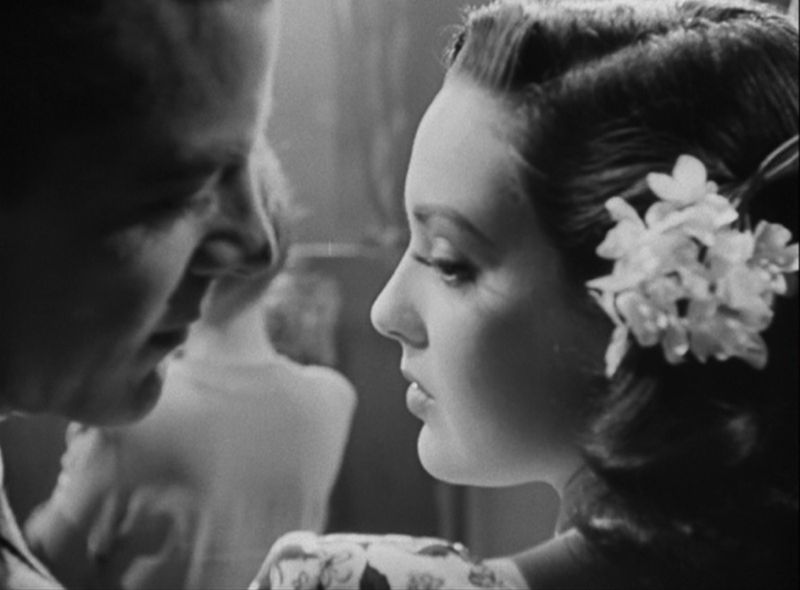
In fact, it’s one of the grimmest “romantic” endings I’ve ever seen. Eric has told June that it wouldn’t have lasted with Stella, and he’s probably right, but … this is the answer? Poor June, she’s not gonna have a good life. And Stella… why does she have to be dead? She’s the one with everyone’s number. She knows, like Preminger knows, like the writers know, what lurks in the heart of anyone putting on their best face: “You talk different, sure, but you drive just like the rest.”

6a00d83451cb7469e2022ad36532ba200c-800wi

From my piece in Ed Brubaker's Kill or Be Killed

Business: Murder By Contract

6a00d83451cb7469e2022ad3a0ae36200b-800wi

“Why are you miserable? Cause you haven't got any dough? And why haven't you got any dough? Because you're too scared to go out and get it yourself. You want it to come to you. Well, nothing comes to you, Harry. Nothing except one thing… death. Death comes to you… comes to everybody. Only everybody thinks they'll live forever.” Claude (Vince Edwards), Murder By Contract

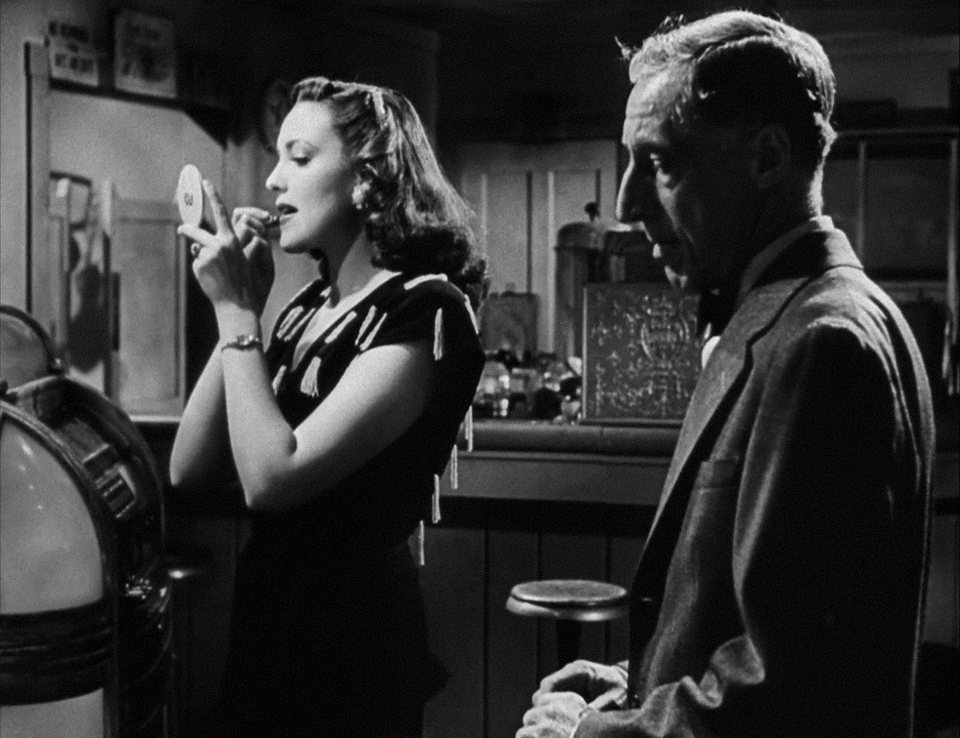
In Irving Lerner’s Murder By Contact, Claude doesn’t like women. And more specifically, he doesn’t like killing women. Since it’s his job to kill people, presumably all kinds of people, this comes as a potential moral jolt when he announces his aversion to the two mob men facilitating the murder. Claude (he has no last name) has been hired to knock off a person named Billie Williams – this person is going to testify to a grand jury against a gangster – and Claude’s taken a train all the way from New York City to Los Angeles to accomplish the hit. He’s been leisurely about it. The moment he stepped off the train (in Glendale, I’m thinking he’s not going to be seen at a bigger station), he’s had the two men who picked him up drive his handsome mug all over the place— he wants to see the sights. It’s altogether weird, normal, sinister and funny.
C14e945932c3ef5fccf72429ecee3ce5

Claude wants to take in the Pacific Ocean. He wants to swim. He wants to go deep-sea fishing. He also wants to think. And he wants to make sure there’s no funny business going on. By the time he’s ready to accomplish his task, we’re nearly a half an hour into the picture and Claude has tested the men’s patience so much that they can’t figure him out. One likes him, he likes listening to him talk; he even dries his back after Claude swims (he seems a little in love with him, in fact). The other more cantankerous fellow who mockingly calls him “Superman” thinks he’s a pain in the ass and even weirder than the average contract killer. But they wait until he’s well-rested and ready and then finally, they venture up to the potential dead person’s house. Claude spies a woman walking in the living room. Is that his wife, he asks? That’s the target, the two men say. Claude panics. A woman? No one told him it was a woman. This is the part of the movie where you think Claude has a moral code when it comes to the opposite sex.

It’s not as simple as all that.

6a00d83451cb7469e2022ad380dbe7200d-800wi

Nothing is simple in Lerner’s lean, low budget 1958 masterpiece (shot in eight days), a noir of sorts, but something cooler (as in crisply composed) and modern that it’s hard to classify simply as noir. And it doesn’t need to be classified. More in common with films that followed it – the assassin as monk of Jean-Pierre Melville’s Le Samouraï, the assassin as organized list maker, working out to keep himself murderously awake in Martin Scorsese’s Taxi Driver (no surprise Scorsese reveres this movie and worked with Lerner) and the deadpan style of Jim Jarmusch – Murder By Contract is entirely its own dissolute creature.  A movie of sunny wide open spaces in which rot and existential dread cling to the jaunty, jaundiced characters like the smog we don’t see (it’s too bright), the light and L.A. neighborhoods (shot by Ace Lucien Ballard) and the anticipatory, evocative music (scored with a spare guitar by Perry Botkin recalling The Third Man – Scorsese has also cited this guitar score as an influence on The Departed) underscores that it is a movie of the late 1950s, when stability and a nice house were a yearned for and achievable American dream, but a questioned dream like – so many other things in a consumer-driven society.

You may end up, metaphorically speaking, like Claude’s target, the night club singer Billie (Caprice Torie) – depressed, stuck inside under guarded watch with the television blaring all day, eating your delivered soup and sandwiches, slamming the keys to your piano in anguish as you play a lovely classical piece only you care about. That’s no way to live. And this is no “femme fatale,” this is a woman sitting in a prison, smoking all day with literal killers (and now Claude) lurking all around her.  By the end of the film, as scared and as tough as she is, part of her seems like she doesn’t even give a shit anymore. This is her life now. Keep playing the piano.

MV5BOGZmOGUxNzQtYWYyNi00YTQ4LWIwMzAtNTVhNTQ1MjljMmQzL2ltYWdlL2ltYWdlXkEyXkFqcGdeQXVyMTE2NzA0Ng@@._V1_

Lerner, with a background in ethnographic filmmaking (one early 1940’s documentary stars Pete Seeger and features Woody Guthrie, among others) connected killing with business, a common trope in this kind of movie, but he (and screenwriter Ben Simcoe) took it one step further with the killer (played brilliantly by Vince Edwards, also in Lerner’s fatalistic City of Fear), yearning to make a fast buck so he can get to the unglamorous business of buying a house and settling down. It’s such a normal desire for such an abnormal character. Or is he so abnormal? He’s new to the game, no spotty past to speak of. He’s never been to prison, he doesn’t even carry a gun, he just wants to make large sums of money to fast track a more leisurely life. That he has to unleash a cold-hearted psychopath makes no difference to him. Business, he says, business:

“Now, why would a stranger kill a stranger? Because somebody’s willing to pay. It’s business. Same as any other business. You murder the competition. Instead of price-cutting, throat cutting. Same thing. There are a lot of people around who would like to see other people die a fast death or they can’t see to it themselves. They got conscience. Religion. Families. They’re afraid of punishment here, or hereafter. Me. Ha. I can’t be bothered with any of that nonsense. I look at it like a good business. The risk is high but so is the profit. I wasn’t born this way. I trained myself. I eliminate personal feeling…. I feel hot. I feel cold. I get sleepy and I get hungry.”

Murder by contract

Claude’s focus and methodical approach (Lerner and Ballard frame this beautifully) is partly what does him in. Women are hard to kill. They blur his focus. He spits: “It’s not a matter of sex, it’s a matter of money. If I’d-a known it was a woman, I’d've asked double. I don’t like women. They don’t stand still. When they move, it’s hard to figure out why or wherefore. They’re not dependable. It’s tough to kill somebody who’s not dependable.” He also says, “The human female is descended from the monkey, and monkeys are about the most curious animal in the world. If anything goes on, it just can't stand it not to know about it. Same thing with a woman.”

It’s an amusing speech, both awful and sexist and weirdly, not sexist at all. He’s saying, they – women – need to know things. That’s not really an insult exactly, and, yet, of course it is, coming from Claude because he doesn’t like them wanting to know things. Still, it shows that they’re not hard to kill because they’re stupid, but likely because they are observant, smart.  But then Claude is not an easy guy to read – even when he says he doesn’t like women – so who knows how much he actually hates women. Women may not be dependable to him but, without really knowing it, he’s describing women as complex, curious.

6a00d83451cb7469e2022ad3823e66200d-800wi

The movie showcases this with Billie and two other women – a sad, sloppy drunk painting the apartment she’s afraid of being kicked out of and a call girl who has endured who knows what in her line of work. Both drunk and call girl inadvertently help Claude, and Billie, in the end, tells him to leave, she won’t nark him out. These women are hanging by their fingernails to live in a world that is crushing them down and breaking their spirit, and whether or not Claude cares, the film takes the time to care. And they are outsiders, like Claude, who, in a bracing scene with a male hotel room service attendant, surely remembers what it means to be a wage slave. That Lerner gives all of these women enough time in their brief moments to reveal their shattered selves inside their outward, supposedly, untrustworthy exteriors gives Murder By Contract a depth that seeps into Claude, who, by the end, simply can’t kill Billie.

6a00d83451cb7469e2022ad35ad401200c-800wi

Does he have a crisis of conscience? And, if so, why does he suddenly feel something? He appears almost sickened when pulling off his tie and readying to strangle Billie, poisoned by a heart. Perhaps he’s spent so much time trying to kill her (in other unsuccessful attempts) that while watching her sad, trapped life, he now feels a connection to her that’s both empathetic and terrifying. The American Dream is now kaput. The guy who just wanted a damn house winds up dead under Billie’s nice home, trapped like a rat. Claude says earlier, “The only type of killing that’s safe is when a stranger kills a stranger.” Billie is no longer a stranger. In Murder By Contract, that revelation is now scary, tragic and strangely beautiful.

Originally published in Ed Brubaker's Kill or Be Killed

Aug Sight & Sound: McCoy, West & Fuller

6a00d83451cb7469e2022ad3a079f9200b-800wi

“It is hard to laugh at the need for beauty and romance, no matter how tasteless, even horrible, the results of that are. But it is easy to sigh. Few things are sadder than the truly monstrous.” — Nathanael West, Day of the Locust

I've got a few pieces in this August's Sight & Sound.

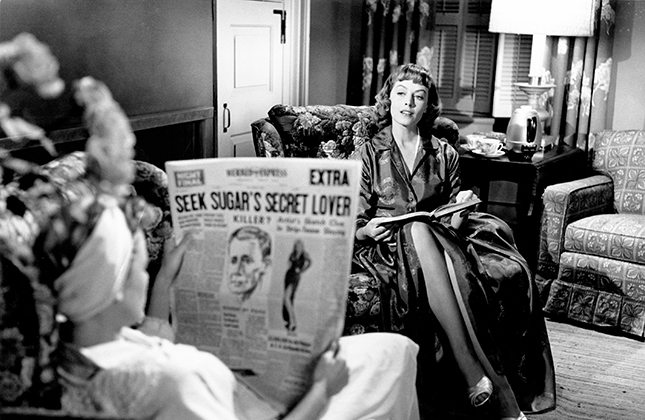
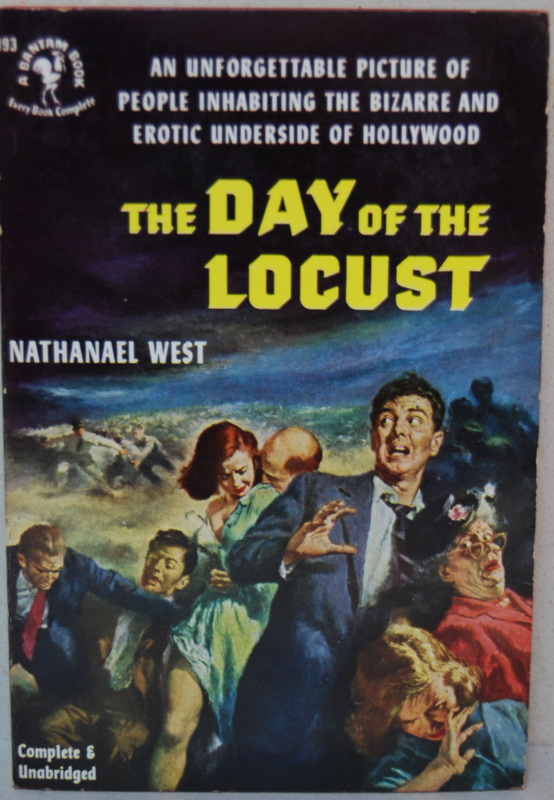
The cover story is a compendium of writers discussing novels and short stories about movies & moviemaking — I write about Horace McCoy's "I Should Have Stayed at Home" and nathanael West's "Day of the Locust."

6a00d83451cb7469e2022ad380a871200d-800wi

My other longer piece is on the great Samuel Fuller and his movies at Columbia — I write about seven of his pictures, including two of my Fuller favorites, Underworld USA and The Crimson Kimono, along with the charming It Happened In Hollywood, the very short (!) Adventure in Sahara, the needs-more-Fuller Power of the Press, and the impressive Scandal Sheet.

6a00d83451cb7469e2022ad380a8ce200d-800wi

On shooting The Crimson Kimono's dangerous opening, in which stripper Sugar Torch runs for her life down a busy downtown LA street, Fuller reflected later about how no one on the street (these were not paid extras, but real people) gave a damn about this poor woman. In “The Third Face” he wrote of watching that scene with head of Columbia, Sam Briskin: “When I looked at the rushes with Sam Briskin, we realized that nobody, not even a passing sailor or a homeless drunk-was paying any attention to the big, scantily clad gal running along that downtown street. Nobody gave a damn. ‘What the hell's wrong with this country?’ asked Briskin.”

Pick it up

6a00d83451cb7469e2022ad3a07a2f200b-800wi

Elaine May and Mikey and Nicky

6a00d83451cb7469e2022ad39cd4b4200b-800wi

A shorter riff on this movie…

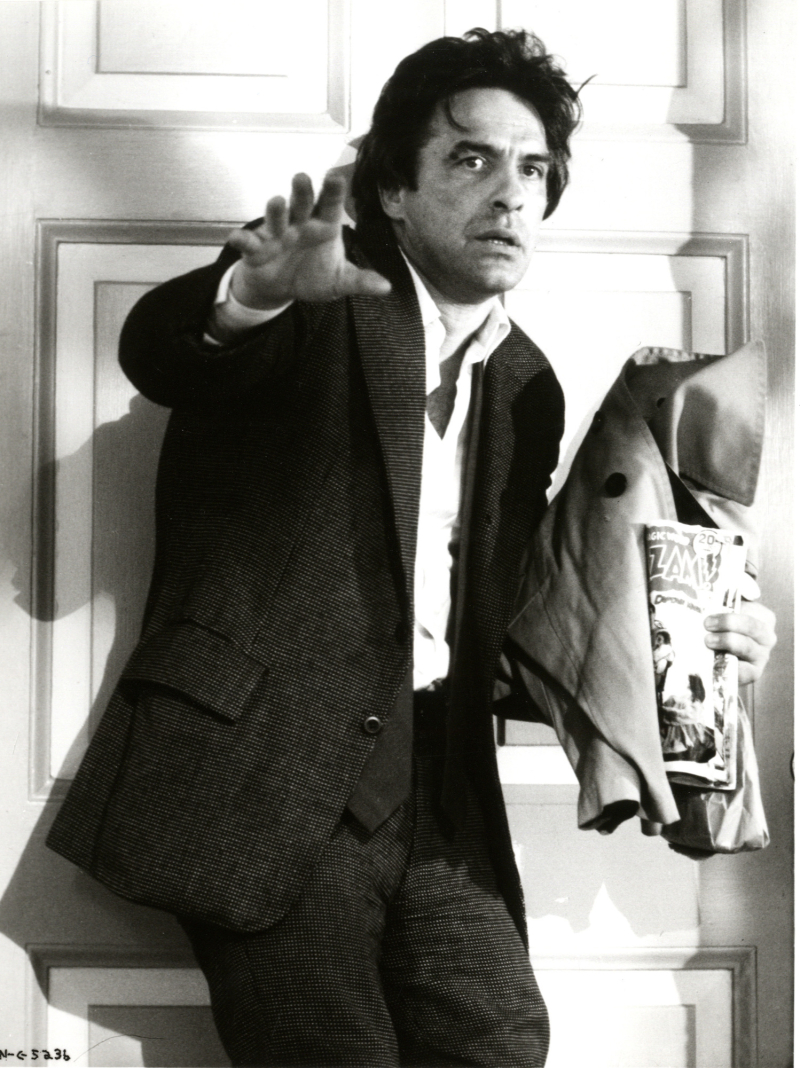
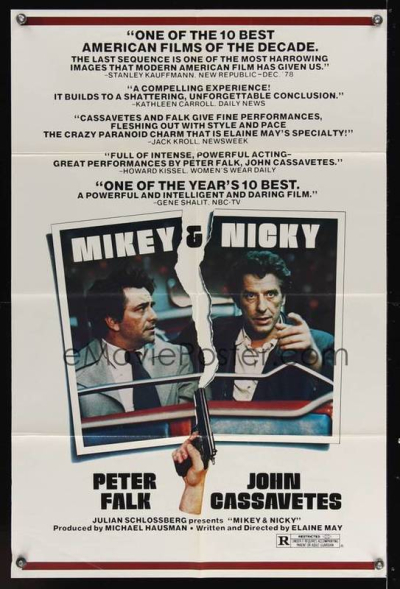
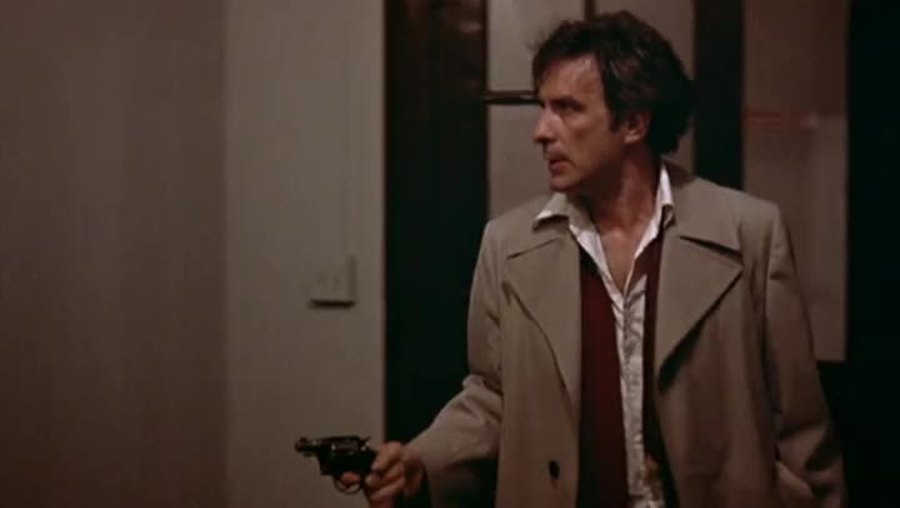
At the beginning of Elaine May’s Mikey and Nicky, John Cassavetes’ Nicky is holed up in a seedy motel room in Philadelphia, terrified and desperate. He’s in the midst of a nervous breakdown and looks like he’s been up for days with his messy, bed-head hair, handsome, haggard face and wrinkled white dress shirt sticking to his thin frame in an angst-filled, ulcer-ridden sweat. He’s stooped on a dingy bed and staring nervously rat-eyed at the dirty, chain-locked door, hoping no one busts through. He’s got a gun. Of course he’s got a gun. This place is the kind of fleabag hovel where people shoot through filthy locked doors or bribe front desk clerks who’ll look the other way when an offender blasts through those grungy openings and commit whatever bit of unpleasantness that happens on the other side. The joint is haunted with the lives of those who hide in the rooms, sitting on bed-bugged blankets full of dope, hope and desperate dreams. Nicky isn’t dreaming, his life is a wide-awake-nightmare. But he does have hope – he hopes to stay alive.

Picture-64He's got a good reason to be scared – he’s heard there's a contract out on him. He calls the buddy he’s known since childhood, Mikey (Peter Falk) and begs for help. Nicky knows Mikey’s going to come up, even if Nicky throws down a towel and nearly knocks Mikey with a bottle. You feel for him. Mickey reassures him, spending the entire movie with his pal. Mikey’s an old friend and Nicky can trust him. Oh… hold on. Can he? Is he on the level? When you eventually learn that Mikey is not  on the level (and you don’t catch this right away), and once you realize that the hit man (played by Ned Beatty) on Nicky’s trail is being aided along by Mikey, you start to piece together that this friend isn’t the one Nicky should have called. You’re on Nicky’s side. You think. Keep watching. No, you’re on both of their sides because, what kind of hell are these men trapped within? What kind of life is this? Is Mikey really going to deceive Nicky? Is Nicky maybe a sociopath?

Tumblr_nnqgex61jp1r1jmv0o1_1280

As the night wears on and these two talk, fight, hit each other and smack a troubled, sensitive woman, the friends reveal more and more about themselves and your emotions shift all over the place. Whatever alliances you had, whatever charm you’ve felt from these two guys, all that has been dragged around and sullied, dirtied up like that door in Nicky’s dumpy motel room. And May shoots it that way, never allowing a glamorous moment to enter the frame. You can practically smell the bars they’re drinking in. And yet, you don’t want to get out of this movie, you don’t want to unlock the door and make a run for it. You like being stuck with these two small-timers, you’re fascinated and drawn to them, and you wonder where this is all gonna end … who is going to make it through the night?

6a00d83451cb7469e2022ad37cf017200d-800wi
That is the genius of writer director May and her actor’s Cassavetes and Falk. In one night, in the ghostly urban environ of Philadelphia (a decidedly less romantic place than New York City or Chicago or Los Angeles, or at least May shoots it that way, haunting, at times oddly beautiful), we tag along with two scumbags who talk in junky beat-up bars and on city busses or in the streets and we are enlivened, anxious, depressed, disturbed and empathetic. By trusting the chemistry and brilliant interplay between Cassavetes and Falk, May not only shows her subjects as flawed, violent, vulnerable, selfish, guilt-ridden and manipulative men carrying around decades of resentment (as many friends do) but men who are constantly on the precipice of violence, emotion or literal, and violence ready to do them or someone else in. You feel jangly and uncomfortable watching these two – you are waiting for a shoe or two or three shoes to drop. Maybe on Falk’s head.

6a00d83451cb7469e2022ad37cf01b200d-800wi
There’s nothing noble about these guys – when they stop off at Nicky’s mistresses apartment, Nicky spouts some hollow “I love you” line so he can nail her on the floor, while Mikey’s hunched over in her depressing kitchen, waiting for them to finish and for his turn. When Mikey’s rebuffed, he smacks her. Just as feel like Mikey’s a real son of a bitch, you feel sorry for him minutes later (in spite of yourself) when he accuses Nicky of setting the scene up to embarrass him, to hurt his male ego. But then you start to believe Mikey when he claims she’s just a psycho and needs to be coddled with sweet talk before the act, and then you realize you’re buying this atrocious behavior. God, you’re right there on the street with them. Nicky breaks Mikey’s watch – his father’s watch, something that holds sentimental value. What an asshole, you think. But they’re both assholes. You want to keep on with them regardless. They’re so compelling that they make unlikable characters not, lovable, but magnetic and, at times, totally recognizable. It’s what people call a “high wire act” and the artists walk it bravely. Too bad some critics in 1976 didn’t think much of this movie ( not all of course) – a movie that now stands as one of the most underrated works of the 1970s. What were they thinking?

25051_3_large

This was considered, by some, a darker turn for May, who had directed the brilliant comedies A New Leaf (which she wrote) and The Heartbreak Kid (written by Neil Simon) prior to this, though it’s not like those two films were light comedies. The Heartbreak Kid is as bleak as anything in Mikey and Nicky (maybe even bleaker) but we don’t get to see the sunny beauty of Cybill Shepherd running around in a bathing suit to quell any of the acidity (though her brittle beauty is the catalyst towards selfish, terrible Charles Grodin marital doom). Instead we see the perpetually ruffled and combative Cassavetes’ protagonists (and of course May was compared to Cassavetes’ own films – Husbands being a chief picture) skulking around in a paranoiac frenzy. And she captured their movements, their words, their chemistry, creating a world that feels empty (the streets) and full all at once. Full of fear, full of possible love that probably won't happen. Full of deceit. What she does with the darkness, the bars, the hotel rooms and the talk – it's all perfectly realized — and she keeps you off kilter in a way where you can't take your eyes away from these two supposed low-lifes.

She shot a lot on this one. The movie carries a notorious production history (it’s been talked about retrospectively enough, but May notoriously went over budget, reportedly shot more film than Gone with the Wind and, at one point, reportedly hid reels somewhere in Connecticut). She didn’t direct another film until her vastly underrated, excellent Ishtar came out eleven years later. Well, that’s a shame.

31798.largeMikey and Nicky is also funny, grooving on the darkly comedic and very human rhythms of Cassavetes and Falk through which even their explosions of violence play as darkly humorous, at least for a moment, until you’re taken aback and saddened by the needlessness of it all. It’s painful and poignant and challenging and funny and finally, heartbreaking. The picture ends as you might expect it to and yet, it feels totally surprising, this rush of emotion you feel as Nicky bangs on Mikey’s much nicer door, nicer than the one in his crappy motel room. He’s yelling in misery: “Mikey, you son of a bitch! You bastard! You bastard! Mikey!” His life is nearly over and damn, you really feel it. You believe it. You believe every second of this movie. A line uttered earlier by Mikey is now, not so much funny as more awfully prophetic, circling back to desperate Nicky screaming at his door: “It’s very hard to talk to a dead person. I have nothing in common.” Maybe Mikey’s telling himself that at this anguished moment. Maybe not.

Originally published in Kill Or Be Killed

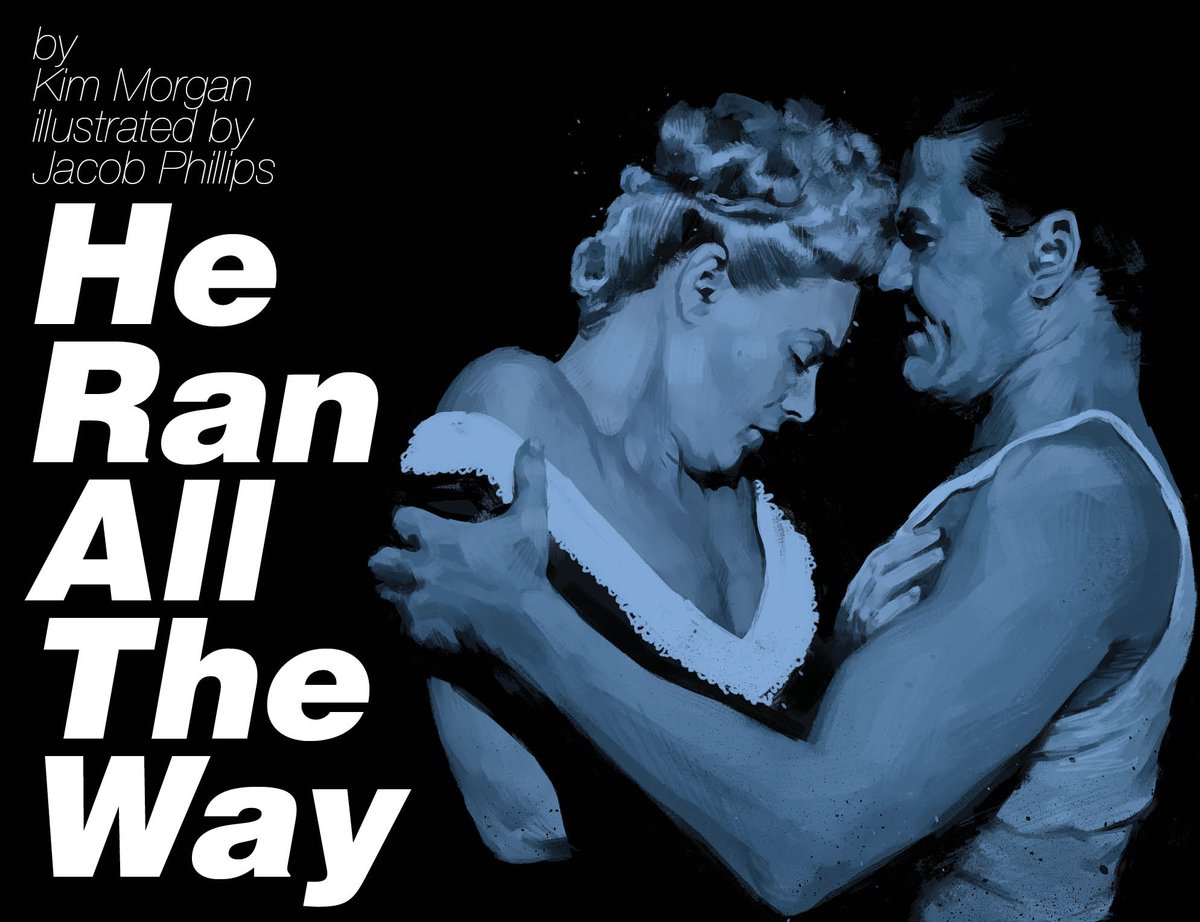
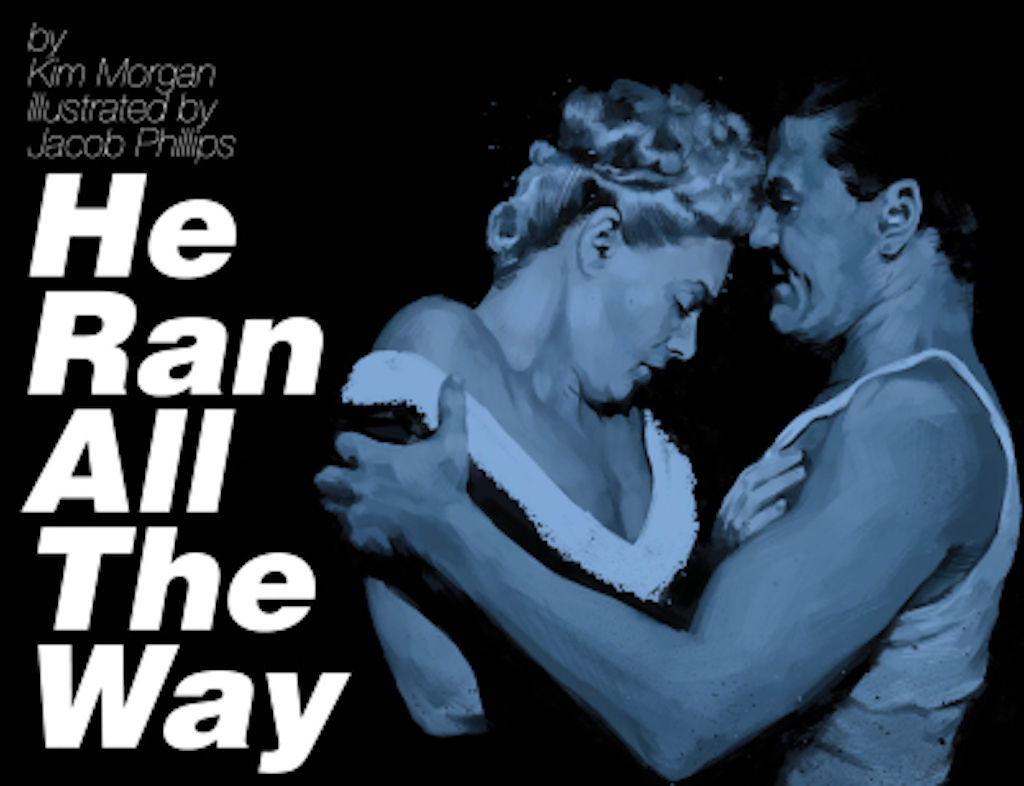
Kill or Be Killed: He Ran All the Way

Dgsmrn1UwAAOuH8-1
A bit from my piece in the newest Kill Or Be Killed:

By the end you see where and it’s not through some sunny field – it’s staggering in a gutter with Shelley Winters close behind. That Nick is brilliant John Garfield in director John Berry’s tough, poignant and doomed (on and off the screen), He Ran All the Way – a movie that opens with this beautiful loser tossing and turning in his bed, sweaty and convulsed in bad dreams. But he wakes up to something worse – reality – his mother (a harsh as hell Gladys George). After hollering at him for moaning in his slumber (no maternal instinct in this woman), she pulls open the dingy shades of his room and screeches: “If you were a man you’d be out looking for a job!” His reply? “If you were a man I’d kick your teeth in.”  This ain’t no happy family. But family will become something important to Nick in this picture – even if he has to force his way into one.

Read it all (my essay on "He Ran All the Way") in the newest and final of Ed Brubaker's "Kill Or Be Killed" — out now. Pick it up or order here.

Happy Birthday Marilyn Monroe: Nell

6a00d83451cb7469e20224df3762c1200b-800wi

“There was just this scene of one woman seeing another who was helpless and in pain. It was so real, I responded. I really reacted to her. She moved me so that tears came into my eyes. Believe me, such moments happened rarely, if ever again, in the early things I was doing out there.” – Anne Bancroft on Marilyn Monroe

Dont_bother_to_knwock_1050_591_81_s_c1

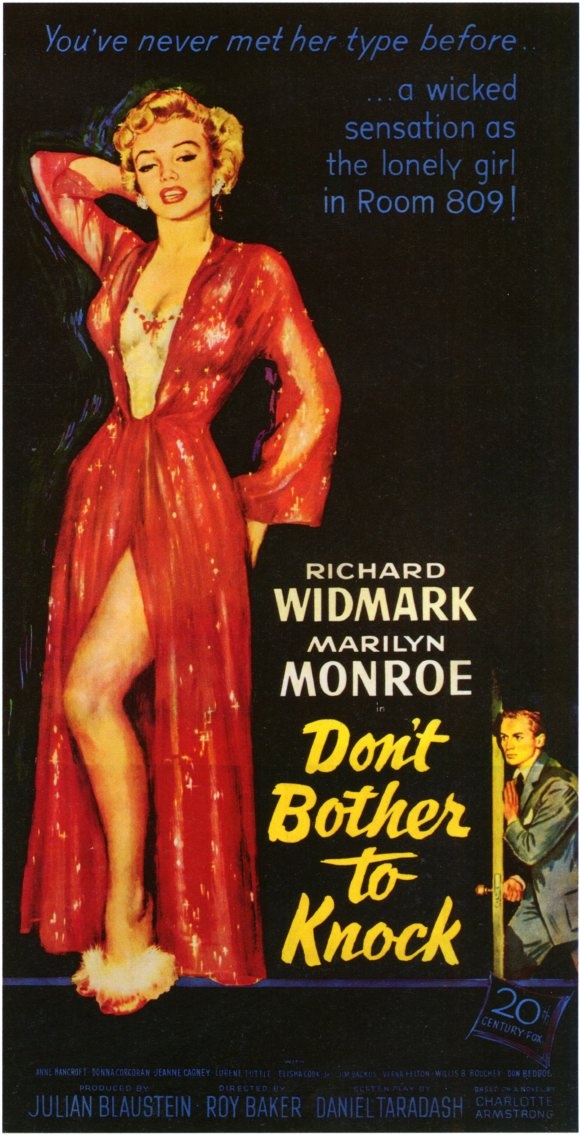
The moment Marilyn Monroe walks into the hotel of Don’t Bother to Knock – we are enthralled. It’s her first scene in the movie and without knowing anything about her beautiful, troubled Nell, and what her beautiful, troubled Nell has been through, we feel a pall hanging over this young woman. Monroe, on sight, is that powerful. Monroe’s tentative gait and unsure eyes enter the space (its own kind of asylum) where the lounge singer, Lyn Lesley (a grounded, lovely Anne Bancroft) sings swoony tunes in a cowboy themed room. It’s an intriguing juxtaposition – a nervous 1952 Marilyn (ten years before her death) – less made up, darker blonde hair, simple dress – passes the poster of glamorous Bancroft – not knowing she’ll be in a room with that woman’s soon-to-be ex, cocky pilot, Jed (Richard Widmark). That’s not so surprising – a seduction with Widmark. This is Marilyn Monroe after all, and even clad in simple frock and sad expression, she’s stunning to behold. But what feels unexpected is that the most understanding characters, the ones who will really sit down with this poor young woman and approach her with kindness, will be that hotel chanteuse and that cocky pilot. There’s no irredeemable cad in this picture and there’s no femme fatale either – even if the movie’s poster blared: “A wicked sensation as the lonely girl in Room 809!”

6a00d83451cb7469e20223c84fb70f200c-800wi

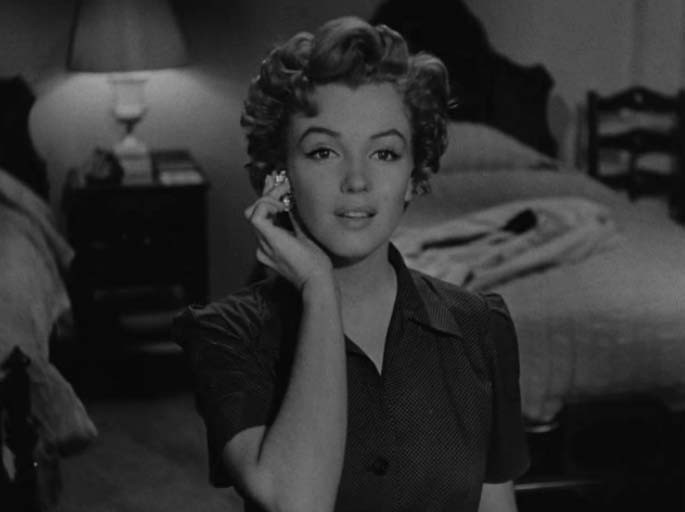
The scene continues and we’re further drawn to Nell. She walks up to a man she knows –  the elevator operator (Elijah Cook Jr.) – and she smiles. It feels disarming to us, and it surprises him, possibly angers him: “What’s the smile about?” He asks. “You seem so different in those clothes,” she answers with a curious mixture of eager happiness, even some relief. It’s a nice comment that is met with the slightly defensive: “I’m different all the time.” Immediately I’m thinking – let her say something nice, jeez. And then I think, he’s probably right – that he is different all of the time – and not in a good way. Cook Jr. excels at being so simultaneously wormy and woeful that right away you feel … she ought not be around this guy. Later you’ll learn he is indeed, not so nice to her, even as he’s supposedly doing her a solid. We don’t know how to feel about him.You see, not long ago, she was released from an insane asylum in Oregon, and she’s come to stay with him, her Uncle, in New York City. He’s gotten her a gig to babysit the child of some swanky hotel guests that night and she wonders if she’s ready for it. He thinks she’s getting better. He should have listened to her hesitation.

Nell reads to her little charge and then quickly puts the girl to bed. She eats the chocolates she turned down originally (a wonderful little moment) and walks through the suite, performing a beautiful, silent scene lasting two minutes where Monroe’s expressions, body language, how she reacts to objects, everything, comment on both her hope and her turmoil. Nell turns the dial on the radio (in a lovely, lingering touch, Lyn’s songs are piped into the rooms – Jed cannot escape her), then clicks off the radio, almost annoyed. She is drawn to the vanity table and puts on the mother’s perfume and diamond jewelry. There is something so touching and intoxicating about Marilyn placing those earrings next to her face – Norma Jeane to Marilyn – her skin lights up. And then she hears an airplane and everything darkens. She becomes haunted, her worried eyes moving towards the sound, her body twisting towards the window. It’s mysterious, but telling; it’s filling in details and nuanced. Nothing about this is easy, acting wise, and Marilyn makes it look effortless.

1_lM6Cs8Satvyr9RaDPKGCug

Director Roy Ward Baker shot on a short schedule, in sequence and reportedly printed the first takes. If true, she is all the more impressive. (As much as I revere The Misfits and Marilyn in it, I have seen interviews with Arthur Miller in which he says The Misfits was her first real dramatic role and I never understand what  he is saying — Don't Bother to Knock was certainly a dramatic role. As were Niagara and Bus Stop and River of No Return, and there's drama and pathos in her comedic roles, as well as her smaller parts in pictures like Clash By Night and The Asphalt Jungle.)

Watching her act silently, you further understand why she was one of the most brilliant models of all time. As I wrote of her in an essay for Playboy, she had the God-given talent, artistry and charisma to turn on that inner light, and she had the intelligence to dim that light as well, to create darker, erotic images, sad images, vulnerable images. If she was scared, she was also brave.

In another room, there is the man who will take all of her in – Jed – restless and stinging after Lyn has dumped him for being, well, a cad. “You lack an understanding heart,” Lyn opines. In an incredibly erotic flirtation, he spies Nell from his window to hers (the use of space in this picture is wonderfully utilized –black and white cinematography by Lucien Ballard) and when lonely Nell signals him from her room, he comes over for a good time. He puts up with her odd behavior until it gets a little too much. Widmark is fantastic here – he moves from sexy to smug to sympathetic and we never doubt it. He’s turned on and then he’s concerned and then he just wants to get out. But he can’t shake how sad this woman is. When she comes on strong, something most men would dream of, he exclaims, confused and annoyed: "You bother me! I can't figure you out! You're silk on one side and sandpaper on the other!" MM answers, tragic: "I'll be whatever you want me to be!" He asks the sensible, perplexed question: "Why?"

6a00d83451cb7469e20224df3766ca200b-800wi

Well… she has cracked, that’s why. But not because she’s wicked. Her husband died and she remains debilitated by a deep mourning that fogs her mind into thinking Widmark is her dead love. She wants to resurrect caring, protection, escape. Her life was hard. Her parents whipped her. She’s attempted suicide. And who knows what is happening with that Uncle. She’s holding on and protecting herself. She’s vulnerable while deep rage pours out of her. That death and that abuse makes her cling to Jed and terrify the child (she ties her up so she’ll be quiet, and in another scene, you get the sense she might push her out of a window), and Marilyn showcases this with such raw intensity, such honesty, that she is genuinely disturbing. We are truly concerned for her. But Nell doesn't really mean any harm – and Jed doesn’t think so either. She needs help, and, perhaps, she yearns to be herself, to be appreciated, and to be appreciated for not being what everyone wants her to be. Normal. What does that mean?

27316227545_ce7fcc42de_b 2

There’s such a prophetic sadness to Monroe’s complex performance, and knowing all we do (or think we know– there are so many books – MM manages to be ubiquitous and mysterious at the same time), it most likely wasn't a stretch for young Marilyn to understand the pathology and despondency of her character. As Donald Spoto wrote: “Marilyn made of Nell not a stereotypical madwoman but the recognizable casualty of a wider urban madness… As she said her lines that winter … she may well have thought of her own girlhood; when she spoke of the character’s loneliness in an Oregon asylum, the memory of her Portland visit with Gladys [her mother] may have come to mind.”

It’s a heartbreaking portrait, and a movie that sympathizes with Nell, but the moral of the story comes somewhat at Nell's expense – Widmark’s Jed becomes the decent man for not giving into temptation with the damaged woman. He finally shows an “understanding heart.” It’s almost heroic because, in real life, many men wouldn't be sensitive enough to resist. And you know that Nell will learn that soon enough. Likely, she already has.

6a00d83451cb7469e20223c84fb513200c-800wi

Kill Or Be Killed: Fallen Angel

6a00d83451cb7469e20224e03e53b9200d-800wi

“You talk different, sure, but you drive just like the rest.” — A tired-of-it Linda Darnell as lovely Stella, the woman who can't get every damn man OFF HER BACK, and who has everyone's number in Otto Preminger's wonderfully dime-store "Laura" — "Fallen Angel" — the movie I dive into in this month's "Kill or Be Killed." I love this gorgeously shot movie (by Joseph LaShelle) and all of the performances. I even like the weird kinda "happy" ending that is entirely dysfunctional. And, of course, how Linda Darnell eats a hamburger. Out today. Pick it up now

6a00d83451cb7469e20224e03e53c8200d-800wi

Kill Or Be Killed: Too Late For Tears

6a00d83451cb7469e20224e036f5ee200d-800wi

“I let you in because, well, housewives can get awfully bored sometimes…”

“What is it, Jane? I just don’t understand you.” So asks Arthur Kennedy’s upright husband to Lizabeth Scott’s kinked, cryptic wife in Byron Haskin’s Too Late for Tears, a movie as much about one woman suffering her own private hell (an infernal boredom with the late 1940’s bonds of traditional marriage, a disgust with patronizing rich people) as it is about a coveted bag of loot. And of course, murder – murder enacted by this “femme fatale” who hides her new furs in a comfy, nutritious place – the kitchen.

Read it all (my essay on "Too Late for Tears" starring the fantastic Lizabeth Scott and Dan Duryea) in the newest of Ed Brubaker's "Kill Or Be Killed" — out now. Pick it up or order here.

Bringing It All Back Home: The Hired Hand

6a00d83451cb7469e201b7c95f469c970b-800wi

“The Hired Hand is the America of what Walt Whitman means to me. I’d respect Peter for no other reason than showing me the family as an ideal unit. That’s very close to me, I’ve gone through divorce.” – Warren Oates (“Warren Oates: A Wild Life,” Susan Compo)

“Morality sucks. Clearly, so does gravity, but we can prove gravity. We can’t prove morality. It doesn’t exist at all. Don’t pay any attention to it. Those were the characters that Alan Sharp had written so beautifully. He has this old slang of that time. It comes just rolling off Warren Oates’ tongue, and you’re right there in that time in 1881. It wasn’t really a three-way deal, sexually, but the inference was that she was not a bad person, but that she didn’t have any compunction about forgetting the man who ran out on her six years earlier, and having sex with someone else. Women get horny, too. They did in 1881.” – Peter Fonda (Onion AV Club interview, 2003)

370cf371975770ffc6c3afec428fc735Peter Fonda and Warren Oates looking at each other – it’s an achingly beautiful thing. You feel the depth and concern of these two men, their friendship, lived-in and real, their faces, one blonde and stoic, sometimes dreamy-eyed and languid, a little lost, mysterious; the other dark-haired and soulful, but wily, and with a toothy grin and crinkly smile that can veer from loving laughter to murder ballad darkness – as Oates put it himself, a face like, “two miles of country road.” Captain America and Bennie. Iconic oddballs. Gorgeous in their own way and so deeply American. You see them together, take in their natural chemistry, and think, of course they love each otherTake this scene in Fonda’s elegiac, western, his masterpiece, The Hired Hand – it’s the moment in which we learn Fonda’s cowboy drifter, Harry Collings has a wife he left seven years ago. One of their riding companions, the youngster of the three, Dan Griffen (Robert Pratt), seems little interested, he doesn’t understand the depth or importance of this revelation and prattles on while Harry’s best friend, Arch Harris (Oates) looks at his good friend. Fonda gets up from the saloon and walks towards the door, as he walks, face melancholic, Oates watches him as if no one else is in the room. Dan says to Arch, “The hell with him we can go to the coast together…” and Oates states, while still watching Fonda, the seven years. Seven years – it’s been seven years that the wife and kid have been waiting for Fonda, or lamenting he’s never coming back, or perhaps forgetting he ever existed or not even caring if he does anymore. Who knows how they feel? His eyes are full of compassion and concern and maybe even worry as he gazes at his friend, studying his movements, knowing right then and there, without saying anything, this is a significant event.

Fonda’s face says, without words, I have a wife and kid out thereI need to go back. Oates’ face says: He has a wife and kid out there. He should go back. And then there’s the added question mark to Oates’ gaze: But will I lose my friend if he does?  It’s a meaningful exchange of such subtle, empathetic acting and beautiful, pure chemistry — they are so … powerful together. You believe every moment between them. It’s a meaningful exchange of such subtle, empathetic acting and beautiful, pure chemistry – they are so … powerful together. You believe every moment between them.

The Hired Hand was a first for quite a few people, a movie made with love and vision and the care to be quiet and reflective, something that came off both hippie dippy to some, and simple and sincere to others. Or both. Or perhaps it’s really a unique alchemy of many things. A revisionist western, or a hippie western, or just a different kind of western, the way Monte Hellman’s masterful The Shooting and Ride in the Whirlwind are so spare and existential, showing the west as a place full of mystery – mythic, yes, but the mythic almost looming over characters as a reminder of what once was, or who they should be, but also confusing; a place full of rough absurdities. Fonda’s reflection (from a lovely script by Scottish novelist and screenwriter Alan Sharp who wrote Ulzana’s Raid and Night Moves) was spare, if that is even the right word considering how visually stunning and scored the picture is. It also played with mythic ideas – what one should be or is required to be or was thought to be back then as a roaming man – but it was also bound to family and friendship and the struggle to come to terms with … a woman.

Hired-hand-5-1

Not just duty to a woman in a traditional sense, but a woman’s needs. It asks, what happened when he left? This is and was a refreshing question and Peter’s sister, Jane was pleased that it was what one would call something you don’t hear much of – a “feminist” western. His father, Henry, a western hero, reportedly admired it as well. Surely this made Peter happy, particularly with family at the core of this movie. In fact, at one point Fonda wanted his father to play the Warren Oates part. Fonda Sr. thought he was too old. Well, that would have been interesting, but Oates is so beautiful here and the movie is so powerful, so singular, that it works in every way. Every way. Alas, when released, Universal didn’t think so, which is really, really unfortunate. Though the film received mixed reviews, some quite impressed, the studio was upset with the final product. This was not the western they wanted, and it played in theaters for a scant time. It was pulled and buried in obscurity. You watch the movie now and that makes you angry. It wasn’t until 2001 that Fonda re-released it in a lovingly restored director’s cut (he also made the film shorter), and finally received the adulation and attention it deserved.

It was also a movie in which Fonda was given full artistic control. Coming off the phenomena and financial success of Easy Rider (1969), Universal allowed Fonda TheHired Hand to be his movie, his debut. Since Fonda co-wrote, produced and starred in Easy Rider, trust was granted, or perhaps a “this is what the kids want” devil may care attitude. How could it fail? After the counterculture, and everyone, embraced Easy Rider– yes. This is Captain America’s movie – people will go. Not surprisingly, that same year, Universal allowed Easy Rider co-star, and director, Dennis Hopper, to take off and make the fascinating, experimental The Last Movie, a notoriously complicated experience, and something that wasn’t a commercial success (it won the Critics Prize at the Venice Film Festival, but didn’t fare well financially and was mixed, critically, in the states, the New York Times called it “an extravagant mess,” though Stanley Kaufman championed it). Both men were and are talented directors with their own unique style and vision. The reaction to The Hired Hand reportedly left Fonda with a kind of gentle disappointment. That’s upsetting – it should have hung around longer, it should have been seen on the big screen (in initial release) more. It needs to be seen on the big screen. The fact that this film became more available in the 2000’s (on DVD), and was re-released in a director’s cut, underscores all those years Fonda was saddened by its quick obscurity. From 1971 all the way to 2001. That’s a long time. As Fonda say, “Universal tried to bury this film back in ’71. But the people who loved it really loved it. And they’ve kept on loving it.” They do (including Martin Scorsese) and they continue to.

Hiredhand

Fonda directed this sweet, painful, gritty, gorgeous, mystical and emotional story with a visual lyricism that tells its tale through its images (and score) as much as the script does. Working with the relative newcomer (in America), cinematographer Vilmos Zsigmond. The Hired Hand has been deemed his first movie, but he shot, distinctly, James Landis’ The Sadist and the underseen James Bruner picture, Summer Children, before that, and some other B movies – you can see the master’s talent and style in those movies. (Zsigmond said, “Before that, I basically did commercials. The Hired Hand was probably the first time that I actually had a dramatic story with good actors.”) But the magnificent, highly stylized choices he and Fonda worked with here immediately set the picture apart and certainly cemented Zsigmond’s tremendous craft – it’s a uniquely stunning picture. The long lenses, dissolves, slow motion, the figures in silhouette, the lens flare and the exquisite, expressive colors –all of this – created a superb tone poem of imagery that, at times, feels transcendent. (Editor Frank Mazzola’s lyrical montages also swirl into the mix, underscoring or adding emotions and mystery.)

6a00d83451cb7469e201b8d2e98010970c-800wi

An early scene of Fonda riding his horse through the water shows him in an almost other-universe of light, color and nature – he’s suffused in a deeply blue world, and he no longer looks like just a man on a horse, but he looks like a man in a painting. Adding to this poetry is the brilliant score by Fonda’s friend, Bruce Langhorne, who had never scored a movie. A musician, and session man, who had worked in Greenwich Village with everyone from Bob Dylan (Dylan’s “Mr. Tambourine Man” was inspired by Langhorne, he also played on many of Dylan’s records) to Joan Baez to Richie Havens, Langhorne’s score is a character in itself, speaking when the film needn’t, but never obtrusive. Using varied instruments including soprano recorder, harmonica, upright piano, organ, dulcimer, and fiddle, the effect feels the landscapes Fonda directs, it instinctively understands the emotions conveyed on screen, while weaving itself into the poem of a movie. The score became as famous as the movie, and was released 35 years later. As Scissor Tail editions described:

61PRHHNSKJL._SX466_[Langhorne] opted out of scoring the film in a projection room, instead chose to shoot the film onto a small black and white camera to take back to his home in Laurel Canyon. He would watch the film and play along to it as his girlfriend at the time would record him and play it back, allowing him to overdub Farfisa Organ, piano, banjo, fiddle, harmonica, recorder, and Appalachian dulcimer onto his Revox reel to reel. Bruce’s 1920 Martin guitar is most prominent throughout the record. The Results were a uniquely wide and lonesome soundscape. The closest comparison might be Sandy Bull or possibly John Fahey, but nothing of its kind or even of its time poses a resemblance to Langhorne’s minimal masterpiece."

There’s a dreaminess to The Hired Hand that shifts between feeling live and direct, and then, wistful, faraway, like you are always reaching for something, and even if it’s right in front of you, speaking frankly, you’re looking beyond. Or trying to understand something larger than yourself. You see it in Fonda’s eyes, you see it in Oates’ eyes, and then you see it in moments that you’re not even sure of – like when coming across something very real that doesn’t look real, not at first. Not right away.

What comes across is when the men (including young Pratt) find a dead girl in the water – something that feels not just incredibly sad, but portentous to the understandably disturbed men. A dreamy, natural reverie is interrupted by something that’s at first unreal, and then shapes into what is tough and hard in life, and something of which they know of – of course. But this girl’s death feels like something else. And it makes them think. It makes you think as well. People die. And women die. With those thoughts lingering, Fonda begins pondering life, that wife he left behind. Fonda needs to go back. That little girl in the water – dead as anything and drifting – that could be her. Or him. Or anyone. Life needs to change. Or at least it needs to stop drifting the way it is.

7bd17a83d201487f82c9fff67cdf93dc

This is when Verna Bloom comes in. Or, rather, Fonda returns to her, his wife. An excellent stage-trained actress (she had made two movies prior, Medium Cool and Street Scene), Bloom is wonderfully unadorned here, though uniquely lovely, and she’s playing older than her co-lead by ten years (the actors were, in fact, the same age). I love her performance – she’s at once, matter of fact and sexual, then hard, then vulnerable. She’s complex. She’s real. She’s so real, in fact, that her sexuality feels striking and so refreshing that it’s almost startling to see, and not in any obvious come-hither way, but in the way that women just need to be pleased, like any man needs to be pleased. And she’s so open about it.

When Fonda does come back (almost like a new relationship) and back to their child, who has now grown into a young girl of about ten (again, you think of that portent at the film’s beginning), he brings his best friend Oates with him. The wife is skeptical at first. This man abandoned her. Why should she allow him back in her life? And who is this other guy? How is this going to even work? Fonda doesn’t ask to be her husband again, not right away, but just to work as her hired hand. He’ll work for his wife, he’ll get to know her again, if she likes. In a potent little moment, she asks, “Why’d you come back?” He answers, “Got tired of the life.” It’s a spare exchange, and she is maintaining her strength, her toughness, but Bloom is so marvelous, you can feel her emotions vibrating under that hard shell.

6a00d83451cb7469e201b8d2e97fc3970c-800wi

This is where the film turns into something audiences probably weren’t expecting: a movie about a man who returns to his wife and a movie about a man who comes to terms with her sexuality. There’s a frank exchange between the two of them after Fonda and Oates have heard in town about how many men she’s slept with since he left – all the hired hands she takes to her bed – the typical “the woman is a whore” moment. The two men are livid, and further than that, Fonda is confused. But later that night, he discusses the situation and talks with her and … she lays it out, bare. Essentially, she says: You left, I walked this house lonely night after night, and then, I decided to do something about it. She did do something about it. She states: “Sometimes I’d have him and he’d have me… But not all of them…” It addresses many of those westerns in which you wonder, what are the women thinking about, past their husband, past their children, past the horses or whatever else? All those things lingering in movies – like the sexual tension between Alan Ladd and Jean Arthur in Shane, or the obvious unspoken past love between John Wayne and Dorothy Jordan in The Searchers. Those women weren’t alone like Bloom is in this picture, but clearly, they wanted other men too, even while married. And the men who wandered off drifting, just as Fonda did in The Hired Hand, well, they wanted to sleep with them, and they wanted their love. You know Ladd’s Shane is yearning for something, something to hold on to. Here, had Bloom so desired, she would have invited Shane in and held him close. And more. As Fonda said in an interview, “Women get horny too. They did in 1881.”

The-Hired-Hand-1971-2

But what ties all of this tension and yearning and attempts at understanding together so gorgeously and perceptively is Warren Oates, the best friend. He is so close to Fonda that Bloom accuses him of marrying him, not her. (Oates and Fonda would go on to become best friends themselves, Oates both pal and father figure, and they’d memorably make other pictures together, including Race With the Devil and 92 in the Shade). Fonda understood Oates as more than a character actor, he got his depth, his experience, his sex appeal: “I had watched Warren in a couple of films and realized there was something else going on in this man. When he wasn’t playing the assistant sidekick character or the doofus goofus role, he had this quality which in a strange way was dashing—like Bogart. He had to play wisdom and experience and when it came time to cast the role, I didn’t even think of anyone else.”

6a00d83451cb7469e201b7c95f4839970b-800wi

And you get his sex appeal in The Hired Hand right alongside Bloom. Bloom doesn’t resent Oates as an interloper, and, instead they, too, share lovely moments together. He treats her with the utmost respect, something that feels supremely touching, as women are so frequently not treated that way. At times you think, who are these men? Why are they so patient and accepting? But, then, you further think, why wouldn’t they be so sensitive? Drifters, misfits, however they would be labeled, who is to say the Old West wasn’t full of unconventional situations not ruled by fear of God or the townspeople’s gossip or typical “masculine” attitudes that we all think everyone exhibited back in the day? I mean, of course it wasn’t all that. And why should these men and this woman care what people think? They just want to start their lives over again and keep the family together – who cares about the petty gossips? As exhibited by that poor girl in the water – people die – adults die. People you love die. They know that.

6a00d83451cb7469e201bb0a02655c970d-800wi

Oates is with them in regards to these sentiments – live your life – though he realizes his own attraction could be getting in the way of his friend. He wishes for Fonda to just be with his wife and restore the original family. And, so, he leaves. It’s a gently heartbreaking moment because, well, we don’t want him to leave. It feels wrong and even a little scary. And, in the end, perhaps he shouldn’t have left – trouble awaits him. The trouble isn’t his fault, but this past trouble catching up with him, ropes in Fonda. And Fonda will … I can’t say anymore. Oates will return to Bloom, bringing Fonda’s horse with him. Whether or not he will stay is up to question, giving the movie its aching, high lonesome power… we want him to stay. Someone stay. Someone stay because nothing lasts. In an earlier scene between Oates and Bloom, she fears Fonda will leave again, and says resolutely and with fear, “He’ll go. Just a matter of time.” Oates answers with a line that sums up the film, the west, life, the nature of love and friendship, even his own mortality and loving union with Fonda, he says: “Well, most things are, ma’am. One way or the other.”

Originally published at the New Beverly, extended from my essay for Arrow.

Kill Or Be Killed: Don’t Bother To Knock

6a00d83451cb7469e201bb09fd58c5970d-800wi

"There was just this scene of one woman seeing another who was helpless and in pain. It was so real, I responded. I really reacted to her. She moved me so that tears came into my eyes. Believe me, such moments happened rarely, if ever again, in the early things I was doing out there.” – Anne Bancroft on Marilyn Monroe's heartbreaking, complex performance in "Don't Bother to Knock"

Out today  — the newest of Ed Brubaker's Kill Or Be Killed featuring my essay on one of Marilyn Monroe's finest performances (an early, brilliant leading role not discussed enough for how impressive she was), Roy Ward Baker's Don't Bother to Knock, also starring Richard Widmark and Anne Bancroft. Pick it up or order here.