Felix E. Feist’s The Threat

5cf03b247ae04
“When I accepted the assignment to take over Nick Fury, Agent of S.H.I.E.L.D., Marvel Comics’ four-color 007 facsimile, the series was shambling through creative purgatory, charted by a knot of writers and artists who (with the exception of Jack Kirby) apparently didn’t know or didn’t care about its direction—or, more appropriately, its lack of direction… I might have used Charles Bronson, Kirk Douglas, James Coburn, or other cinematic tough-guys upon which to build my matrix, but instead opted for one of my favorite character actors: Charles McGraw. Whether playing heroes or villains, he was always as hard-boiled as they came, always just as ready to shut anyone up with a backhand slap as with a warning. His vocal delivery neatly summed up everything he brought to the screen: a predatory growl as harrowing as that of a cornered tiger’s, bristling with menace, and suggesting a penchant for violence beyond that of his blunt, granite features. Sometimes there was even a harsh, metallic quality in his timbre, like that of a Sonovox voice amplifier. Something beyond human. Perhaps something even less than human. The voice of Charles McGraw personified what I felt Fury was all about. His was the voice I heard as I wrote him into the S.H.I.E.L.D. saga. His voice was the core of the character, the point at which every adventure began and ended..” – Jim Steranko, from his intro to Alan K. Rode’s “Charles McGraw: Biography of a Film Noir Tough Guy”

 In Felix Feist’s The Threat, Charles McGraw’s Red sits in a chair in California desert shack – he’s leaning back. His feet are propped up on another chair – indifferent to the cast of characters freaking out around him – hot-placid amidst chaos. His sweaty partners in crime (Anthony Caruso’s Nick and Frank Richards’ Lefty) are pacing uncomfortably, wishing the beer wasn’t so warm (“Hot or cold it’s still beer!” Nick snarls to Lefty’s whining). They keep on the lookout. The tied-up men in the back – police detective Ray Williams (Michael O’Shea) and district attorney, Barker MacDonald (Frank Conroy) responsible for Red’s prior incarceration (Red busted out) – are strategizing and scared – and they look completely useless. What on earth are these straight-arrow fellas gonna do? What are they capable of – up against Red? Let’s see them try. Will they try?

The traumatized ex-girlfriend, Carol, who was forced along this dire road trip (Virginia Grey), the one who never ratted Red out and keeps telling him so – she is trying to keep her shit together and we feel for this poor soul. Red doesn’t believe her or the cops, and this slip of a woman (she is pretty, very distinct looking, but so thin she looks almost like she’s going to pass out), endures, vulnerable as all hell, but somehow stronger than the authority figures wiggling in the further room. She has a past with this man – you’d have to be vulnerable and strong to have a past with Red. And we’ll see more of that later.

Charles+mcgraw+in+the+threat
The force of Red is so intense, so nearly unmoving, that everyone around him look like mice, circling an enormous cat – one who will casually swipe his paw and lay any one of them flat, maybe even dead. He’s ready to strike and yet totally relaxed – if that’s possible in a human. With McGraw it is. He doesn’t look comfortable necessarily, that’s not the right word, he doesn’t look like he’s enjoying himself either – he looks angry, but not out of control (just born pissed, something) – but he looks in his element, as if this was just what he was naturally meant to be and do and live in. Like he almost can’t help himself. 

At this point, no one seems like they could take him (no one ever does, not really, until the end … keep your eye on skinny Carol), and all he really has against him is that old standby – time. So, when one of his partners claims that Red said they’d be out of there by daylight (it’s past daylight – and they’re worried and itching to exit this hell hole), the other asks for the time. Red rasps, “Give me your watch.” The guy (that’s Nick) takes his off watch and hands it to Red. Red puts the watch on the table, grabs a beer bottle, and smashes it. He chucks it back to Nick and says with his distinct growl, simply: “Now you don’t have to worry about the time.”

Well, indeed no.

This is a perfect Charles McGraw moment and one where you think – no other actor in the world would deliver that line the way he does. Even that simple of a line. None. Not even Lawrence Tierney, who never seemed like he was acting either. There is just something about this man’s voice and demeanor that is unmatched and reverberates through a room. Alan K. Rode, who wrote the ultimate biography on McGraw, summed it up beautifully in his book:

"His guttural rasp of a voice, reminiscent of broken china plates grating around in a burlap sack, was complemented by an intimidating, laser-like glare and a taciturn demeanor that verged on being closed captioned for the hearing impaired. McGraw’s brusque noir characterizations are comparable in technique to Thelonious Monk’s splayed fingers beating his unique jazz stylings into submission on the piano ivories. The title of Monk’s identifying theme ‘Straight, No Chaser’ exemplified McGraw’s artistic and personal bent for over half a century.”
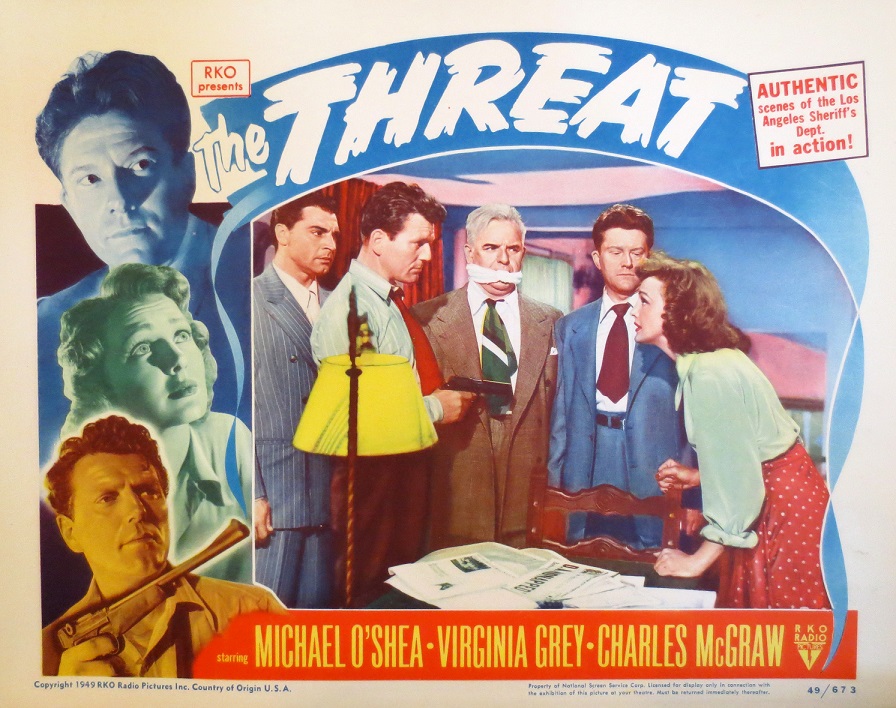
The-threat-7
In The Threat (1949) – Feist’s lean and mean story is told without an ounce of flab – filled out by the presence of the electrifying McGraw. The story is simple: Red busts out of Folsom Prison – we see this briefly at the very beginning – guys running, guns firing, sirens blaring, but we don’t need to see much else. The movie gets right to it. He’s on the run, and hell bent to get the guys who put him behind bars — that’s the District Attorney and the police detective who wind up in the aforementioned shack (one will get such bad treatment off screen, we hear his torment and truly wonder what on earth is being done to the guy – it’s more terrifying that we only hear his pained moans). They nab these two, nab sad Carol, nab a poor guy who has nothing to do with any of this, a guy named Joe (Don McGuire), and head out to the California desert hide-out, waiting for Red’s old partner to smuggle him into Mexico.  

So, what’s going to happen? I’m not going to say because the joy in this movie is wondering how on earth anyone is going to get out of this place alive. And how are they going to take on McGraw? You wonder about the body count. You worry about Carol and you are riveted by Red. You can’t take your eyes off of him.

And so we watch – we watch the room rumble with McGraw's blood, his pumping black heart bouncing off those hate-shack walls. He’s casually savage, and for a moment, we might think he’s got something going on inside there – so if he briefly stares forlornly into the void, we look for some kind of feeling – and then wonder if he’s merely staring into a sociopathic abyss. McGraw’s Red, a furnace of vengeance, is boiling his captive's lives away by simply breathing near them. But, really, he’s boiling his own life away too – absolutely self-destructing. But he’s doing it his way. We guess. We wonder if this guy ever feels joy. He doesn’t seem too sad.

Everyone’s good to great here (Gray is a standout as are McGraw’s sleazy cronies), but it’s McGraw’s gruesome party all the way – from his silent menace to his terrifying bursts of violence (like pinning a man's wrists with his feet and crushing his head with a chair – one of the greatest scenes in the movie – emotionally and technically— and it was probably that same chair Red was so easily reclining) he is like nothing you’ve ever seen, and probably never will.

This is the movie that made McGraw something of a star – thought not a usual leading man – notably in Richard Fleischer’s Armored Car Robbery (1950), and The Narrow Margin (1952).  And he did sometimes play a good guy – a tough guy but a good guy. He’s also terrific in Harold D. Schuster’s Loophole, Howard Daniels’ Roadblock, John Farrow and Richard Fleischer’s His Kind of Woman and of course, Stanley Kubrick’s Spartacus.

Image6 copy
Feist (who directed two other hellraisers, on and off screen – Lawrence Tierney in the tough, excellent The Devil Thumbs a Ride, and Steve Cochran in the rough and romantic Tomorrow is Another Day) working with cinematographer Harry J. Wild, knows how to showcase McGraw in such doomed digs. Tension builds so much that you can practically smell the sweat – and everyone’s sweat is a little different – you can smell that too. These characters perspire and dread and plan and panic and grow crazier and crazier while their big bad captor sits and waits, radiating wrath.

And all in just 66 minutes. That is six minutes over an hour for those who are bad at math. And during that time, this hysterical entrapment does not waste one minute of intensity, style, intelligence and Charlie-McGraw-magnitude. Feist knew what he was doing and who he was dealing with here. He knew who was the star (even though McGraw is third billed!)

And the movie needn't be shorter or longer. As if you were concerned about the time. Were you concerned about the time? Smash! “Now you don’t have to worry about the time.”

June 1: Marilyn Monroe

6a00d83451cb7469e20263e85f866b200d-800wi

Happy Birthday Marilyn Monroe!

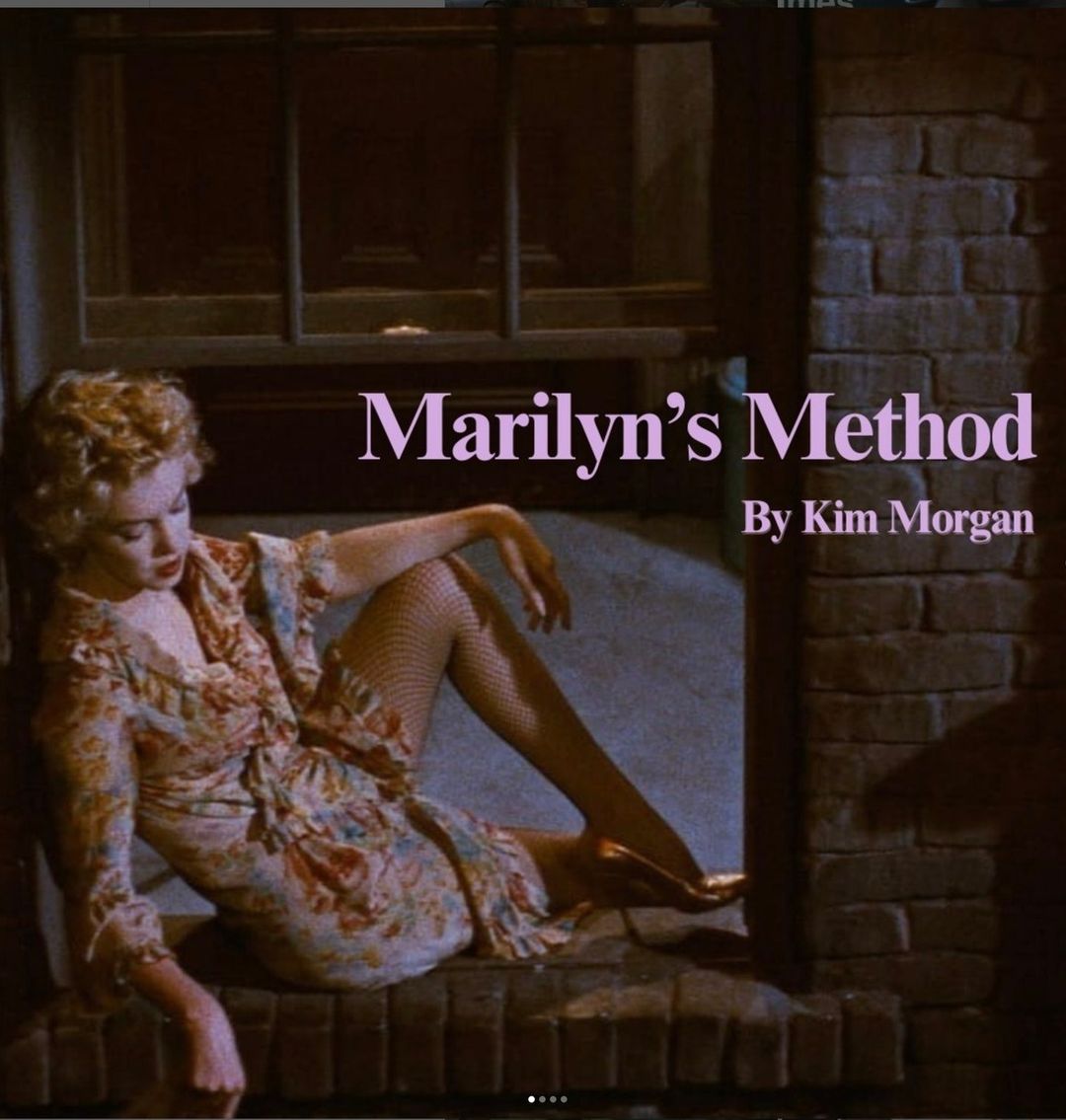
For beloved MM's birthday, here's a small excerpt from my Criterion piece, "Marilyn's Method," published in 2023.  It covers, among other things, her performances in The Misfits, Niagara & Bus Stop, specifically, and her journey and power as an actress and an artist. Here's a portion:

“Do you want me to turn them loose?” This is what cowboy Perce asks a sad-eyed Roslyn in John Huston’s elegiac The Misfits (1961), and that one question about untying the mustangs he and fellow wranglers Gay (Clark Gable) and Guido (Eli Wallach) have captured—beautiful horses who will be turned to dog food—is so extraordinarily moving in its quietly weighed delivery that it’s breathtaking. It’s moving because it’s Montgomery Clift asking the question, and because of the power of Marilyn Monroe’s Roslyn and her chemistry with Clift. But it’s sublimely moving because of Roslyn’s preceding scene instigating the request—her scream in the desolate landscape, her testimony:

Killers! Murderers! You’re liars! All of you liars! You’re only happy when you can see something die! Why don’t you kill yourself to be happy? You and your God’s country! Freedom! I pity you! You’re three dear, sweet, dead men!

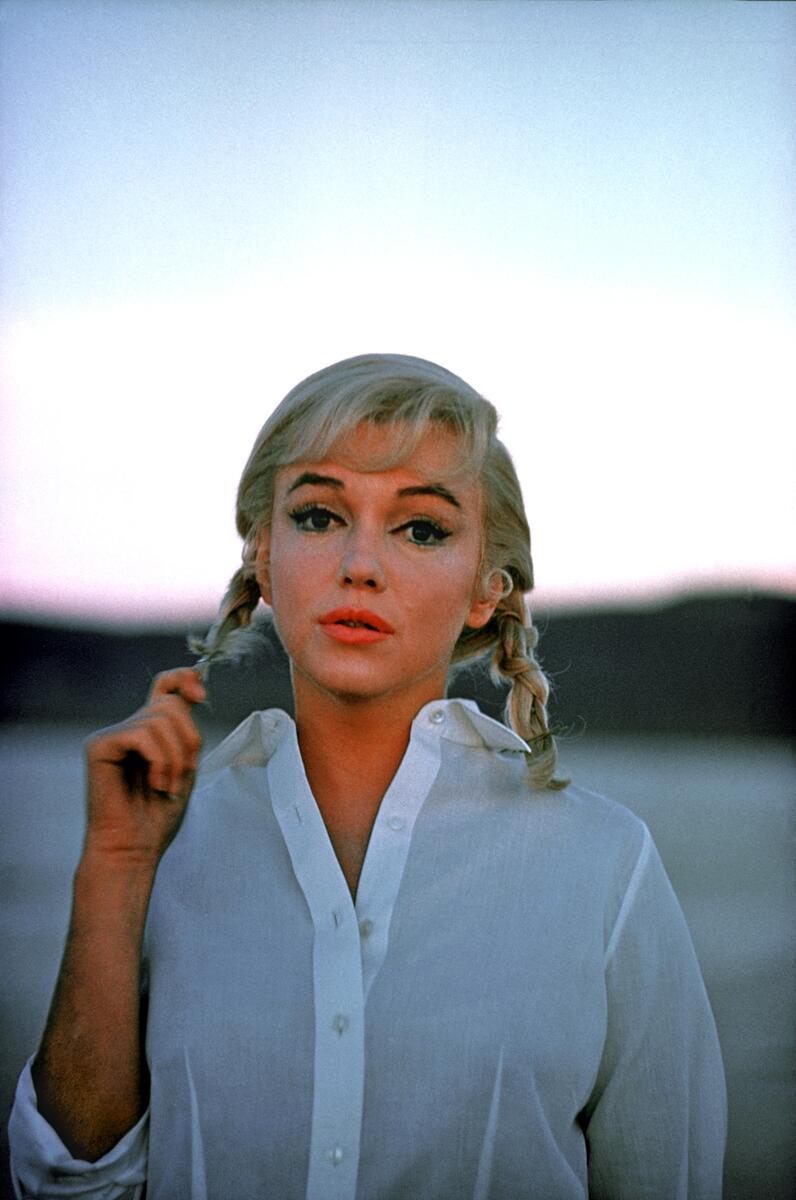
That big, blistering moment is filmed in a gorgeous and almost unmerciful long shot, with a distant Monroe, her blond hair and denim in the desert; viewers fix their eyes to see her better as she rages—a brilliant choice by Huston. By forgoing a close-up, he makes Monroe’s speech feel almost unexpected and shocking, and, oddly, more powerful. There are three men who, throughout the movie, have observed this woman with bewilderment, lust, love, and anger. She’s represented multiple ideas, dreams, or wishes for them (the script was written by her soon-to-be ex-husband, playwright Arthur Miller), but she’s now screaming and nearly tearing her hair out—almost as if to make herself flesh and blood.

Marilyn as Roslyn espouses part of the movie’s thesis—a potential sledgehammer—without the directness feeling unnatural, underscoring the end-of-the-line lives these men lead and the simultaneous empathy and anger she feels toward them. Clift’s Perce, who is already feeling lousy about capturing the mustangs, so much so that he doesn’t even want to be paid for it, gazes with sadness and, perhaps, shame; Gable’s Gay looks on concerned, disquieted, and Wallach’s Guido, at that moment, is all annoyance and anger: “She’s crazy,” he says. “They’re all crazy. You try not to believe it because you need them.”

364807148_10160587287070792_67047706235272040_n

Read it all here.

Happy Birthday Marilyn! 

Little Masterpiece: Little Murders

6a00d83451cb7469e20263e9450338200b-800wi

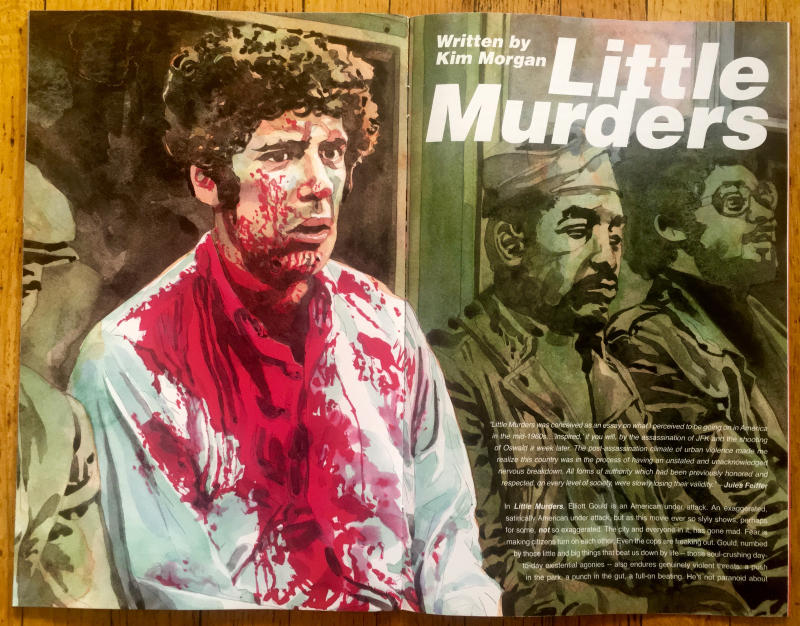
“Little Murders was conceived as an essay on what I perceived to be going on in America in the mid-1960s…’inspired,’ if you will, by the assassination of JFK and the shooting of Oswald a week later. The post-assassination climate of urban violence made me realize this country was in the process of having an unstated and unacknowledged nervous breakdown. All forms of authority which had been previously honored and respected, on every level of society, were slowly losing their validity.” – Jules Feiffer

In Little Murders Elliott Gould is an American under attack. An exaggerated, satiric American under attack, but as this movie ever so slyly shows, perhaps for some, not so exaggerated. The city and everyone in it has gone mad and fear — so much fear — is making citizens turn on each other. Even the cops are freaking out. Gould, numbed by those little and big things that beat us down by life — those soul-crushing day-to-day existential agonies — also endures genuinely violent threats: a push in the park, a punch in the gut, a full-on beating. He’s not paranoid about those waiting in the alleys anymore because, why? Why be paranoid if you’re beat up nearly every day? Gould is so directly in touch with these perils that he’s adopted a nihilistic nonchalance of protection and simply shrugs off the offenses. He doesn’t find the need to fight back, not because he’s a pacifist, but because he’s an “apathist.” As he explains to his soon-to-be-wife’s parents in perfect Elliott Gould deadpan: “Well, there's a lot of little people who like to start fights with big people. They hit me… And they see I'm not gonna fall down. They get tired and they go away. It's hardly worth talking about.”

It’s both a strangely reasonable rationale (people will stop, you might wind up dead but they will eventually stop hitting you) and an absurdly funny display of dispassionate blunting: he says he hums through the pain and thinks of something else, like taking pictures (he’s a photographer). Makes sense — if the world feels insane — and it often does, especially now.  Cartoonist, playwright and screenwriter Jules Feiffer wrote this in response to what he deemed America suffering from: an “unacknowledged nervous breakdown.” That was 1967. And here we are (as I wrote this — 2017) — now, it's 2025.

Little Murders is a satire, but never beyond reality  – it’s so brilliantly observed, so smart, so hilarious, and so disturbing, that watching now, the picture moves beyond a time capsule of New York City circa late 60s early 70s and into the dark heart of American madness. And in the grand American literary tradition — Hawthorne, Melville, Poe — we are all a little crazy: Said Poe, “I became insane, with long intervals of horrible sanity.”

Little-murders-2
I’m not sure if anyone displays simple sanity (whatever that means) in
Little Murders — maybe (OK, not really) Patsy Newquist (played by Marcia Rodd) who is trying her hardest to at least be optimistic in a city full of muggers, shootings and heavy-breather obscene phone calls that follow her from apartment, to parent’s place to even a payphone at her wedding. But trying is indeed a “horrible sanity” in this movie’s unsparing universe, so when she meets Alfred (Gould) as he’s getting attacked outside her flat, she does the most insane thing imaginable, she falls in love. Her version of love is to “mold” Alfred, a photographer who takes pictures of dog shit (a jab at the art world? Or he’s a really talented photographer of dog shit? I say both), and she urges him to listen to her schizoid entreaties: “I want to be married to a big, virile, vital, self assured-man that I can protect and take care of! You've got to let me mold you. Please! Let me mold you!” Gould’s not so sure about this whole love thing but he proclaims a more powerful declaration: “I trust you! I very nearly trust you!”  For a guy like him, that’s saying a lot. Hell, that’s saying a lot of anyone.

Directed by Alan Arkin and shot by Gordon Willis, this 1971 adaptation of Feiffer’s genius, pitch-black comedic play still feels like nothing you’ve ever seen before. The beats of the movie, from hilariously nutzo family dinners to genuinely reflective moments of horror (like a blood splattered Gould on the subway), remain potently uneasy. This is not a comfortable movie, nor should it be. For that reason, one can understand its fascinating backstory as a play. First running in 1967 and starring the great Gould, it only played seven nights and then closed. People weren’t ready for it, perhaps; something didn’t click, or something clicked too much. Two years later, after America had been batted around enough (and would even more in the ensuring years), it played off Broadway, this time to great success. As for the film? In 1971 so much had hardened in this country.

P1444_i_h9_aa
In Feiffer’s vision no one is spared. He’s not being conservative at all — this is not a decrying of city violence or a return to values. I believe Feiffer is instead a shrewd, frustrated observer, while giving what we hold “sacred” a raspberry. Patsy yells at Arthur to fight back, she can’t stand his apathy. She’s right, but then she’s not right. She ceaselessly questions his masculinity as Gould in all of his tall, dark, offbeat Belmondo prime, wanders around in a bemused daze — he's a guy who could likely land a punch but doesn’t want to. Maybe that’s just as masculine, not giving a fuck. Everything is questioned here. Patsy’s family, the conservative father (Vincent Gardenia) who thinks everyone’s a “swish” and is so fearful of appearing weak that he hollers at anyone who states his first name (“Carol”); her “come and get it!” mother (Elizabeth Wilson) who sits Arthur down to show him pictures of their dead son because she figures Arthur likes photography; her bizarre little brother (a hilarious Jon Korkes) who moves around in constant comic motion, lurching and smiling and making noises to be humorous (we think), and he is funny, albeit with a kind of sinister brotherly love (he and Patsy have some underlying incestuous dynamics).

Their apartment feels like a bunker as shots are fired outside and the “typical” American family is holed up, a group of loons, no crazier than Arthur and, yet, strangely recognizable if you’ve ever felt unsure meeting a partner’s family. Arthur’s intellectual parents are a different kind of nuts — they only speak through books — and so when he drops in on them (he clearly hasn’t seen them in forever) and questions his childhood — they can only answer through literary, philosophical and even cinematic reference. It’s funny, but it’s a bit heartbreaking as Arthur returns to Patsy, defeated, and, then defeated to become what she wants. He discusses his past college days when he was an activist and the FBI was on his tail. He says, "It was after this that I began to wonder…. why bother to fight back? It's very dangerous. It's dangerous to challenge a system unless you're completely at peace with the thought that you're not going to miss it when it collapses."

Feiffer, who also wrote Carnal Knowledge, released the same year as Little Murders (what a year) is relentlessly, hilariously toxic and yet, one never feels pushed away from the movie. The characters become weirdly likable; we start caring about them, we understand their anxiety while questioning those sacred institutions right along with Feiffer and Arthur: There’s a fantastic wedding scene with Donald Sutherland as a hippie reverend, announcing vows that are hysterically sensible:

“So what I implore you both, Patricia, and Alfred, to dwell on, while I ask you these questions required by the state of New York to ‘legally bind you’ — sinister phrase, that — is that not only are the legal questions I ask you, meaningless, but so too are the inner questions that you ask yourselves, meaningless. Failing one's partner does not matter. Sexual disappointment does not matter. Nothing can hurt, if you do not see it as being hurtful. Nothing can destroy, if you do not see it as destructive. It is all part of life, part of what we are.”

Another powerful, eerily prescient moment comes after Arkin’s paranoid cop flees the Newquist’s apartment, summoned when Patsy’s been killed (yes, this happens — she’s randomly shot). Mr. Newquist loses it and delivers a speech with crazed, paranoid satirical pronouncements that now, don’t seem so satirical anymore:

“What’s left? What’s there left? I’m a reasonable man. Just explain to me, what have I left to believe in? Oh, I swear to God, the tide is rising… We need honest cops! People just aren’t being protected anymore! We need a revival of honor and trust! We need the army! We need a giant fence around every block in the city—an electronically-charged fence! And anyone who wants to leave the block has to get a pass and a haircut and can’t talk with a filthy mouth. We need RESPECT for a man’s reputation! TV cameras, that’s what we need, TV cameras in every building, lobby, in every elevator, in every apartment, in every room. Public servants who ARE public servants! And if they catch you doing anything funny, to yourself or anyone, they BREAK the door down and beat the SHIT out of you! A RETURN to common sense! We have to have lobotomies for anyone who earns less than 10,000 a year. I don’t like it, but it’s an emergency. Our side needs weapons, too! Is it FAIR that THEIR side has all the weapons? We have to PROTECT ourselves and STEEL ourselves. It’s FREEDOM I’m talking about, goddamn it. FREEDOM!”

6a00d83451cb7469e20263e85ff3a9200d-800wi
By the end, Arthur finally breaks down after snapping pictures of people in the park, and it’s important we see he’s shooting people, not shit, which may seem like a bright new beginning. Really, it’s an on-the-nose (but perfectly on-the-nose) symbol of what’s to come. He brings home a rifle and the family embraces violence. They smile and laugh and celebrate crazily, but there’s no catharsis. They sit down to dinner and it’s all so terribly sad. It’s also terribly funny. And terribly timely.

My piece was originally published in 2017 for Ed Brubaker's Kill or Be Killed

Little Murders is playing tonight, June 1, at 7 PM at Egyptian Theatre | Q&A with actor Elliott Gould. Moderated by Larry Karaszewski.