
Pick it up! Issue #10 of Ed Brubaker's Kill Or Be Killed is out. In this one, I ponder Ralph Meeker and Ralph Meeker in Big House, U.S.A. (with art by Jacob Phillips). Here's a preview…
You don’t want to run into Ralph Meeker in the woods. Not if you’re a kid. Not if you have asthma. Not if you’re rich. Now, that’s a real specific set of requirements, and this is regarding just one movie (the one I’m writing about, Howard W. Koch’s Big House, U.S.A.), but when cast as captor, Meeker could be so powerfully feral, so cunning and so caddishly sexual (and in some cases, so touchingly vulnerable), that his effect is immediate. Oh god, who is this handsome devil? This is wrong. I don’t know? Is this wrong? On the adult, female side of it, see the Meeker-holding-women-captive stories like Something Wild with Carroll Baker, Jeopardy with Barbara Stanwyck and The Fuzzy Pink Nightgown with Jane Russell. These pictures all have varied endings, happy or curious or god knows what will happen, but all show Meeker getting away with his transgressions.

In the masterpiece, Something Wild, he’s much more sensitive and complicated, romantic and creepy, seriously inappropriate and seriously damaged (Meeker was a brilliant actor who really wasn’t cast enough to showcase his range, a shame), but in The Fuzzy Pink Nightgown, he’s just flat-out the romantic lead, even as a kidnapper. And in Jeopardy . . . we truly wonder if Stanwyck would go off with him at the end, just for a second, even as he’s made her life a living hell by kidnapping her and cruising through Mexico as she’s desperately trying to save her husband. “I’ll do anything for my husband, anything!” she says, deep emphasis on anything. But in all three movies, he really does wind up helping these women from their direct threats (he saves one from killing herself, he saves another’s husband, and he saves Jane Russell from a cynical movie studio-controlled life devoid of true love, something like that). And yet, in all movies, even a comedy, a final, unsettlingly erotic feeling lingers – a subversive kind of desire has been unleashed, a dangerous desire. You could see offense in these pictures, but Meeker is so intriguing and provokes such mysterious, unexpected feelings, that you find yourself pondering your own desires while watching him. It’s this kind of specific Meeker-style cad-provocation that makes him something of a genius. No wonder he was the perfect, and in my book, the only Mike Hammer. He helped a woman at the beginning of that movie too (Kiss Me Deadly) – and then the whole fucking world blew up.
But in Big House, U.S.A. (1955) Meeker helps a kid – and his transgression is one of those cinematic taboos that dares as much as Michael Haneke did with Funny Games 42 years later: Are we gonna kill the kid? After all this poor child has gone through? Are we really gonna kill the kid? Yes, we’re gonna kill the kid. Sorry, audience. This isn’t a nice movie. This isn’t a nice world.
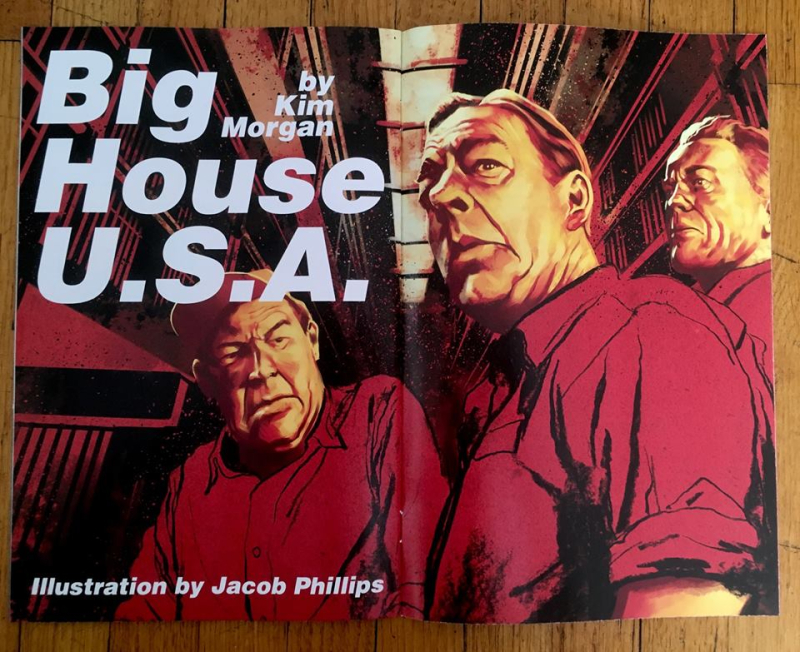
Read it all via ordering a copy here.
 Sunset Gun