Today is Billy Wilder's birthday and one must celebrate. One must watch Wilder. All day, if possible.
There are many masterpieces and near masterpieces to choose from (The Major and the Minor, Some Like it Hot, The Seven Year Itch, Ace in the Hole, Double Indemnity, The Apartment, One, Two, Three, and more and more. And then, the movies he scripted, from Ninotchka to Ball of Fire to Midnight…). And there's plenty other under-seen pictures I need to discuss here that aren't Wilder (Wicked Woman, Play It as It Lays and Cry of the Hunted to name a few, as well as all the pre-code delights I've dug into). And besides, when it comes to Wilder I don't know where to begin. I love Marilyn so much, that I've seen both Wilder's Some Like it Hot and The Seven Year Itch too many times to count, that they deserve a separate essay. So I'll get to that another time.
But then everyone has written about Wilder. And yes, he's too important to not discuss. He's one of the greats. So here's a start — Wilder pictures I watch on a continual, obsessive, bizarre-o basis. These are two movies I revisit so frequently that it confuses me. I'm not sure if they're even my favorites (Ace in the Hole might be tops), and yet, I drop in on these films like old friends. They provide me with a twisted kind of comfort, clearly the only kind I can stomach these days.
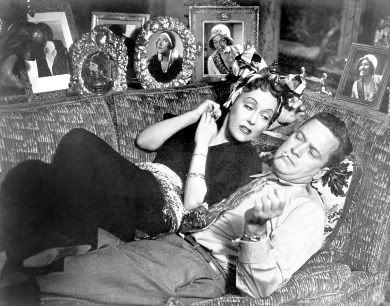
Twisted? Oh, yes…Sunset Blvd. Billy Wilder's cynical look at Hollywood was so scabrous that, as the story goes; famed studio head Louis B. Mayer left a preview hollering, "We should horsewhip this Wilder! We should throw him out of this town that's feeding him!"
Yes, the movie was that disturbing to its own, and for an understandable reason — Mayer and company didn't like their dream factory revealed for what it often was: a nuthouse. Well, sometimes a nuthouse. It was also full of hard workers too.
The story of washed up silent screen star Norma Desmond (Gloria Swanson) and her deranged, desperate attempts to re-enter pictures (for all "those wonderful people out there in the dark") is a noir of sorts, but really, a pitch black satire that reveals how disposable the industry treats their talents.
If you're not significantly saddened when silent film stars Buster Keaton, Anna Q. Nilsson, and H.B. Warner show up as cameos called "The Waxworks," then you don't love movies.

And Wilder loved movies; he just knew how cruel the business was. Within this dark vision, William Holden's struggling screenwriter turned hustler, Desmond, is a kept boy and reluctant writing partner (remember how he reads her long draft of Salome, written in her "childlike scrawl"). He lives in Norma's rambling, bizarre mansion off Sunset Boulevard that, at one point, harbors a pet monkey. A pet monkey. If only I could find that mansion. And Miss Desmond. I'd stick right by her. It's tough out here for writers.
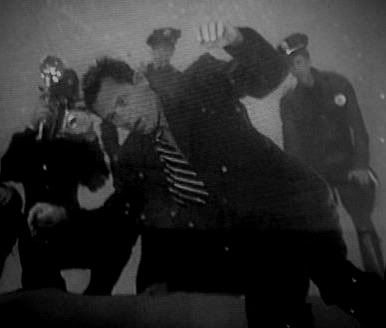
Brilliantly scripted with all those legendary lines, perfectly cast (with the heartbreaking touch of director Erich von Stroheim starring as Desmond's devoted butler/chauffeur), expertly, expressionistically shot and thematically resonant, Sunset Blvd. remains the most salient peek at, in this case, the extraordinary, sick and desperate underbelly that is Hollywood.
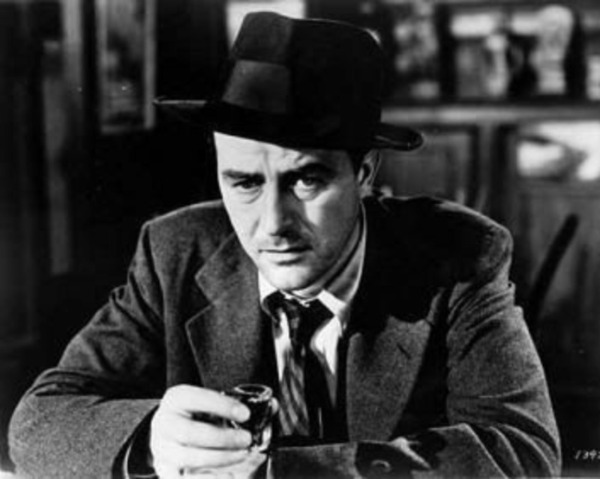
And then there's Wilder's dipso-masterpiece The Lost Weekend, a film I watch so often that I can't see a glass ring on a bar table without thinking of Milland (screw cocktail napkins and coasters). I'm not exactly sure why I must view Milland and bottle so often and yet, I do, especially in the wee-hours when I'm suffering from insomnia. And there's been a lot of sleepless nights.
I suppose there are obvious reasons why the film is so engrossing — it's a deserved classic and Ray Milland is funny, tragic, sexy, mean spirited, sneaky — everything an alcoholic you would know and, unfortunately, love would act like. I get that. (In my past, I have managed to love drunks). And then there's the story, an important chronicle within the history of addiction movies, and one Wilder chose to relay not as a tired warning tale, but in part, as a clever horror movie — creepy, potent use of Theremin and all.
The movie is oddly humorous, but tough and rough and sad and erotic (drugs and booze are turn-ons, and Milland is a seduction). It's a nice cross-pollination of Wilder's wonderfully cynical sense of humor and seriousness towards his subject. He seems to both love and hate Mr. Milland, and we are right there with him, questioning, in my case, such deep attraction to the movie.
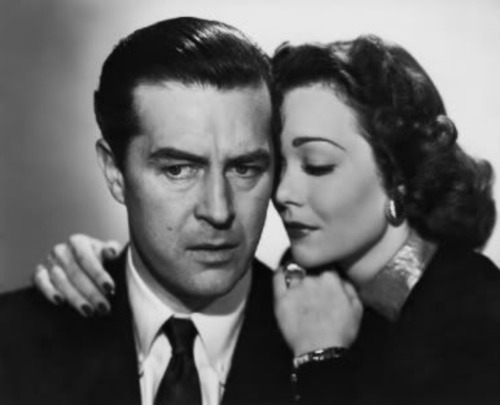
Why is Ray Milland such a lovable jerk, beyond his charming, deceptive alchy ways? Why is Jane Wyman so adorable and yet irritating (could it all simply be that beautiful leopard coat!)? Why does Wilder hand him dishy Doris Dowling ("I'm just crazy about the locks of your hair") and he isn't allowed one wild bender with the woman? Why is that drunken hallucination at the opera so damn horrifying and hilarious and flat-out entertaining to the point of yearning for some D.T.'s? Why do I get a simultaneous kinky kick and a chill when Milland is confronted by the dry out nurse Bim in that oh-so homoerotic episode?

Why do I know he's gonna fall off that wagon directly after the picture ends? Why do I believe the only way he can write that novel is in a dipsomaniacal stupor? Why do I hope that he does finish it drunk? And finally, why does the movie (and this is going to sound terrible) make me want to pour a stiff one and spend all of the day and all of the night with Milland? As the spunky, sexy Dowling might answer, "Because I'm just crazy about it. Don't be ridic'!" Words to live by.
Here's to Billy Wilder. And now, time for a drink. Enjoy a long, lost night, as Milland did below.
Just be mindful of the cute little mice and the murderous little bats.
 Sunset Gun
Not to disparge any of Wilder’s pre-1963 work, I’d like to hear your thoughts on the how’s and why’s of filmmakers falling out of favor. Only 6 years after the dead-on-target “The Apartment” captures the “Mad Men” male zeitgeist, Wilder’s “The Fortune Cookie” seems largely out of sync with the culture of 1966 . . . . and by 1981, “Buddy Buddy” is downright painful to watch.